

GoingDown
Sr. Member
- Joined
- Jul 8, 2005
- Messages
- 356
- Reaction score
- 108
- Golden Thread
- 0
- Detector(s) used
- Minelab Explorer II
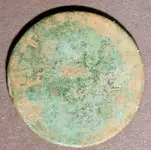
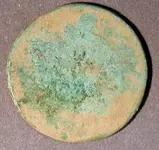
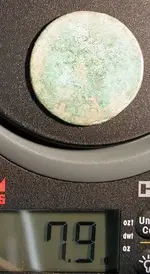
OK......a week after myself, Earthworks, Bergie and Hollowpointred spend a wonderful day at the old colonial site in the lovely Hudson Valley of New York State ...... Earthworks and I decided to give it another go today for a few hours. When the temps reached 27 degrees and the soil was freezing onto out digging tools.....we thought we might be overdoing it. We persisted. Shortly before the sun set and darkness engulfed us ..... a solid copper sound....deep with the Minelab Explorer II. At the time we could not make it out thinking that it was "just" another large cent(!?) After cleaning it to the best of our ability .... and doing some quick research we are simply in awe!!!
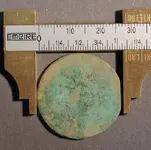
Here's the picture, measurement, and weight of the surviving coin....my BEST to date !!!
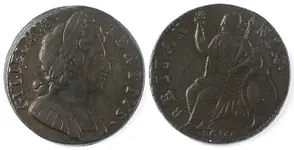
Also....I've added the research (along with a picture of a much better shaped similar coin) that we've done....enjoy!!! (Bergie....the front lawn is definitely "not" all worked out)
GoingDown
William III. GVLIELMVS DEI GRATIA, instead of GVLIELMVS TERTIVS. Pattern Halfpenny. Weight 10.51g.
Dr Nicholson notes: "This piece is in poor condition but it is probably the most important in this collection from the numismatic point-of-view. I read the note in the Seaby Bulletin for November 1984 (that I copy below) with great interest, and have been looking out for it ever since. I saw no further reference to it until the Spink sale of Roger Shuttlewood's collection in 2001, from which the present specimen came. This is a slightly poorer example than the Cowley one, (which was photographed in the Seaby report), and which appeared to be dated 1696. Probably this is the Seaby coin referred to in the note [in Seaby bulletin below]. The note on it in the Spink Circular for February 2001 said 'probably unique and of the highest numismatic importance'. They obviously knew nothing of the Seaby experience of it. They gave Dr Johnstone as provenance who was a contemporary of Peck and who would have shown it to him if he had had it [before Peck went to press]. It is too interesting for Peck to have ignored. The legend GVLIELMVS DEI GRATIA is an assertion of William's divine right to the throne independent of his recently deceased wife Mary, who was closer in the succession. It was an important political statement in 1696 and as such this may be a propaganda medallion rather than a coin. Yet it is in all other respects identical with the 1696 currency halfpenny and it would be unusual to use the currency format for a medallion. Evidently both Seaby and Spink agree that it may be regarded as a pattern which was considered but not put into effect."
from- http://www.colincooke.com/coinpages/nicholsoncollection/nicholson_part2.html#
Attachments
Upvote
0


 Nice find! COngrats!
















