Wow!
That is a sweet find Wil.
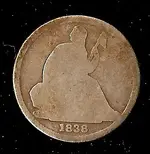
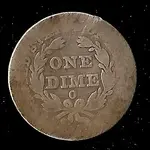
1838-O Dime
The Philadelphia Mint had a hard time keeping up with the demand for coins. The first branch mint, in New Orleans, was authorized in 1835. It was needed because of “the great importation of gold and silver into New Orleans and the great risk and expense incurred by sending on all the bullion form the South to be coined at Philadelphia,” said Sen. George A. Waggaman.
J.L. Riddell, the Mint’s coiner, described operations at New Orleans: “The planchets, with wax or tallow still adherent, are…heated to a dull redness in iron recipients placed in the annealing furnace, and poured, hot as they are, into a tub of diluted sulphuric acid, by which means all impurities are removed from their surfaces, the alloyed copper superficially dissolved away, and the clear, beautiful, dead white appearance of pure unburnished silver is elicited.
“Adhering acid is washed away in water, and adhering water dried away by hot mahogany sawdust, in an ingenious rotating apparatus heated by steam, invented by the present coiner.
“The dies are prepared for this Mint in Philadelphia. The letter ‘O’ placed usually under the eagle, is intended to designate the coinage at New Orleans.…
“There are four presses in the coining room, forming a series in respect to size and strength, adapted to the stamping of the various coins, from the half dime to the dollar… Each operating press requires a man to watch it, to oil the joints occasionally, and to keep a vertical brass tube supplied with the blanks or planchets to be coined. The untiring press goes on, seizing with iron fingers from the tube a planchet of its own accord, carefully adjusting it to the retracted dies, squeezing it with a degree of force sublime to contemplate, and then quietly and safely depositing it in the box placed to receive it.
“From 80 to 150 pieces, dependent on the size, are thus coined in one minute’s time. The obverse, reverse, and indented work upon the edge are all completed at a single effort of the press.”
The New Orleans Mint struck its first dimes, distinguished by an “O” mintmark on the reverse, in 1838. Some 20 1838-O dimes may have been placed in the cornerstone of the New American Theatre in New Orleans.
New Orleans was suffering through hard times when the coins were struck. In August 1838 the mayor told the municipal council the city owed banks more than $1.2 million and was unable to make the payments. City land was mortgaged to the banks to meet routine expenses, and an agent was sent to New York to raise money.
The Seated Liberty design by Christian Gobrecht first appeared on the dime the previous year. Originally there was no border of 13 stars on the obverse. The stars were added in 1838, but not on dimes struck at the New Orleans Mint, which waited another year to revise the design.
The New Orleans Mint struck slightly more than 400,000 dimes in 1838. A Very Good-8 survivor is valued at $60, according to Coin Prices. There is also an 1839-O dime variety with the reverse of 1838-O. It was struck from rusty dies and has a bumpy surface on the reverse. A VG-8 example is valued at $225.
The real significance of the 1838-O dime is that it helped make the dime a national coin, not one whose use was limited just to the East. Before the New Orleans Mint opened, dimes were rarely seen in New Orleans or anywhere west. The situation began to change with the introduction of New Orleans dimes and really picked up steam when the San Francisco Mint went into operation in the 1850s and began churning out Seated Liberty dimes.
The Carson City Mint opened in the 1870s and, on a smaller scale than San Francisco, did its part to insure the dime’s success in the West. If the New Orleans Mint had fizzled, however, and the 1838-O dime had never been struck, the story might have had a different ending.



 I would love to get an early seated like that