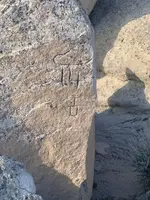
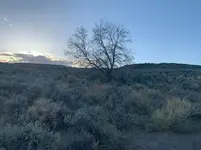
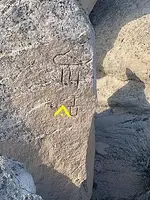
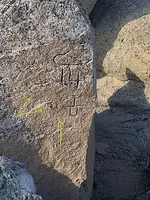
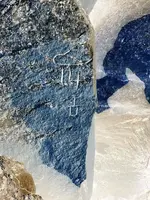
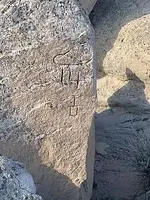
My son sent me this carving pic from the Red Desert in Wyoming. Looks like a fish over 14 over a shovel. To the left of the fish head is maybe a W. In the direction the fish head is pointing about a 100yds. away is a Spanish olive tree. There are no other trees really in this area and Spanish olive trees don't grow there naturally. One local said birds brought the seed in. The tree got my attention, and no evidence of an old homestead around it. This area had a large population from about the 1850's til the turn of the century. Lot of mining activity and at one time 31 nationalities represented. We had an idea it might be a mine claim marker. Barren wasteland these days. In person it looks pretty old, best he can see is not recent, and not random graffiti. Told him I would run it by the best experts I knew on this sort of thing, and all opinions welcome.
RGINN,
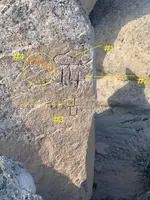
Starting from the left with the mark that you suspect to be a ‘W’ in front of the fish, …and going DOWN to the number 14, and going Down again to the shovel with a Mark on the left side of IT….here’s my take on your location.
If you enlarge the picture and look carefully, you will notice that the ‘W’ is actually the faded word C A I U, where the ‘U’ is dropped a little lower (from the angle it was taken), but nevertheless C A I U…
The numbers in the picture go as follows:
#1 …is a large fish or whale which stands for Deep or Depth…
#2 …14 is your Depth Gauge aka …’at 14’ (something) …the Unit of measure remains unknown. It could be varas, feet, meters, inches, or any other Marine measurement of their time such as ‘fathoms’.
#3 …the shovel is self-explanatory as “dig”, but you also have a Mark on the left side of the shovel and possibly you could also have the same Mark on the left side of the Tree, in situ.
At this point, it should make sense to take some pictures around the base of that tree, all around from several steps away, but pay attention at anything that looks “placed” on purpose, …and take detailed photos of such (markers).
#4 …C A I U …is your keyword, used by many old European navigators/mariners from Portugal and Spain (and is almost an ancient slang or activity related lingua franca) when you drop anchor or drop a load in the sea.
Portuguese - detected
English
It fell ……………………………………………………………Past Pefect Tense (or Pluperfect)
Translations of cair
verb
________________________________________
fall
cair, descer, diminuir, baixar, pender, inclinar
________________________________________
drop
cair, soltar, largar, baixar, descer, perder
________________________________________
go down
descer, cair, baixar
________________________________________
collapse
desmoronar, desabar, cair, ruir, desmaiar, sucumbir
________________________________________
sink
afundar, mergulhar, cair, descer, baixar, diminuir
keel over
cair, capotar, soçobrar,
ir ao fundo........” go to the bottom”
Examples:
caiu na terra…….. fell to earth
In your case… it fell under the Tree @ 14 (depth unit unknown)… 14 x ?...inches? feet? Centimeters? Meters? Varas? Or something else…
(un codo is approx. 18 inches +/= , And if you consider 18"x 14 seems about right)
If you guys plan to go back, try and get as many pictures as possible of that tree at the base, but also the first 8-10 feet up of the bark. Also, …a few more detailed pictures of the surrounding rocks where the carved message is.
Hope this helps. Best of luck.
P.S. If this turns out to be a legit long-lost location, …expect to be deep. You may also have some confirmation on the tree bark.