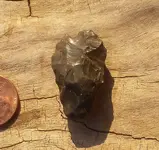
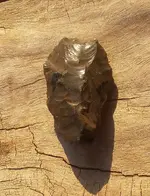
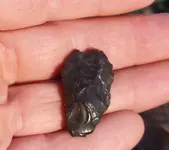
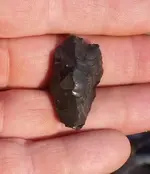
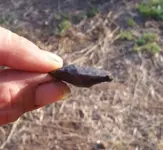
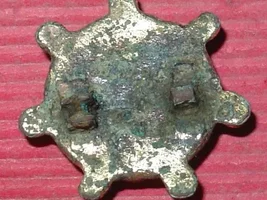
We call those "spoiled knives". A piece, for whatever reason, that wasn't finished. The thinning flakes on the base are not flutes. Just thinning flakes. A Clovis maker flutes a point at the very end of manufacture, not in the middle. Also, it's doubtful a Clovis maker would attempt a point that small. So, it's a small unfinished biface. Gary
ToddsPoint, thanks for this solid info - I totally see where you are coming from. I've thought the same myself.
Coming to this forum and getting the benefit of the communities experience and knowledge is so valuable.
But I hope nobody thought that I was inferring that this was Clovis or Folsom or anything like it.
Clearly it isn't.
Length of 'fluting' aside, it's way too crude.
Plus, as far as I know, there is no real Clovis presence in California.
But there are a number of questions I have about this piece and it's faux fluting.
For background, let me explain, though there is no Clovis in these parts, there have been ancient fluted points found within a relatively short distance from here at Borax Lake.
My understanding is that they are part of an assemblage that included non-fluted points too, and though the archaeology is a little controversial (as it's based on hydration dating), it's thought that these tools might be an outlying expression of San Dieguito Complex (which is early holocene - maybe 9000 BP).
At any rate, from the moment I learned of Borax Lake and the history of Clear Lake in general, I've had it in the back of my mind.
Is there any chance at all that I could find a relic from this culture that is sited less than 20 miles away?
The head says no for a thousand reasons, but the heart want's to believe.
Later as I've learned more of the history of my immediate area the hope remains.
The Napa watershed, and a few adjacent high valleys (in one of which I live), were the territory of the tribe the Spanish named Wappo.
Fascinating people with small numbers and territory, but a major influence on trade in Northern California acting as go betweens between coast and interior and controlling one of the best obsidian sources in the state.
Their language is Yukian (which is distinguished as the only language in California that has no relation to any other and is possibly the original language).
Given this history and the fact that Wappo's also had rights to the Pomo controlled Clear Lake obsidian (in addition to their own high quality Glass Mountain variety), is it possible to dream that Wappo may have roots in Clear Lake and something truly ancient from Borax could be found here?
Ok, so once in a while I find a piece that is made of Clear Lake obsidian.
Invariably they are very worn but never fluted, never the less, I put them in a separate box from the stuff I know is Napa glass and I wonder about them.
I believe they are old, but beyond the material, I have no way to put them at Borax Lake.
However, finding something that looks fluted (even though this point is probably Mount Konocti obsidian), has just the slightest whiff of possibility so I'm intrigued.
That is my long-winded way of explaining why I posted this find.
On to the find itself.
Here are the things I have thought about:-
It was not a normal creek-bed surface find. Instead I found it sticking out of the mud bank about half way up. That's deeply buried.
It is very crude.
It shows no water wear.
It's hard to know which end is which - as MAMucker has mentioned.
If the base is the end the 'flutes' are on, ToddsPoint's view that the scars are sloppy basel thinning rather than deliberate flutes makes sense. Except it's odd that the scars are on both sides.
If the base is the opposite end - truthfully this is the key - then the scars must be a freaky impact fracture.
If it is a preform or discard it would not have an impact fracture.
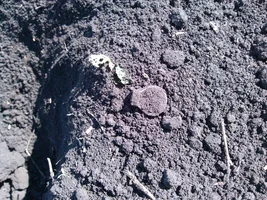
Here is another point I found that shows how deceptive an impact fracture can be....
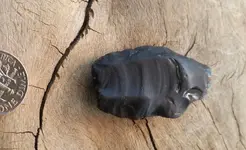
This had me convinced I'd found a fluted point till folks educated me different.
Bottom line, in my opinion, is it's not an ancient Borax Lake pattern point. It just isn't.
I've either been looking at back-to-front and it's suffered an impact fracture or it's been thinned, receiving symmetrical vertical gouges, either by accident or by whimsy but not intentional design.
Figure out which of these two theories is true and I'm done with it.
Thanks for taking the time on this, you'all.