What's new

Bullet Help.

Garabaldi

Bronze Member
Joined
Jun 28, 2009
Messages
2,382
Reaction score
100
Golden Thread
0
Detector(s) used
Whites M6, Whites Pulse Diver, ETRAC.
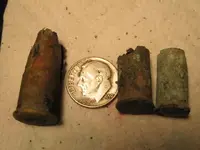
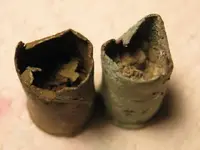
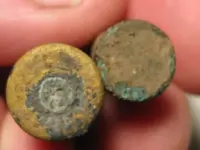
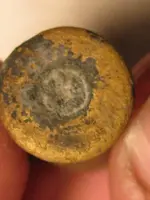
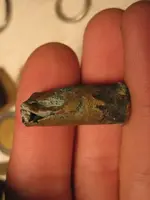
I found these in the ocean stuck in the mud during low tide in Boston. How old are they and what kind of gun would shoot them? :help:
 

Attachments

  • IMG_0614.webp
    IMG_0614.webp
    25.9 KB · Views: 256
  • IMG_0615.webp
    IMG_0615.webp
    18 KB · Views: 232
  • IMG_0616.webp
    IMG_0616.webp
    18.4 KB · Views: 241
  • IMG_0611.webp
    IMG_0611.webp
    25.9 KB · Views: 243
  • IMG_0612.webp
    IMG_0612.webp
    17.7 KB · Views: 230
Sorry Gar....not a whole lot to go on. Between corrosion and beach abrasion its hard to tell with no original dimensions. Scaling from the dime they appear to be something between 44cal and 50cal....that narrows it down to 20-25 different cartridges. The abrasion appears to have worn any head stamp info away. They look like they might have started out as 45/70, 44-40,45 Colt etc.....all rimmed cases.....just my wag.

TiredIron
 
Upvote 0
I would also go with modern as there appears to be a center fire primer. The old rimfire cartridges had no primer, (where the circle is in middle of casing) the firing pin hit any where on the rim and fired.
JMO
 
Upvote 0
They are all rimmed cases, especially the larger one would give you a hint that it could be black powder rifle cartridge. The smaller ones could be handgun cartridges. But in the early teens and up until the mid 1930s a lot of ammo was made to work in a handgun or a carbine interchangeably. With the advent of smokeless powder and it's common use after that time, the rifle cartridges that would fit in a handgun were pepped up with more smokeless powder and then the boxes were labeled "For rifle use only". These rounds still bore the nomenclature of the original black powder loading such as .45-70, .44-40, .38-50, .32-20, etc. And these cartridges are still available today. So, with the corrosion in the salt water and part of the cases missing and no headstamps it's almost imposible to identify the exact caliber and when they were manufactured. That said, I pretty much agree with Tirediron. Monty
 
Upvote 0
Ok Gents. I'll chock it up as modern. :icon_thumleft: Thanks for all your comments. :notworthy:
 
Upvote 0
One additional thought......these shells were obviously longer than whats left.
Most cartridges these days have a uniform wall thickness. The 44-40 cartridge wall thickness tapered from thicker at the rim...to almost paper thin toward the mouth.
So as 44-40 shells deteriorated due to corrosion or abrasion they would lose the forward 30-40% of the body first....like you see on yours. Just food for thought.
Of all the cartridges I reload I hate the 44-40 because of the paper thin brass.

Here's some additional internet info on the 44-40. Like Monty said they talk about the interchangeability of rifle and pistol.

Winchester and Henry realized that a more powerful cartridge was needed on the western frontier, and that led to the development of the centerfire .44-40 Winchester cartridge. The steel frame Model 1873 rifle was designed for the higher pressure of the .44-40, using the basic Henry action. The .44-40 is still used today and is credited with killing more deer than any cartridge except the .30-30 Winchester.

The .44-40 was also adapted to handguns, where its rimmed design made it ideal for use in revolvers. It became one of the most popular cartridges for the famous 1873 Colt Single Action Army revolver, along with the classic .45 (Long) Colt cartridge, also introduced in 1873. Both are used in revolvers to this day, and the .45 Colt remains popular for personal defense, hunting, and Cowboy Action Competition.

TiredIron
 
Upvote 0
Looks like one of hmmm's gold bullets! ...dem bones.
 
Upvote 0
Ty Tirediron, you are the master of bullets.
 
Upvote 0

Users who are viewing this thread

Back
Top Bottom