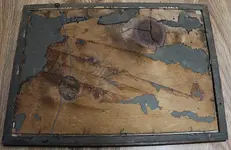
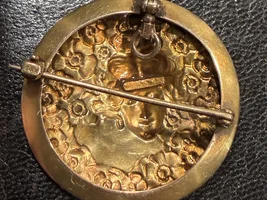
Okay looking at the back on painting. is the canvas glued to board?
I notice staples that might help dating such work. Measure the staples. see if they are modern stables?
Staple history
From the staples we might may get a date range in conjunction with other clues in narrowing down the date of painting?
The other factor is backing board thickness. In 1928, the first standard size 4 ft x 8 ft (1.2 m x 2.4 m) plywood board was introduced in the United States for use as a general building and furniture material. In the following decades, improved adhesives and new manufacturing methods allowed plywood to be used for a wide variety of application. This wood looked older as you can tree knots in the wood. To me reminds me of old packing crates for apples.
The canvas and board was was not made by a dedicated canvas manufacturer. 20th century: Canvas manufacturing became a more industrialized process, with companies like Claessens starting to produce high-quality, prepared canvases for a growing number of amateur artists. This is not a Cassens. to me it looks like a homemade canvass stretch on packing crate. Classic homemade Americana!
Is it black paper? That is unusual as most painting had Brown paper, particularly the modern kraft paper type, began to be used on paintings after its invention in 1879. While artists have historically used brown and other toned papers for centuries, the specific type commonly called "butcher paper" is a strong, recyclable paper known for its strength and affordability, making it an excellent medium for preliminary sketches and paintings after its invention. It evolved from Origin of "butcher paper": This type of paper was originally developed for use in the meatpacking industry to wrap meat. Its popularity with artists grew due to its strength, availability, and cost-effectiveness.
Artists are always broke so they used what ever material that was readily available.
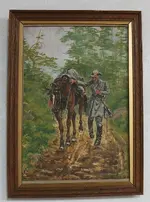
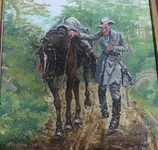
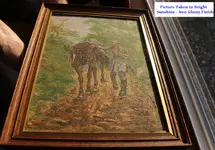
Finally we look at style. I Like to use the term "Post-Realism Expressionism" does not refer to a single, recognized art period to describe the painting. As painting is a combination of several distinct movements. Post-Impressionism 1886–1905 came after Realism. Realism painting is an art movement that depicts subjects truthfully and objectively, focusing on everyday life without idealization or artificiality, and Expressionism 1905–1920 built upon Post-Impressionist ideas by exaggerating and distorting reality to convey emotion. Post-expressionism is a later term coined in the 1920s to describe movements that followed Expressionism. But here is the catch the painting might been painted after those periods. Seeing these two or three styles in painting make hard to find the earliest date of the painting.
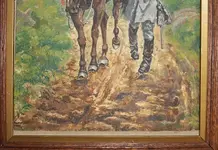
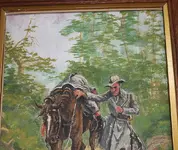
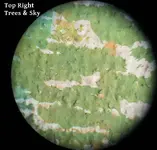
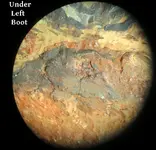
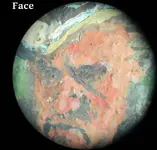
Also we can see technique the artist has used a flat brush in background with thinner paint to create the illusion of distance and in foreground they Impasto is a painting technique where paint is applied thickly so that brush or palette knife marks are visible, creating a textured, three-dimensional surface that captures light. This method can be used with various paints like oils and acrylics, and it gives the finished work a sense of energy, emotion, and a tactile quality.
But from these factors post 1886 onward up to late 1950's. My best guess the painting belonged to an art school student practicing styles and left unsigned.
Crow