chalkoutline
Hero Member
- #1
Thread Owner
In 1795, three boys went to Oak Island where they saw a 12’X12’ impression in the ground and a tree nail (i.e., wood peg) in the tree above the impression. Putting the two together, they concluded someone must have buried treasure and started digging.
First they found a layer of flagstone and then found log platforms at 10, 20 and 30 feet where they stopped. I don’t think the story mentioned whether they removed the 3rd platform.
Most who read this story believe the walls of the hole/shaft are vertical; however, that only works for a
while until the sides start falling into the hole. The deeper you go the more dangerous it gets. Therefore, the walls must be angled resulting in the bottom being smaller than the opening at the top.
Google AI indicates the safest angle is 45 degrees; however, if the clayish till is dry and firm a 60 degree angle is conceivable. This is consistent with the Dunfield’s big dig (i.e., a cone shaped crater) where he estimated the angle of the sides were 60 degrees.
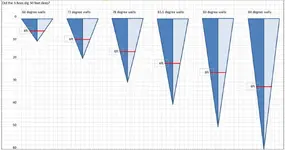
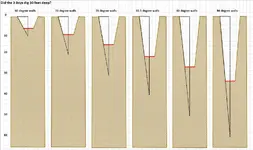
The attached diagram shows the depth one can achieve using different angles from 60 to 84 degrees.
The diagram also shows where the bottom would be 6’X6’. I chose this size assuming the boys weren’t
stupid and realized if they widen the bottom to removethelogs, the hole would collapse.
Not being able to remove the 30 foot platform may have been the incentive to come back in 1803 with the Onslow company and continued to dig down to 90 feet using cribbing. They knew cribbing was a must to go that deeper.
In order for the boys to have gotten to 30 feet, the angle of the walls must be about 83 degrees.
First they found a layer of flagstone and then found log platforms at 10, 20 and 30 feet where they stopped. I don’t think the story mentioned whether they removed the 3rd platform.
Most who read this story believe the walls of the hole/shaft are vertical; however, that only works for a
while until the sides start falling into the hole. The deeper you go the more dangerous it gets. Therefore, the walls must be angled resulting in the bottom being smaller than the opening at the top.
Google AI indicates the safest angle is 45 degrees; however, if the clayish till is dry and firm a 60 degree angle is conceivable. This is consistent with the Dunfield’s big dig (i.e., a cone shaped crater) where he estimated the angle of the sides were 60 degrees.
The attached diagram shows the depth one can achieve using different angles from 60 to 84 degrees.
The diagram also shows where the bottom would be 6’X6’. I chose this size assuming the boys weren’t
stupid and realized if they widen the bottom to removethelogs, the hole would collapse.
Not being able to remove the 30 foot platform may have been the incentive to come back in 1803 with the Onslow company and continued to dig down to 90 feet using cribbing. They knew cribbing was a must to go that deeper.
In order for the boys to have gotten to 30 feet, the angle of the walls must be about 83 degrees.