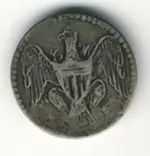
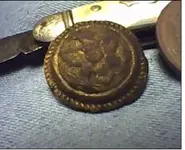
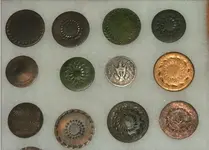
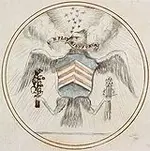
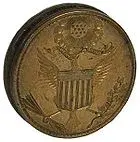
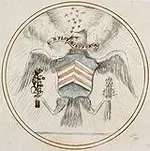
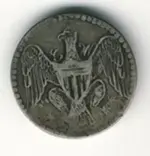
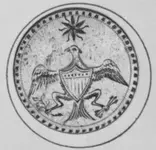
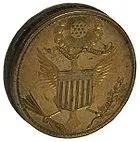
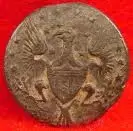
That is a rather unusual eagle button, and of a style and design of which a previously known example has not been noted to my knowledge.
1.) Has this example been tested to affirm a solid silver composition? High tin content pewter is known to hold up quite well in certain soils, occasionally surfacing in remarkable condition. Tombac metal, which was very popular in the 1780-1820 period, also comes out rather unblemished and with a shiny appearance.
2.) During the attempt to straighten the shank, which apparently produce rather negative results, was the shank piece saved? Did the shank (loop) crumble into dust, or simple break off in one solid piece? Any portion of the puzzle contributes a clearer picture in attempting a proper and thorough identification.
3.) What is the actual size (diameter) in inches or mm? What type of target I.D. response will be generated on a metal detector with visual target display? If this button example is actually silver, (or even silver plated brass), the target I.D. should read around dime/quarter on most metal detectors. Both pewter and tombac metal read down in the low nickel range.
4.) Due to the weak portion of the design, and inconstant quality exhibited across the top surface, the button almost appears to be cast rather than stamped. Generally, cast buttons will have mold seam lines evident on the back, as well as some traces of rough flash in areas. The back of this example does show signs of a slightly wavy surface with a bit of a possible edge bevel that could be attributed to surface tension flow on a slight over-pour in an open back mold. A closed back split mold though, would produce the characteristic mold seam line running across the surface that we often see on cast pewter buttons of the period.
CC Hunter