1. If you have a target that gives the wrong target ID for whatever reason, what tone would you get? Would you get the tone associated with the target (an accurate tone) or would the tone returned be the tone associated with the target ID (which would actually be the wrong tone)?
No way to predict what tone you'll get, depends on the target. The tones and target ID's are usually based off of target conductivity. On my Sovereign, tones are based on conductivity of the target, i.e., silver gives a high-pitched tone, nickels give a mid-tone, some gold gives a low tone. I assume NOX's operate the same, as that would allow the Engineers to tie Target ID to target conductivity. When the detector determines the probable conductivity of the target, it sends that to the screen to report as a specific number(s). Most times, the number jumps up and down a little bit as you're swinging. Although detectors have come a long way and are much more Hi-Tech than previous detector technology, they're not infallible. They're pretty accurate but not 100% all the time, other factors that can mess with a signal come into play like ground conditions, mineralization of the soil/sand, saltwater, EMI, etc.
Also, Target ID's can't always be 100% accurate, they'll just give you a probable idea of what the target might be because various types of targets can fall into the same conductivity range. For example, a certain Target ID #, along with maybe an additional number or two above and/or below, might indicate a nickel. But some pull-tab falls frequently fall into the same range as a nickel, as well as some gold rings. The only way to really be able to connect target ID's with types of targets is through experience and digging every target. You need to dig all targets, even trash, so that your brain can start associating certain Target ID's and tones with certain targets. By digging all targets, you'll start seeing that sometimes a pull-tab might give the same target ID # as a nickel. Or you think it's a nickel but might turn out to be a gold ring. Target ID is not infallible, it's just reporting on conductivity the detector determines, but it will give you an initial indication of what the target could potentially be. So many variables come into play, only way to get really proficient is by experience and digging every target.
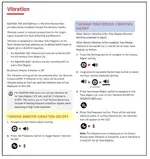
2. I was looking at page 21 about enabling Vibration. The blue section shows how to enable vibration by each tone region. I guess this implies that the yellow section shows how to enable Vibration outside of all tone regions, but how is that possible? At any given time, wouldn't you have to be in one of the tone regions?
Minelab is giving you the ability to determine what tone region(s) will cause the vibration, so you can set the vibration to meet your preferences, but you set this up before you start hunting. For instance, someone who is hearing impaired can adjust settings so that every target makes the handle vibrate. Or, if you're hunting an area with a lot of iron/trash, you can adjust the settings where ferrous targets vibrate the handle only and not give an audible tone. This way, you don't have to listen to a ton of beeps/tones when you're over junk/trash, you'll just feel the vibration instead. You'll still know you're over iron/trash but won't have to listen to constant beeping in your ears.
Or let's say you're on the beach and want to focus only on finding gold. You're not interested in silver, coins, etc., just gold. So, you can adjust the handle to vibrate on ferrous targets (iron/trash), and also higher-mid to high tone regions. This way, the detector will only give you an audible tone when over low to mid-level tone ranges, which is where most gold rings/jewelry are found. But if you happen to scan over a silver coin, which is a high conductor and hence, would give a high-pitched tone, the handle will vibrate but you won't hear an audible tone. You can set the handle to vibrate on some tone regions, off on others, all based on your preferences, what you're looking to find and the area you happen to be hunting.
3. Suppose you have a target that has 3 different metals in it and there are no other targets nearby. When you swing the detector over that target, what target ID would be returned? Would it be the target ID associated with metal 1, metal 2, metal 3 or even some other target ID?
No way to be able to tell you a specific target ID, as it depends on the composition of metals involved and how the detector interprets those metals. I can tell you first-hand that a lot of pull-tabs are made with 2 different metals & shapes. The beaver tail is one smooth piece of metal, the ring you use to pull the pull-tab is another metal but is circular with an open center. This is one of those targets that you'll learn to ID through experience. If the pull-tab is lying vertically, with the ring on top, beaver tail below, and you swing the coil left to right or right to left, you'll usually get just 1 tone.
But if the pull-tab is lying horizontally, with the ring on the left and beaver tail on the right or vice versa and you swing the coil right to left or left to right, you'll usually hear a quick double blip. That's because when it's horizontal, your coil will hit either the beaver tail or ring first, then the other piece next. Your detector will react with a tone for the first piece, then may give a slightly different tone when over the 2nd piece. Since you're typically moving the coil quickly over that small target, the audio will present as a double blip, as the detector is hitting on 2 different connected metals back-to-back. That's why it's important to sweep every target signal from a variety of directions before digging, as a target may give a certain signal in one direction, but a different signal when swinging in another direction. Or a good target could be lying next to a junk target.