What's new

Two Stacked Boxes

chalkoutline

Hero Member
Joined
Apr 1, 2025
Messages
679
Reaction score
279
Golden Thread
0
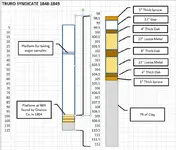
I am intrigued by Armchair's post on the Truro Syndicate where core samples indicated there were two stacked boxes located from 100ft to 105ft.
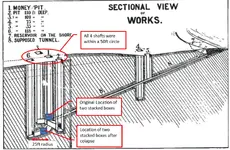
The first diagram details the core sample described by Truro.

According to their accounts, their last attempt was to dig shaft #6 shown in the second diagram.

"A short time after, SHAFT #6 was sunk on the south side of the "Money Pit," and to a depth of 118 ft. "

"A tunnel was driven from shaft 6 towards and reached a point directly under a part, at least, of the bottom of the "Money Pit." It was now the dinner hour, and the workmen had left the tunnel. Before they had finished dinner, a great crash was heard in the direction of the works."

"Subsequently, it was found that 12 ft of mud had been driven by the force of water from the old to the new shaft."

The core samples indicated below the two boxes was at least a 7ft layer of clay. Based on my study of till/cribbing, clay becomes a soupy mess when saturated with water. This means the two stacked boxes would have had about 10ft of clay below them when they collapsed.

Depending on the weight of the two boxes, they would have pushed the 10ft of clay into the connecting/horizontal tunnel.
Since the horizontal tunnel was 20ft to 25ft long, the two boxes could have also slid into the tunnel if they were heavy enough.
-CO
 

Attachments

  • Truro Auger Detail.webp
    Truro Auger Detail.webp
    50.3 KB · Views: 212
  • Two Stacked Boxes.webp
    Two Stacked Boxes.webp
    129.2 KB · Views: 89
Actually, its not the weight of the boxes that would cause the log platform to collapse and push the clay into the horizontal tunnel but rather the weight of the 12ftx12ftx70ft column of water.
The water would easily push the two boxes into the horizontal tunnel.

The water; however, would not push them deeper unless a hole somehow opened up underneath the vertical shaft.
 
A 12ftx12ftx70ft column of water weighs 629,264lbs or 315 tons.

The spruce platform can support a safe working load of approximately 425 lbs per log. If constructed as a solid floor across the 12ftx12ft span could support
A total capacity is roughly 12,000 lbs (approx 6 tons).

Note: the niches supporting the 14ft spruce logs must be structurally sound to prevent the log ends from crushing the wall material or shearing.
 
The report stated they heard a great crash coming from the work area; however, im not sure it would be described that way since it would have been underwater.

A "great crash" sounds like a collapse in a dry shaft.
 
Subsequently, it was found that 12 ft of mud had been driven by the force of water from the old to the new shaft."
One thought i had was...it was the cribbing in shaft 6 they heard collapse because it was dry up to that point.
However, based on the above observation of mud at the bottom indicates their cribbing was still in tact to descend the shaft and make the claim.

Also, with the much water getting released at once, i think shaft 6 would have already been flooded by the time they got there.
 
According to Google AI, core samples taken in 1850 at the time Truro was taking samples used a hand cranked auger.

So im trying to understand how Truro took the samples from a plaform 70ft above the first spruce platform they encountered, then continued to bore through the next 7ft of boxes/loose metal, followed by another 7ft of clay.

And how did they hear/determine loose metal that was 72ft to 76ft underwater.?

It seems like Truro must have used something other than a manual auger.

Does anyone know if there was another method used for core samples at the time?
 
And how did they hear/determine loose metal that was 72ft to 76ft underwater.?

It seems like Truro must have used something other than a manual auger.

Does anyone know if there was another method used for core samples at the time?

One of my projects recently has been transcribing old newspaper & magazine articles related to Oak Island (pre-1950). I have found a few which have some great details that were missing from the books I've digested so far, particularly regarding personnel, company names, and some of the subtleties of the excavations. I might get only one or two tidbits per article, but as there were MANY over the years, the data starts to add up.

As I've mentioned before, I've also been curious about the augers, and whether it was realistic to expect they could get as much data that way as has been claimed. These presumably would have been T-shaped, with the handles they used to manually twist it into the target forming the T's crossbar. You can find old woodcut/engraving illustrations of this kind of tool (and the smaller woodworking versions) dating back centuries. This style of auger is quite old and used in mining and farm work. Apparently extensions could be screwed onto the top ends the further they went down.

The books refer to "pot augers" or "pod augers", and apparently one of those is not really a thing, though I can't recall which. One of the articles I transcribed this past week, however, called it a "ball sludge auger", which also seems to be a unique nomenclature that has not turned up any hits, but a "sludge auger" was definitely a thing. Perplexity conjectured that a ball could have been a part of the partial enclosure at the end to help hold any samples in place for retrieval. An article also detailed how it was the sound and vibration of the auger as it traveled through different strata that told an experienced hand what the general materials were. (But cf. that Reddit article I posted a few days ago which recounted one skeptic from the era saying they'd mistaken the sound of gravel for "loose metal".) One analogy given was the sound that an iron bar would make in a keg of nails. They also mentioned how they brought up the drill very, very carefully to avoid losing the samples embedded at the working end. When they had trouble getting through certain materials they would change out the bit for a chisel tip.

In later syndicates, some of these techniques were given over to powered devices, of course, but not for quite awhile after the two supposed boxes were identified.

--GT
 
I'm seeing an error creep in - there is only 1 box in the Mccully letter. The measurements for the 2 box idea come from the 1965 readers digest article, a fine but only an entertainment type magazine. Given a choice, I prefer the history of someone who was there.

But it is interesting to note from the letter there was a second container. The last auger apparently bounced off a barrel or keg shaped casing made of oak, and caught a piece of the upper hoop made of birch. It is shorter than the box.

So makes oaken kegs with birch hoops, and what for?

(To make things fun, the box may not be a box, but also a barrel or keg.)
 
I'm seeing an error creep in - there is only 1 box in the Mccully letter. The measurements for the 2 box idea come from the 1965 readers digest article, a fine but only an entertainment type magazine. Given a choice, I prefer the history of someone who was there.

It dates from much earlier than that ... at least the 1930s and maybe the 1890s (and maybe 1865). I'll have to re-read some of these articles to see exactly where but there were ppl in that crew saying things, if not to the article writer than to someone who then told the article writer, to the effect of "we assumed that the large tier of wood was the bottom of one container and the start of the next". But of course like everything else about Oak Island, many of the articles just flat out get stuff wrong, whether because they didn't fact check their sources or whatever, and different articles contradict each other to a non-trivial degree.

On the other hand, since they described a "roof" and "floor" levels as well, you could think of that as one BIG container, with two smaller ones inside it.

--GT

Edit: "J.B. McCully, of Truro, who is still living and can vouch for these facts, was manager. A platform was rigged in the 'money pit' thirty feet below the surface and just above the water. The boring started, the platform was struck at ninety-eight feet, just as the old diggers found it when sounding with the iron bar. After going through this platform, which was five inches thick, and proved to be spruce, the augur [sic] dropped twelve inches and then went through four inches of oak; then it went through twenty-two inches of metal in pieces, but the augur failed to take any of it in except three links, resembling an ancient watch chain. It then went through eight inches of oak, which was thought to be the bottom of the first box and the top of the next; then six inches of spruce; then into clay seven feet without striking anything else."

source: The Nashville American [Nashville, TN] 1895-10-27, p.19 "TO DIG FOR KIDD'S CHEST"
 
Last edited:
but the augur failed to take any of it in except three links, resembling an ancient watch chain
GT,
Do your know the diameter of the augers used? We might be able approximate the object size it could pick up.
 
How would you interpret this claim...

Rushing back to the pit, they found that the bottom of the "Money Pit" had fallen into the tunnel that they had a short time before vacated and that the new shaft was fast filing with water. Subsequently, it was found that 12 ft of mud had been driven by the force of water from the old to the new shaft.

They had dug shaft 6 to a depth of 118ft. Does that mean after the crash the mud filled shaft 6 up to 106ft?
 
GT,
Do your know the diameter of the augers used? We might be able approximate the object size it could pick up.

For the syndicate that found the stacked "boxes", I do not. But Oak Island Treasure Co. in late 1890s were boring a 2.5" hole. I don't imagine them being drastically different.

They had dug shaft 6 to a depth of 118ft. Does that mean after the crash the mud filled shaft 6 up to 106ft?

I think it means that mud squished into the bottom of the shaft like toothpaste from a tube, and rose 12 feet from the bottom, so that their shaft was now only clear to 106 feet deep from surface.

--GT
 
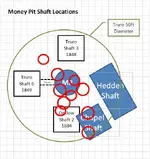
According to the Truro account shafts 2, 3 and 6 were within a 50ft circle.
I added these three shafts to my shaft location diagram i created for the dunfield dig thread.

The red circles indicate the cason locations.

My theory is...the deluge of water from the colapse in the Money Pit pushed the 2 stacked boxes into the bottom of Shaft 6.
 

Attachments

  • Shaft Locations.webp
    Shaft Locations.webp
    35.4 KB · Views: 84
I drew shaft 6 at the location shown in th 3D drawing of all the Truro shafts but the Truro account indicates Shaft 6 was south of the Money Pit.

Google AI...
Shaft 6 is located approximately 18 to 25 feet west of the original Money Pit

Does anyone know which is correct?

Depending on its location would determine how bad Rick and Marty missed the boxes.
 
Last edited:
Before i stopped watching CoOI, i remember them talking about the collapse and seeing a diagram of the debris field and thinking it was huge and any treasure was spread across a large area.

After considering the Truro core samples, the debris field could only be two log platforms and two aleged boxes with loose metal.

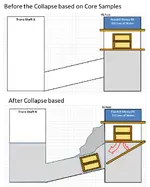
The attached diagram shows shaft 6 and the MP before and after the collapse.

The first area of collapse would have been where the horizontal tunnel entered. As the shaft wall above it collapsed, the 315 tons of water would have pushed the boxes into the tunnel possibly riding on the logs of the platform it sat on.

For the mud to rise to 12ft in shaft 6, the shaft 6 wall probably gave way also. The boxes never hit anything hard to break them open so they would still be lying at the bottom of shaft 6 fully intact

This senario seems quite possible.
 

Attachments

  • MP Collapse.webp
    MP Collapse.webp
    49.1 KB · Views: 73
i wonder what the boxes would weigh in at.
 
There was another thread where the weight of the boxes were discussed. Does anyone remember the title?
I found the thread.

Some Notes Re: Construction of the Money Pit​

The box discussion starts at post 61.
 
Here is a thought i just had...
if my theory is correct and the two boxes are in shaft 6, retrieval could be much easier.

It is the MP that has continual flow of sea water which is why when you try to access from another parallel shaft, the the sea flows into the parallel shaft.

However, shaft 6 was dry until Truro tunneled to the MP so if the deluge pushed the boxes to shaft 6 they are no longer in the MP flood area but in the dry area of shaft 6.

All they have to do is drop a cason around them and pump it dry.
 
i wonder what the boxes would weigh in at.
Box estimates...
A 12ftx12ft vertcal shaft you have to have no more than 6ftx12ft log platforms to keep the other half of the shaft open for raising and lowering material.

The previous thread discussion used a 30"x30"x30' box which weighed 440lbs.
Since the shaft had a 6ftx12ft opening, i calculated a 32"x36"x60" rectangular box at 1000lbs.

A launch from the ship can handle 1000lbs including a couple of men which would indicate the alleged treasure was taken to shore in multiple trips (500lbs at a time) and placed in the two boxes fabrcated on site and then lowered to the bottom.

The question becomes...how much did the loose metal weigh?

A 1700 2" to 2.5" auger would have a 3/4" center shaft which would allow picking up objects 3/4" in size. Since there was no gravel reported, ill assume it was metal they went through as indicated. However, i would think coins would have been pulled up by the auger but none were reported.

They did report 3 links of a gold watch chain so the boxes contained jewelry?
I don’t know how to estimate the weight of a box of jewelry.

This is all speculation so i am more than willing to correct anything i got wrong.
 

Users who are viewing this thread

Back
Top Bottom