What's new

Two Stacked Boxes

Box estimates...
A 12ftx12ft vertcal shaft you have to have no more than 6ftx12ft log platforms to keep the other half of the shaft open for raising and lowering material.

The previous thread discussion used a 30"x30"x30' box which weighed 440lbs.
Since the shaft had a 6ftx12ft opening, i calculated a 32"x36"x60" rectangular box at 1000lbs.

A launch from the ship can handle 1000lbs including a couple of men which would indicate the alleged treasure was taken to shore in multiple trips (500lbs at a time) and placed in the two boxes fabrcated on site and then lowered to the bottom.

The question becomes...how much did the loose metal weigh?

A 1700 2" to 2.5" auger would have a 3/4" center shaft which would allow picking up objects 3/4" in size. Since there was no gravel reported, ill assume it was metal they went through as indicated. However, i would think coins would have been pulled up by the auger but none were reported.

They did report 3 links of a gold watch chain so the boxes contained jewelry?
I don’t know how to estimate the weight of a box of jewelry.

This is all speculation so i am more than willing to correct anything i got wrong.
So much time and effort spent trying to explain something that never existed.
 
".... After going through this platform, which was five inches thick, and proved to be spruce, the augur [sic] dropped twelve inches and then went through four inches of oak; then it went through twenty-two inches of metal in pieces, but the augur failed to take any of it in except three links, resembling an ancient watch chain. It then went through eight inches of oak, which was thought to be the bottom of the first box and the top of the next; then six inches of spruce; then into clay seven feet without striking anything else."

source: The Nashville American [Nashville, TN] 1895-10-27, p.19 "TO DIG FOR KIDD'S CHEST"
I see you found the source of the reader's digest article - wow. Do I take it that with the fullerton clipping you are a one boxer?

A keg with birch hoops might hold various liquids says Google, and interestingly, gunpowder. This fits neatly with my theory that this was a British arms cache from the revolutionary war, so naturally I am suspicious.

Google algorithms are about teasing you to use more Google.
 
Do I take it that with the fullerton clipping you are a one boxer?

Me? I don't have a strong opinion. For the original "box" discovery (Truro, I believe), I lean towards the theory of two boxes within the spruce delimited "room" or vault, only because they went through wood, then the metal, then more wood, then more metal, which lends itself instantly to thoughts of contents within containers.

The Fullerton box from Freeman's scan, if it is, as I speculated, the Chappell "vault", has never aligned clearly as the same structure as the Truro box(es). That outer layer of concrete was not described by Truro (though I've also wondered if the mottled, primitive concrete they have shown on CoOI might have been mistaken for rock by the earliest syndicates), and the dimensions don't seem to match up. But maybe the spruce room had collapsed onto its side since Truro, giving only the illusion of different dimensions since its former width would now be its height, and any other containers or substructures contained therein tumbled about from their original arrangement ... there were air gaps described by Truro that could have allowed contents to move.

One of the articles I've looked at recently describes one of Fred Blair's syndicates as having found a 40-foot (!) chamber "of cement reinforced by iron" at 153 feet. That seems much larger than I recall the books describing the Chappell Vault. All these conflicting details. Frustrating but still fascinating.

--GT
 
However, shaft 6 was dry until Truro tunneled to the MP so if the deluge pushed the boxes to shaft 6 they are no longer in the MP flood area but in the dry area of shaft 6.

All they have to do is drop a cason around them and pump it dry.

Not to be a downer, but the impression I get from the last two seasons of CoOI and the "solution channel" theory is that the constant movement of water has undermined every previous shaft, and perhaps dissolved much of the anhydrite strata below them. I would be shocked if there exists a distinct searcher shaft from the 1800s still intact that has not been at least intersected, if not obliterated, by Dunfield, Triton, or Laginas and their dozens of bore sites and caissons.

--GT
 
Hmmm.

Knowing that, and knowing that some grapeshot ranges from 1.5 " to 2", and that there was an auger bit "with a pin in it" of which it was said "would not allow the metal bits to pass through it" - it becomes a good possibility that the box was filled with grapeshot.

Another point for an arms cache.

Darn Google is teasing me again.
 
With regards to the auger...
I am not convinced they brought up well defined samples.
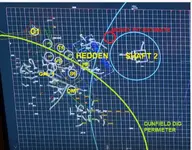
Dunfield dig not dig the MP but rather south-west of the MP. He was looking for flood tunnels to/from South Shore. See the green line in the attached pic.

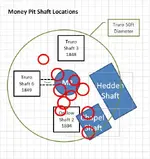
Also, when studied Dunfield for my Dunfield thread, i determined the MP in the diagram is not correct. The general concesus places the location where i posted earlier...where all the cassons are shown.
The best argument being...if the MP is in the upper right, why did Rick and Marty drop cassons to the west of the Heddon shaft.

Also the S6 casson is not for shaft 6 but over the Chappell shaft/vault.
 

Attachments

  • Screenshot_20250707_152541_Chrome~2.webp
    Screenshot_20250707_152541_Chrome~2.webp
    104.2 KB · Views: 41
  • Shaft Locations.webp
    Shaft Locations.webp
    35.4 KB · Views: 63
Last edited:
As mentioned, one of the articles I transcribed referred to a "ball sludge" auger. Now a different article has called them "sledge-ball" augers.

Sludge / sledge ... a minor spelling difference but may help figure what their capabilities were.

--GT
 
Did a little research on grapeshot.
(This is based on American Civil War information 1860's).
.... is packed in canvas bags.
.... shot size is CRITICAL to specific guns.

This could mean that the decision to bury 100 ft deep was a TACTICAL decision - too unique to abandon, possibly used by the same cannons as the enemy.
 
A question remains...
If it was grapeshot packed in canvas bags, why did the auger not pick up samples of the canvas?
When did canvas become standard? How was it done before that?
I need to find an expert .
 
A question remains...
If it was grapeshot packed in canvas bags, why did the auger not pick up samples of the canvas?
When did canvas become standard? How was it done before that?
I need to find an expert .
I question the accuracy of the auger samples
As GT mentioned, the augers were turned manually and typically used by grabbing a sample and pulling it out then pushing it back into the same hole to grab the next sample a little deeper.

To perform deep core sampling they had to use a pipe to contain the sample as they twisted the auger at the end of several extensions through the pipe.

After turning the auger 180 degrees they would have to let go and regrip the handles to turn it another 180 degrees.
This release in rotational force is an opportunity for the sample to slip out since the shaft was flooded and the samples wet. If the auger was designed for soil cores it may not have been able to pick up coins but thats speculation.

When they pull the core to the surface, i don't think they had 5 inches of spuce, the 4 inches of oak etc. But samples of spruce, samples of oak. The thicknesses were determined on top by how far the auger traveled before difficultly of turning changed.

The information i read said they lost the first sample they tried to retrieve so it looks like they were going through a learning process.
 
Some more info ...
Possibly the grapeshot was packed in boxes, then shipped, requiring it be unpacked, pur in canvas bags to get ready for battle. Such a shipping container must be built heavy duty, such as these were.
But ...
Such container packed with grapeshot would weigh like 2000 lbs, which would require equipment to simply move across ground.
 
Okay, so I need a way to transport HEAVY boxes.

There is a picture of a sled Dan Blankenship uncovered In the U structure in Smith's Cove
in 1970. Find the thread The "U" Shaped Structure (currently 9 pages over in the main menu), posts #77, #102, and #107.

When you've seen the slipway that was uncovered in season 6 on COOI, that sled could easily be a cart sliding over the rollers.

The bunghole is not placed to drain or fill liquid, but is there to attach a rope to the sled - there's no other way to do it.
 
Still some questions....

1. If the box was packed "from the factory" grapeshot would be nested so close together they probably couldn't move aside for an auger bit. ...a partially packed box?

2. The sled picture is troublesome. Parts of the sled are clearly rough cut, but the bottom looks like plates? Can you cut plates like that out of wood pre 1795?
 
For reference

Google "norway 17th century barrels" and you get pictures of newly unearthed lime barrels.
There are no dimensions, but Google's guesswork puts dimensions within 2" of mccully's recorded box (or barrel) auger samples.

You look at them and wonder.
 
Now this is looking like the original target was a barrel, not a box.

And only one barrel. This is consistent with Auger #2 hitting the solid top, and Auger #5 ?
glancing off the side of the same barrel. Also those digging reports that say they hit it but push it aside or down or something - they keep glancing off the side.
 
Now this is looking like the original target was a barrel, not a box.

It would be a pretty chonky barrel. Top and bottom of four-inch oak?

For comparison, some unearthed Roman-era barrels had 1.5-inch thick staves (top thickness not mentioned).

Interestingly, from the same article: "Empty casks were used to line the walls of shallow wells from at least Roman times ... They had Roman numerals scratched on the surface of each stave to help with re-assembly."

--GT
 
A final note on barrels.

They are intended to be rolled on their sides, so no especial handling equipment is needed, and if it's a very heavy barrel with a light thickness on the bottom, rolling it on that edge between side and bottom would just split the side staves .

GT have you looked up "valve sludger"? It is the lost piece of the first auger attempt by the Truro Co so named in the Mccully letter I keep referring to.
 

Users who are viewing this thread

Back
Top Bottom