What's new

flumoxed

unclemac

Gold Member
Joined
Oct 12, 2011
Messages
8,031
Reaction score
9,228
Golden Thread
0
Primary Interest:
Beach & Shallow Water Hunting
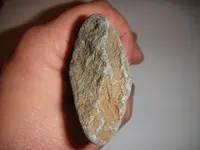
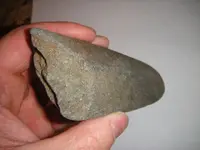
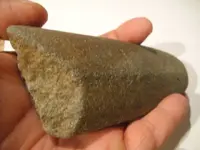
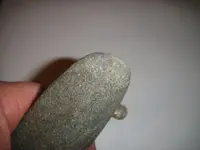
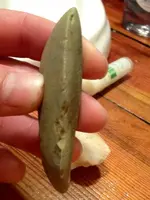
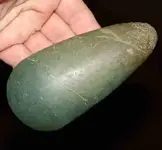
this one has me going...I found it at a village site where I had found other obvious artifacts made from the same stone (pestles, mauls, and the like)...so it has that going for it. Notice the beveled sides...both sides.... Obviously broken, very smooth and a rounded tip. Got any ideas? The only similar item I have come across are "slave killers" but this is not fine enough for that...too rough.
 

Attachments
  • DSC03281.webp
    DSC03281.webp
    25.1 KB · Views: 161
  • DSC03283.webp
    DSC03283.webp
    23.9 KB · Views: 154
  • DSC03285.webp
    DSC03285.webp
    23.1 KB · Views: 162
  • DSC03287.webp
    DSC03287.webp
    19.2 KB · Views: 160
  • DSC03291.webp
    DSC03291.webp
    18.2 KB · Views: 154
Upvote 0
Hey NC what type of stone are those made from? I know your others look to made from Granite. Are the tan ones Green Stone?
 
Hey NC what type of stone are those made from? I know your others look to made from Granite. Are the tan ones Green Stone?

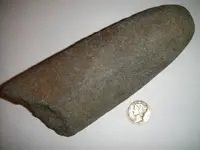
This big nasty looking one is green stone I'm relatively sure of. I have the bit of a Celt that is polished to perfection that is rhyolite.

image-2509581322.webp

Just the bit. Bitter sweet. I suppose more sweet than bitter.
 
That looks like a celt bit...the other looks like a hoe or hoe preform to me. The bit looks more like greenstone than rayholite and that other..is no way greenstone.
Just sayin.
 
Last edited:
This is a greenstone celt

Aqua_Greenstone_Celt_FB_1.webp
 
That looks like a celt bit...the other looks like a hoe or hoe perform to me.

That would be a monster hoe. I meant to get a pic of that one at a distance today. I got tied up looking points after work.
 
It's big because it wasn't finished yet
 
Rayholite Was used As a flakeable lithic in your area.. There's no mention of a polished rayholite celt anywhere in documentation I've seen from North Carolina. Plenty of green stone though.
 
Last edited:
To make tools using the ground stone method American Indians shaped a rock or cobble by pecking, grinding, or polishing one stone with another. This was a labor-intensive process of repeated pecking and grinding followed by polishing with sand and water. The craftsman drilled holes by spinning a pointed stone, hardened stick, or bone between the hands against the stone, using sand as an abrasive. Ground stone tools were usually made from rhyolite, granite, or other rocks with a coarse structure. Softer stones such as limestone and steatite were fashioned into more elaborate objects. The ground stone method was used to produce axes, adzes, smoking pipes, bannerstones (atlatl weights), figurines, chunky stones (an American Indian game), beads, bowls, cooking pots, and storage containers.
 
To make tools using the ground stone method American Indians shaped a rock or cobble by pecking, grinding, or polishing one stone with another. This was a labor-intensive process of repeated pecking and grinding followed by polishing with sand and water. The craftsman drilled holes by spinning a pointed stone, hardened stick, or bone between the hands against the stone, using sand as an abrasive. Ground stone tools were usually made from rhyolite, granite, or other rocks with a coarse structure. Softer stones such as limestone and steatite were fashioned into more elaborate objects. The ground stone method was used to produce axes, adzes, smoking pipes, bannerstones (atlatl weights), figurines, chunky stones (an American Indian game), beads, bowls, cooking pots, and storage containers.


If you are going to quote something you found on the net, or in a book, maybe you should give the good folks who wrote it a little credit.. Or are those you're words?
 
If you are going to quote something you found on the net, or in a book, maybe you should give the good folks who wrote it a little credit.. Or are those you're words?

http://www.voicesofthesandhills.com/artifacts/stone-tools.html


Sorry I accidentally plagiarized!! You Caught that fast Viking. I was working on posting the whole link as a correction. My point, rhyolite can be polished, flaked, what ever. Green stone, different ball game.
 
If you are going to quote something you found on the net, or in a book, maybe you should give the good folks who wrote it a little credit.. Or are those you're words?

My words apparently don't mean crap. I could paraphrase this, and have, only to be told I'm wrong. So.... Rhyolite can be polished. The good people at UNC wrote it in the link. Gator, you can now add polished rhyolite to your "extensive" study of NC artifacts. As for a "grooved Celt" they do not exist!! They are axes. Axes have a poll end that can be used as well as a sharp bit for chopping. Celts can only be used for chopping.
 
Gees...haha.. OK... post a photo of a polished rayholite celt. From..anywhere.
 
Last edited:
Next look at Celts of North Carolina and note the materials used.
 
My words apparently don't mean crap. I could paraphrase this, and have, only to be told I'm wrong. So.... Rhyolite can be polished. The good people at UNC wrote it in the link. Gator, you can now add polished rhyolite to your "extensive" study of NC artifacts. As for a "grooved Celt" they do not exist!! They are axes. Axes have a poll end that can be used as well as a sharp bit for chopping. Celts can only be used for chopping.

Ouch.... Now Celts don't have poll ends? who said anything about a groove????
 
Last edited:
ForumRunner_20130316_203107.webp one poll end of said celt coming right up
 
Last edited:

Users who are viewing this thread

Latest Discussions

Back
Top Bottom