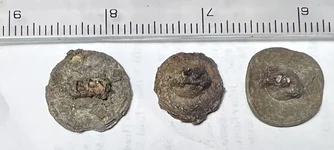
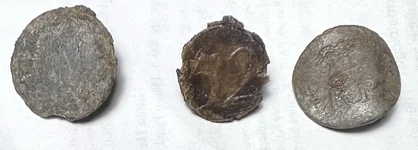
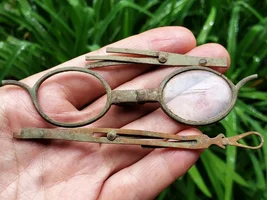
Thanks for the welcome and reply. Dont think its lead, as not soft. No white corrosion. I assume hole goes all the way through but cleaning does not open it up. I thought it had an iron shank inserted at casting. there looks like rust. Its like some brittle pot metal. Rang up high 40's on the AT/Gold.nyhistory, welcome to TNet! Interesting find. Based on appearance alone to me it kind of looks like lead or similar. How did it ring up on your detector? If you clean it more, does the indentation in the center go all the way through?
Maybe a pot metal pull knob once on a ferrous rod that was part of a vehicle or screwed to a drawer.Thanks for the welcome and reply. Dont think its lead, as not soft. No white corrosion. I assume hole goes all the way through but cleaning does not open it up. I thought it had an iron shank inserted at casting. there looks like rust. Its like some brittle pot metal. Rang up high 40's on the AT/Gold.
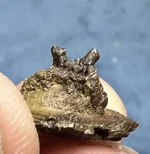
Are there any tests to determine specific metal? I did consider a choke or throttle control but the iron part would have been very thin. seems the iron bit was cast in. Anyone know if this is a known method of attaching shank?My impression is an old pewter button too. A pewter button is usually pretty old (like 1700s).
I've dug hundreds of buttons from the 1700s and 1800s and none had an iron shank. an Iron shank would stain the cloths with rust. the size is very large for a button as well. Dandy buttons were large but did not have a heavy build like your item does.Are there any tests to determine specific metal? I did consider a choke or throttle control but the iron part would have been very thin. seems the iron bit was cast in. Anyone know if this is a known method of attaching shank?
I have dug a few pewter buttons with iron shanks. The problem with them is that they seem to be in worse shape then a pewter with a pewter shank, likely due to dissimilar metal corrosion from years of ground action.I've dug hundreds of buttons from the 1700s and 1800s and none had an iron shank. an Iron shank would stain the cloths with rust. the size is very large for a button as well. Dandy buttons were large but did not have a heavy build like your item does.
your find does look like pewter.
Thanks. Now I know that a pewter button with iron shank was a thing. If you have any pics handy i would love to see them.I have dug a few pewter buttons with iron shanks. The problem with them is that they seem to be in worse shape then a pewter with a pewter shank, likely due to dissimilar metal corrosion from years of ground action.
I'd love to see one too, I'd also like to see one that messures an inch acrosswould love to see them.
Thanks for posting those. I am blown away!!!!’Since dug pewter buttons are fragile even after being "stabilized", they require separate holders rather than tossed into a button jar. That being said I only hold onto the ones with any sort of design unless I ever dig a plain in spotless condition which is rare in my area.
Here are three pewters that had iron shanks that have since corroded away: An RP, a 71st, and a 52nd. You can still see part of the iron loop on the eaten up 52nd. Also note that the iron shank on the Royal Provisionist is bleeding through the face just above the "R".
As stated I don't dig a lot of iron shank pewter buttons but have dug a few.
BTW two of the buttons are 7/8 inch.
You are correct. Everyone has their own recipes/methods. I soak my pewters in 2/3 elmers and one third water for a few days then air dry .As for preservation, if you wish to save it (the pewter will disintegrate quickly) you have options of polyurethane spray or an Elmer’s glue/water mix (likely several others). There are others on this site way better at me on pewter preservation, and hopefully they’ll weigh in.
That is the “stabilizing” mentioned above.