What's new

Help with bottle washed up on the beach

PikesPeakCharlie

Bronze Member
Joined
Nov 19, 2008
Messages
2,194
Reaction score
3,194
Golden Thread
0
Location
Pikes Peak
Detector(s) used
Garrett Gti 2500, Garrett Gta 350, Garrett Pro-Pointer -- Whites IDX Pro, AutoMax V2 Pinpointer
Primary Interest:
All Treasure Hunting
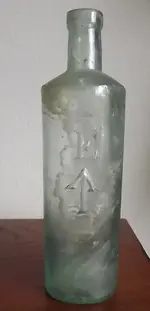
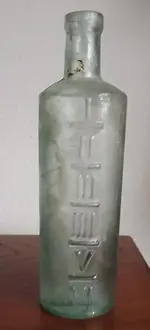
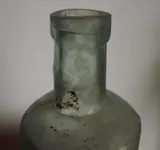
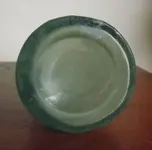
I could use some help on this one , found washed up on a Florida beach. I have not seen anything like it up here on the mountain, must not be too old it has a smooth base and a tooled top , and someone scratched some letters in the side of it. I'm guessing it is a medicine bottle ,but I don't know :icon_scratch:
 

Attachments

  • DSCF7185 (2).webp
    DSCF7185 (2).webp
    23.5 KB · Views: 141
  • DSCF7187 (2).webp
    DSCF7187 (2).webp
    22.5 KB · Views: 125
  • DSCF7189 (2).webp
    DSCF7189 (2).webp
    21.6 KB · Views: 116
  • DSCF7191 (2).webp
    DSCF7191 (2).webp
    26.5 KB · Views: 113
  • DSCF7193.webp
    DSCF7193.webp
    45.1 KB · Views: 120
I really like it, no clue as to origin, but it's a good looking hunk of glass
 
I think I see Greek letters on it . cool bottle!
 
Thinking its foreign too. Haven't seen anything like it and it's an interesting piece.
 
I knew I'd seen that arrow mark somewhere.

The broad arrow is a mark to identify British Government property:
The Office of Ordnance was created by Henry VIII in 1544.[SUP][3][/SUP] It became the Board of Ordnance in 1597, its principal duties being to supply guns, ammunition, stores and equipment to the King's Navy.
The Office and Board used the broad arrow to signify at first objects purchased from the monarch's money and later to indicate government property since at least the 17th century. The introduction of this symbol is attributed to Sir Philip Sidney, Joint Master of the Ordnance in 1585/6, since the pheon appears in the arms of the Sidney family.

The broad arrow frequently appeared on military boxes and equipment such as canteens, bayonets and rifles, as well as the British prison uniform from the 1870s, and even earlier, that of transportees in British penal colonies such as Australia.[SUP][7][/SUP] The broad arrow marks were also used by Commonwealth countries on their ordnance.

With the demise of the Board in 1855, the War Department and today's Ministry of Defence continued to use the mark.

Similarly to hallmarks, it is currently a criminal offence in the United Kingdom to reproduce the broad arrow without authority. Section 4 of the Public Stores Act 1875 makes it illegal to use the "broad arrow" on any goods without permission. (from Wikipedia)
 
so it may be to miser gun powder for cannons ?
 
What is the volume of the bottle? Divide by six. I suspect that this is a Royal Navy medicinal bottle with six doses. Probably not lime juice . . . all those bottles I've seen are black glass. Could be laudanum (if the bottle/dose size is small). Could be medicinal whisky (British sp.) if it's a quart bottle. Could be just about anything, I guess.

The "E" may be the key to the contents. Or not. More research is required.
 
A collector who specializes in British bottles says:
That is a British military marked bottle made for an Engineering dept.,hence the "E", possibly for a fine lubricating oil.
 
Good work Harry😃
 
Thanks for all of the replies everyone , Harry WOW !!!!! Thank you for all the info !!!! it just goes to show we never know what's going to pop up next. I know next time I make it to the coast and take an early morning walk on the beach my eyes will be peeled for bottles rolling in the surf. I will say I'm surprised they used glass bottles for oil. Thanks again to all !!!!
 
P.S it holds 6oz to the neck.
 
That is one cool looking bottle, love the crudeness.
The only bottles I've seen wash up on the lakes up here in Denver tend to be 40 ouncers!
Carl
 

Users who are viewing this thread

Back
Top Bottom