
You are using an out of date browser. It may not display this or other websites correctly.
You should upgrade or use an alternative browser.
You should upgrade or use an alternative browser.
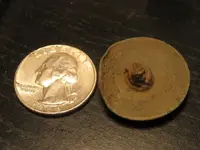
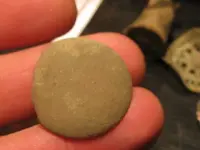
Horse piece?
- Thread starter Garabaldi
- Start date



Bigcypresshunter
Sapphire Member
- Joined
- Dec 15, 2004
- Messages
- 27,124
- Reaction score
- 3,351
- Golden Thread
- 0
- Location
- South Florida
- Detector(s) used
- 70's Whites TM Amphibian, HH Pulse, Ace 250
- Primary Interest:
- Beach & Shallow Water Hunting
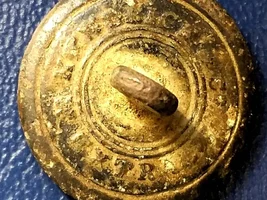
That may be one of those items that we argued over in the past. Some say its a large button and others say its a large tack with a steel shaft.  http://forum.treasurenet.com/index.php/topic,299911.0.html
http://forum.treasurenet.com/index.php/topic,299911.0.html
Upvote
0

vayank54
Silver Member
- Joined
- Oct 11, 2009
- Messages
- 2,738
- Reaction score
- 26
- Golden Thread
- 0
- Location
- Northern VA
- Detector(s) used
- Whites Blue Gray & Tesoro Cibola
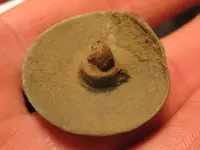
We find them in colonial sites. I have never seen one with more than just a small bit of iron on the back. We always figured they were horse rosettes. The iron piece in the ones I've dug and seen have never looked like a button shank. The always look like it was a shaft or pin. It's also possible the were rosettes for furniture.
Upvote
0

Lucas
Bronze Member
Big tacks/plain furniture rosettes don't show up till the Arts and Crafts era... you see things like chests with copper banding held on by jumbo brass tacks. If the context is colonial, I would go with horse tack.
But, for the record, I wouldn't know horse tack if it bit me in the...
But, for the record, I wouldn't know horse tack if it bit me in the...
Upvote
0

timekiller
Silver Member
- Joined
- Feb 10, 2009
- Messages
- 3,853
- Reaction score
- 966
- Golden Thread
- 1
- Location
- Morehead City / Newport NC
- 🥇 Banner finds
- 1
- Detector(s) used
- Minelab E-Trac
- Primary Interest:
- All Treasure Hunting
Button 1650-1700 
Upvote
0

ShootTheMoon
Jr. Member
- Joined
- Apr 20, 2010
- Messages
- 95
- Reaction score
- 0
- Golden Thread
- 0
- Location
- North Alabama
- Detector(s) used
- Discovery 1100, Pioneer 101
They always look like saddle conchos to me.
Or conchos for gun holsters/belts....spur and chap conchos or for mailbags.
Can be bit pieces as well. Or stirrup pieces.
With the long shank on this one, it could have been attached to a stirrup.
The possibilities are endless really.
http://www.greybirdrelics.com/Miscellaneous_Dug_Relics.htm
http://www.civilwarpreservations.com/catdet.asp?TargetItem=BTG301&CategoryType=Old
Or conchos for gun holsters/belts....spur and chap conchos or for mailbags.
Can be bit pieces as well. Or stirrup pieces.
With the long shank on this one, it could have been attached to a stirrup.
The possibilities are endless really.
http://www.greybirdrelics.com/Miscellaneous_Dug_Relics.htm
http://www.civilwarpreservations.com/catdet.asp?TargetItem=BTG301&CategoryType=Old
Upvote
0

CRUSADER
Emerald Member
vayank54 said:We find them in colonial sites. I have never seen one with more than just a small bit of iron on the back. We always figured they were horse rosettes. The iron piece in the ones I've dug and seen have never looked like a button shank. The always look like it was a shaft or pin. It's also possible the were rosettes for furniture.
I don't keep the plain ones but I agree not buttons. I thought they were Furniture related but didn't research it much.
Upvote
0

Silver Searcher
Gold Member

It looks like a cap :P yours seems to have an Iron screw piece to it, which could have been used for many things including Horse or furniture fittings

SS
Upvote
0
ShootTheMoon
Jr. Member
- Joined
- Apr 20, 2010
- Messages
- 95
- Reaction score
- 0
- Golden Thread
- 0
- Location
- North Alabama
- Detector(s) used
- Discovery 1100, Pioneer 101
Silver Searcher said:
It looks like a cap :P yours seems to have an Iron screw piece to it, which could have been used for many things including Horse or furniture fittings
SS
He does have one with a nice rivet on the back. Almost looks threaded. Many conchos can be pressed into the leather with a back piece, or could be screwed into place.
Upvote
0
timekiller
Silver Member
- Joined
- Feb 10, 2009
- Messages
- 3,853
- Reaction score
- 966
- Golden Thread
- 1
- Location
- Morehead City / Newport NC
- 🥇 Banner finds
- 1
- Detector(s) used
- Minelab E-Trac
- Primary Interest:
- All Treasure Hunting
Button! 
While pre-1700 styles of Spanish uniform hardware were being relegated to obsolescence at the beginning of the eighteenth century, they were still in at least limited use by Spain's military establishment in Florida and Guale at the time of the English/Yamassee raids during Queen Anne's War. The illustrations that follow provide a cross section of the typologies utilized by the Spanish troops in Florida and its provincial satellites during the ca. 1650-1700 period.
Note: All photographs feature 1/4" gridded backgrounds.
Above: Convex Rimmed Forms
In almost all cases, excavated examples of buttons of this period retain only small lumps of rust where their iron wire eyes were once located. This type of shank was replaced by integrally cast shanks with drilled eyes at the beginning of the 18th century. The most commonly encountered button form of the period was convex with a small outer rim as shown at left, with minority subtypes of this form exhibiting a raised, rounded central protrusion at top and a "bull's eye" obverse design pattern shown at the right.
Recessed Buttons
Flat, "frying pan" shaped buttons with skirted edges both with and without protruding outer rims as shown at left, right, and bottom comprise other frequently encountered military button subtypes of the ca. 1650-1700 period.
Ornately Embellished Stud-Shanked Buttons
Ornately embellished and occasionally silver plated or gilded cast brass or bronze types like those shown at right are considerably larger and generally more carefully crafted than their more prosaic counterparts. These may have seen use as officers' or gentlemen's cape or cloak buttons rather than as functional coat fasteners of the period.
--------------------------------------------------------------------------------
Formative and Ancestral Button Typologies
Certain stud-shanked button types are virtually identical in fabrication, shape and finishing characteristics to later and more frequently encountered forms with drilled shanks. These stud-shanked buttons may be directly ancestral to their drilled shank counterparts of the eighteenth century and thus may represent formative, prototypical stages of Spanish military button evolution. Several of these hypothetically formative examples are shown below. Later, drilled shank typologies are illustrated and described in the Early Buttons section of this web site.
Stud-Shanked Convex Pattern
With the exception of its shank configuration, this somewhat irregularly fabricated and slightly convex/concave subtype is virtually identical in construction and form to the later Florida typology, whose members have integrally cast, drilled shanks. This form lacks the outer rim of and is less carefully made than its stud-shanked convex counterparts of the period.
Stud-Shanked Flat Pattern
If this form had an integrally cast, drilled shank rather than the stud-mounted iron shank it once mounted, it would be a classic example of the eighteenth century América Spanish military button classification.
1500-1525
1520
Pedro de Quexoia leads a Spanish expedition from Santo Domingo that explores the coastal region.
1524
Florentine explorer Giovanni da Verrazano explores for France along what is now the North Carolina coast.
(Back to Top)
1526-1550
1526
July: A Spanish colony directed by Luís Vasquez de Ayllón settles along the Cape Fear River. The colony has more than 500 men, women, and children, including African slaves. After more than 300 settlers die of starvation and disease, the survivors abandon the colony in October and return to Santo Domingo.
1540
A Spanish expedition led by Hernando de Soto explores the western portions of present-day North Carolina, looking for gold. De Soto and his men visit Indian communities and probably introduce smallpox and other deadly European diseases to the native populations.
(Back to Top)
1551-1575
1565
Spanish explorers establish Saint Augustine in present-day Florida. This is the first permanent European settlement in America.
1566
August 24: Spaniards looking for the Chesapeake Bay land on the coast of present-day Currituck County. Led by Pedro de Coronas, they explore for a few days without encountering any natives and eventually return to the West Indies.
1566–1567
Spanish explorer Juan Pardo, seeking gold, leads an expedition through what is now western North Carolina. Pardo visits the Catawba, Wateree, and Saxapahaw Indians.
(Back to Top)
While pre-1700 styles of Spanish uniform hardware were being relegated to obsolescence at the beginning of the eighteenth century, they were still in at least limited use by Spain's military establishment in Florida and Guale at the time of the English/Yamassee raids during Queen Anne's War. The illustrations that follow provide a cross section of the typologies utilized by the Spanish troops in Florida and its provincial satellites during the ca. 1650-1700 period.
Note: All photographs feature 1/4" gridded backgrounds.
Above: Convex Rimmed Forms
In almost all cases, excavated examples of buttons of this period retain only small lumps of rust where their iron wire eyes were once located. This type of shank was replaced by integrally cast shanks with drilled eyes at the beginning of the 18th century. The most commonly encountered button form of the period was convex with a small outer rim as shown at left, with minority subtypes of this form exhibiting a raised, rounded central protrusion at top and a "bull's eye" obverse design pattern shown at the right.
Recessed Buttons
Flat, "frying pan" shaped buttons with skirted edges both with and without protruding outer rims as shown at left, right, and bottom comprise other frequently encountered military button subtypes of the ca. 1650-1700 period.
Ornately Embellished Stud-Shanked Buttons
Ornately embellished and occasionally silver plated or gilded cast brass or bronze types like those shown at right are considerably larger and generally more carefully crafted than their more prosaic counterparts. These may have seen use as officers' or gentlemen's cape or cloak buttons rather than as functional coat fasteners of the period.
--------------------------------------------------------------------------------
Formative and Ancestral Button Typologies
Certain stud-shanked button types are virtually identical in fabrication, shape and finishing characteristics to later and more frequently encountered forms with drilled shanks. These stud-shanked buttons may be directly ancestral to their drilled shank counterparts of the eighteenth century and thus may represent formative, prototypical stages of Spanish military button evolution. Several of these hypothetically formative examples are shown below. Later, drilled shank typologies are illustrated and described in the Early Buttons section of this web site.
Stud-Shanked Convex Pattern
With the exception of its shank configuration, this somewhat irregularly fabricated and slightly convex/concave subtype is virtually identical in construction and form to the later Florida typology, whose members have integrally cast, drilled shanks. This form lacks the outer rim of and is less carefully made than its stud-shanked convex counterparts of the period.
Stud-Shanked Flat Pattern
If this form had an integrally cast, drilled shank rather than the stud-mounted iron shank it once mounted, it would be a classic example of the eighteenth century América Spanish military button classification.
1500-1525
1520
Pedro de Quexoia leads a Spanish expedition from Santo Domingo that explores the coastal region.
1524
Florentine explorer Giovanni da Verrazano explores for France along what is now the North Carolina coast.
(Back to Top)
1526-1550
1526
July: A Spanish colony directed by Luís Vasquez de Ayllón settles along the Cape Fear River. The colony has more than 500 men, women, and children, including African slaves. After more than 300 settlers die of starvation and disease, the survivors abandon the colony in October and return to Santo Domingo.
1540
A Spanish expedition led by Hernando de Soto explores the western portions of present-day North Carolina, looking for gold. De Soto and his men visit Indian communities and probably introduce smallpox and other deadly European diseases to the native populations.
(Back to Top)
1551-1575
1565
Spanish explorers establish Saint Augustine in present-day Florida. This is the first permanent European settlement in America.
1566
August 24: Spaniards looking for the Chesapeake Bay land on the coast of present-day Currituck County. Led by Pedro de Coronas, they explore for a few days without encountering any natives and eventually return to the West Indies.
1566–1567
Spanish explorer Juan Pardo, seeking gold, leads an expedition through what is now western North Carolina. Pardo visits the Catawba, Wateree, and Saxapahaw Indians.
(Back to Top)
Attachments
-
![stdpn2sm[1].webp](/data/attachments/379/379532-e296590ceb5adbed1b50e69012999965.jpg?hash=3r3LeMSBSv) stdpn2sm[1].webp5.4 KB · Views: 466
stdpn2sm[1].webp5.4 KB · Views: 466 -
![stdpn1sm[1].webp](/data/attachments/379/379531-6a089a92aed9a343e7b6cfcacac5f44a.jpg?hash=WHjEInIJJa) stdpn1sm[1].webp5.3 KB · Views: 482
stdpn1sm[1].webp5.3 KB · Views: 482 -
![stdbulsm[1].webp](/data/attachments/379/379528-cc1ecc5dd2f29e86c2baad7fd57bdb9c.jpg?hash=z5_2L3eaep) stdbulsm[1].webp3.6 KB · Views: 474
stdbulsm[1].webp3.6 KB · Views: 474 -
![DSCN0406[1].webp](/data/attachments/379/379526-61657d51f59471f5f27fd5ec6f75cb19.jpg?hash=lZJ6T5rfh6) DSCN0406[1].webp33.4 KB · Views: 443
DSCN0406[1].webp33.4 KB · Views: 443 -
![DSCN0405[1].webp](/data/attachments/379/379518-cf6a8f210fbc1b0acc4dfcfd90b979df.jpg?hash=u-rENsqEt8) DSCN0405[1].webp39.1 KB · Views: 447
DSCN0405[1].webp39.1 KB · Views: 447 -
![StudFlavestsm[1].webp](/data/attachments/379/379553-d6ae1052a711edfed88f1433276373ac.jpg?hash=_cXY69MkYN) StudFlavestsm[1].webp3.1 KB · Views: 478
StudFlavestsm[1].webp3.1 KB · Views: 478 -
![Studbumpsm[1].webp](/data/attachments/379/379547-859793f6c8f8c1bf18923919f3567222.jpg?hash=a6wYffDe_i) Studbumpsm[1].webp4.5 KB · Views: 475
Studbumpsm[1].webp4.5 KB · Views: 475 -
![StudAmericasm[1].webp](/data/attachments/379/379543-7b74bac097ce0a75a3aeca17e7556fb8.jpg?hash=dv_3UilHNy) StudAmericasm[1].webp4.1 KB · Views: 482
StudAmericasm[1].webp4.1 KB · Views: 482 -
![stdpn3sm[1].webp](/data/attachments/379/379535-4679dd8bcefd7c50ab931458870789c7.jpg?hash=6t2Z90PMnq) stdpn3sm[1].webp5.9 KB · Views: 482
stdpn3sm[1].webp5.9 KB · Views: 482 -
![StudFloridasm[1].webp](/data/attachments/379/379557-c310fa25d44ec55034272f0cedd94cd0.jpg?hash=XB1e7V0DD1) StudFloridasm[1].webp4.1 KB · Views: 477
StudFloridasm[1].webp4.1 KB · Views: 477 -
![studrmsm[1].webp](/data/attachments/379/379560-5ef3f565cb9a050423fc07be511a60bc.jpg?hash=LYLNySDzk-) studrmsm[1].webp5.3 KB · Views: 469
studrmsm[1].webp5.3 KB · Views: 469
Upvote
0
timekiller
Silver Member
- Joined
- Feb 10, 2009
- Messages
- 3,853
- Reaction score
- 966
- Golden Thread
- 1
- Location
- Morehead City / Newport NC
- 🥇 Banner finds
- 1
- Detector(s) used
- Minelab E-Trac
- Primary Interest:
- All Treasure Hunting
As shown in the map at right, greater Florida—with which were once dotted Spanish missions and outposts from present-day Virginia to the central Florida panhandle region—was a stage for violent conflict between the English, Spanish, and, to a lesser extent, the French during the 1670-1740 period. By 1706, the English and their Indian allies had reduced Spain's once expansive colonial presence in eastern North America to two tenuously held presidios at St. Augustine and Pensacola
Attachments
![flormap1[1].webp](/data/attachments/379/379587-059dfd5a1698eca24d37cf69a51b3423.jpg?hash=U2-SACIcWj)
Upvote
0

randazzo1
Bronze Member
- Joined
- Feb 1, 2006
- Messages
- 1,582
- Reaction score
- 1,746
- Golden Thread
- 0
- Location
- New York, NY
- Detector(s) used
- Whites (CM 5000, XLT, VX3) and Minelab (Svgn GT & Excal III & Equinox)
- Primary Interest:
- All Treasure Hunting
Timekiller - that was impressive.
Upvote
0

Bigcypresshunter
Sapphire Member
- Joined
- Dec 15, 2004
- Messages
- 27,124
- Reaction score
- 3,351
- Golden Thread
- 0
- Location
- South Florida
- Detector(s) used
- 70's Whites TM Amphibian, HH Pulse, Ace 250
- Primary Interest:
- Beach & Shallow Water Hunting
Good link but I think Garabaldi hunts in Mass. http://www.artifacts.org/Mission.htm
http://forum.treasurenet.com/index.php/topic,299911.0.html
Button, Tack or Horse decoration?
http://forum.treasurenet.com/index.php/topic,299911.0.html
Button, Tack or Horse decoration?
Upvote
0
vayank54
Silver Member
- Joined
- Oct 11, 2009
- Messages
- 2,738
- Reaction score
- 26
- Golden Thread
- 0
- Location
- Northern VA
- Detector(s) used
- Whites Blue Gray & Tesoro Cibola
Good job TimeKiller but I still say the ones we dig in Va are horse related. 


Only kidding .Good job. I guess I have to agree that they are buttons.
Only kidding .Good job. I guess I have to agree that they are buttons.
Upvote
0
timekiller
Silver Member
- Joined
- Feb 10, 2009
- Messages
- 3,853
- Reaction score
- 966
- Golden Thread
- 1
- Location
- Morehead City / Newport NC
- 🥇 Banner finds
- 1
- Detector(s) used
- Minelab E-Trac
- Primary Interest:
- All Treasure Hunting
Whoa your hard on mevayank54 said:Good job TimeKiller but I still say the ones we dig in Va are horse related.
Only kidding .Good job. I guess I have to agree that they are buttons.
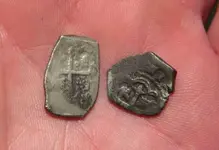
The site I dug them three at was a wierd site as it was small in size and had odd finds compared to the other old colonial sites I've dug.Not the normal type colonial British items you would expect for here.I think it had some spanish influence in it at one time for sure.These two cobs came from it as well.Attachments
Upvote
0
timekiller
Silver Member
- Joined
- Feb 10, 2009
- Messages
- 3,853
- Reaction score
- 966
- Golden Thread
- 1
- Location
- Morehead City / Newport NC
- 🥇 Banner finds
- 1
- Detector(s) used
- Minelab E-Trac
- Primary Interest:
- All Treasure Hunting
Not sure how his got to Mass if that is were he's from.It would be nice to go back in time to see how things were.  But I can't help to feel like these guy's had to bump in to one another at trading ports and such along the way.Much like fisherman of today with scallopers up north,shimpers south,long liners,lobster potters,clamers,ETC.We all bump in to each other from time to time at different ports.You also through pirates in the mix and I can see things getting mixed up and strone all up and down the seaboard.I don't know all the answers but it is FUN to think about!
  Maybe it's alot like how civil war buttons and buckles show up on the west coast!
But I can't help to feel like these guy's had to bump in to one another at trading ports and such along the way.Much like fisherman of today with scallopers up north,shimpers south,long liners,lobster potters,clamers,ETC.We all bump in to each other from time to time at different ports.You also through pirates in the mix and I can see things getting mixed up and strone all up and down the seaboard.I don't know all the answers but it is FUN to think about! Maybe it's alot like how civil war buttons and buckles show up on the west coast!
Upvote
0





Featured Treasure Finds
Featured Treasure Finds
Similar threads

- Replies
- 8
- Views
- 742


- Question
- Replies
- 5
- Views
- 412

Users who are viewing this thread
Total: 1 (members: 0, guests: 1)















