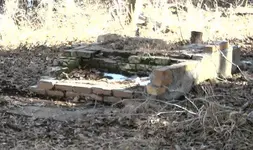
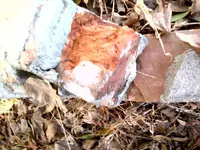
Judging from the look of the mortar joints and the 3/4 & 1/2 usage on the corners I would have to go along with the earlie 1900 est.
The real old masonry used course sand and lime mix which dried out and you could scrape it out easily. The bricks are hard to tell without seeing in person.
Bricks were brought over in the early sailing ships as ballast weight and swapped out for stones on the return trip. Some "imported" bricks will set off a detector because they contain bauxite, a clay with traces of aluminum. This is usually only present in "imported" bricks. Also standard USA bricks are 2x4x8".
Hope this helps, Frank
I also found stacked stone made with small river pebbles in the mortar, on the property. They probable got it right out of the river, 150 feet from the house.
The mortar for stone is thicker. Fine gravel is commonly used. This is because the voids in stonework are much larger. I have seen cut stone laid up dry.
The key to telling age is the binder in the mooter. If it turns to powder or can be easily scraped out ,it is old.
It's not as easy as telling the age of a structure by the plaster.
Very old--lathe boards spread with plaster with horse hair mixed in.
old-- Metal lathe with a brown coat then a white plaster coat.
current---Ta Da, Sheetrock!
Frank
First thing I look at when dating brick is how large and how sharp the corners of the brick as a general rule of thumb. I notice the older the brick, the larger, cruder, and roundish cornered it has a tendency to be. Another thing is that older bricks have a tendency to be a little softer/chalkier.
I certainly don't let more modern looking brick stop me from detecting a site, you never know what was there before the structure.
I have layed bricks for a couple of years so I have handled many. The hard bricks have sharper edges than the soft bricks. The light bricks like the salmon color are softer than the dark red bricks. When you look at a brick wall, the darker bricks are harder because they have been baked longer. They do not get softer. The size of the bricks has been standard for a long time,2"x4"x8". That size is not actually the size of the brick, it is the size of the brick and a 1/4" joint. There are custom size bricks. I have put 12" long bricks in place. There are fire or refractory bricks that are used in the back of fireplaces. They are a light tan. There are many "fancy" style bricks like little English brickettes. The list is endless. Frank
No doubt about that. Especially since the site is on a river there's a good chance it was inhabited some time before the brickwork was done. Rivers and tributaries = old sites. Work the site and it's perimeter for a few months and you should be able to get a pretty good idea of just how old it is.
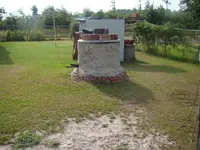
That has to be the worst brick work that I have ever seen. No wonder they parged the top area. Looks like the ground sank around the base exposing it again.