
You are using an out of date browser. It may not display this or other websites correctly.
You should upgrade or use an alternative browser.
You should upgrade or use an alternative browser.
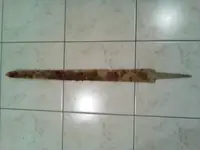
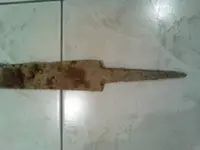
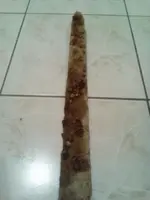
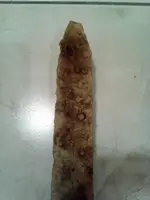
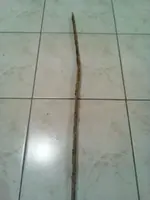
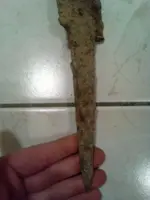
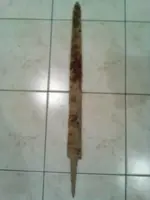
If not a sword,dont know what it is...
- Thread starter limenka
- Start date
StormSurge
Sr. Member
- Joined
- Oct 6, 2011
- Messages
- 400
- Reaction score
- 173
- Golden Thread
- 0
- Location
- S E Virginia
- Primary Interest:
- All Treasure Hunting
Defiantly not a file. Carbon steel does not bend and if one was made that long, I've never seen one, it would have a tang for a handle on both ends.

limenka
Jr. Member
- Joined
- Dec 14, 2014
- Messages
- 34
- Reaction score
- 26
- Golden Thread
- 0
- Primary Interest:
- All Treasure Hunting
- #22
Thread Owner
Thank you all,yes europe if full of long and undiscovered history,i am one of those who does not have a map or dont know what happend where i go and every time is a suprise,but this one is just wow!If i know where i am going and i know what can i find and i dont find it i am sad but i just enter the forest and what i find i am happy,whell if you all like those photos then i have a lot to show to you from previus find's  you are all welcome to come,a place to stay,sleep,no problem,greetings from Croatia!!
you are all welcome to come,a place to stay,sleep,no problem,greetings from Croatia!!

CRUSADER
Emerald Member
Theres a hole in my collections, nice find, I'm going to assume 14th C, but I have little knowledge in these.

Plumbata
Bronze Member
Definitely does not look like a file. It does not appear to be like the typical Roman Gladius you linked to either, but more like a Spatha, an Iron Age slashing sword used by Romans and their Auxiliary units as well as many Celtic/native peoples all over Europe through the early Medieval period. It doesn't look Viking to me (not sure if they were active in the area you found it anyway) so I'd wager it's from ~AD 500 or earlier. Many Celtic peoples ritually "sacrificed" swords and spears by bending them (and then burning/burying/casting them into bodies of water) in exchange for helpful divine interventions, but usually such ritual pieces were fancy, whereas this piece seems more utilitarian so the bend in the blade probably wasn't intentional.
So yes, it seems that you found an Iron Age Celtic/Roman/Slavic sword. Congratulations, it is an excellent find and would probably fetch 500 USD or more if auctioned. Thanks for sharing your special find!
So yes, it seems that you found an Iron Age Celtic/Roman/Slavic sword. Congratulations, it is an excellent find and would probably fetch 500 USD or more if auctioned. Thanks for sharing your special find!
limenka
Jr. Member
- Joined
- Dec 14, 2014
- Messages
- 34
- Reaction score
- 26
- Golden Thread
- 0
- Primary Interest:
- All Treasure Hunting
- #26
Thread Owner
Thank you for the info,well around here MD is not legal but so little people do it that the police and others dont know what it is or can do and stuff,so if i show it to someone the next day i am in te media(100%) an the sword is not mine anymore becuse the law is that everything underground is from the state so....dont know what to do with it now,selling is option def. But need to find people that can tell me more when they see it with their own eys and then tell me the value
Plumbata
Bronze Member
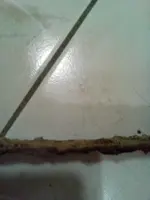
Can you tell if the sword has a fuller (groove) running the length of the blade on either side? I also wonder if the sword had a Pommel at the end of the handle which may have rusted off and been left in the hole where you dug it? Pommels are very helpful for identifying and dating ancient or medieval swords.
Also, regarding the legal grey area, many antiquities excavated in Bulgaria and the wider Balkan region are claimed to be "from an old collection" when they are sold, which might be a loophole they use to traffic recently-excavated antiquities by suggesting that the items were excavated before the laws were passed, which is hard to prove either way. I'm not recommending that you do anything illegal, but I also don't think it's fair that the state can claim ownership of everything you might dig up. Many antiquities from your part of Europe get sent to dealers in Germany and the Netherlands who then say they are "from an old German collection" and sell them on internet auctions all across the world. If this sword was to be sold in this manner, I would expect it to get a price between 500 and 1,000 USD.
Because Viking antiquities are in high demand right now, many sellers claim that swords, spearheads, etc of uncertain Medieval origin are Viking to get more money. Likewise, ancient Roman items are in higher demand than Celtic items, so because a basic spatha (broadsword) used by the Romans versus one used by the Natives would be very similar in appearance, such dealers might call an uncertain Iron Age sword an "Ancient Roman Spatha" to get a higher price. I am very far from an expert, but collecting iron artifacts is a hobby of mine so I've seen how the market works over the past 15 years or so.
Anyway, it is a lovely discovery, and if it were my find I'd keep it forever! Please share some of your other discoveries, ancient European metal artifacts are a favorite of mine.
Also, regarding the legal grey area, many antiquities excavated in Bulgaria and the wider Balkan region are claimed to be "from an old collection" when they are sold, which might be a loophole they use to traffic recently-excavated antiquities by suggesting that the items were excavated before the laws were passed, which is hard to prove either way. I'm not recommending that you do anything illegal, but I also don't think it's fair that the state can claim ownership of everything you might dig up. Many antiquities from your part of Europe get sent to dealers in Germany and the Netherlands who then say they are "from an old German collection" and sell them on internet auctions all across the world. If this sword was to be sold in this manner, I would expect it to get a price between 500 and 1,000 USD.
Because Viking antiquities are in high demand right now, many sellers claim that swords, spearheads, etc of uncertain Medieval origin are Viking to get more money. Likewise, ancient Roman items are in higher demand than Celtic items, so because a basic spatha (broadsword) used by the Romans versus one used by the Natives would be very similar in appearance, such dealers might call an uncertain Iron Age sword an "Ancient Roman Spatha" to get a higher price. I am very far from an expert, but collecting iron artifacts is a hobby of mine so I've seen how the market works over the past 15 years or so.
Anyway, it is a lovely discovery, and if it were my find I'd keep it forever!
Please share some of your other discoveries, ancient European metal artifacts are a favorite of mine.
limenka
Jr. Member
- Joined
- Dec 14, 2014
- Messages
- 34
- Reaction score
- 26
- Golden Thread
- 0
- Primary Interest:
- All Treasure Hunting
- #28
Thread Owner
Thank you also for the info,i am 0 in this,but next i can show you is not that old,it's ww2 mostly German....but that's another subject,so far this i i think a mega discovery(for me def.) And i dont care for money so much,just wanna know how old is it and what century is it,as i can see it is not simple....
limenka
Jr. Member
- Joined
- Dec 14, 2014
- Messages
- 34
- Reaction score
- 26
- Golden Thread
- 0
- Primary Interest:
- All Treasure Hunting
- #29
Thread Owner
No fuller as i can see and sorry but i did not see but must say didnt even checked for the pommel,it was just ground on it everywhere and it was near threes so roots all over it....did not pulled him out easily


Lord Verdigris
Silver Member
- Joined
- Feb 8, 2014
- Messages
- 3,936
- Reaction score
- 9,275
- Golden Thread
- 2
- Location
- East coast Canada
- 🥇 Banner finds
- 2
- Detector(s) used
- Minelab equinox 800, Fisher F75 Ltd SE 2 & Fisher F2 with 11"DD
- Primary Interest:
- Metal Detecting

limenka
Jr. Member
- Joined
- Dec 14, 2014
- Messages
- 34
- Reaction score
- 26
- Golden Thread
- 0
- Primary Interest:
- All Treasure Hunting
- #32
Thread Owner
Dont think i am going to do that or even anything else,it's not a old car so that it needs to be restored,this belongs in the museum,need to find the right people to make a possible value and to if possible detirmine how old it is,theese day's you dont find sword's around so i think other people would like to see it also so museum!!this site is awesome and thank you all for your time and help

ARC
Emerald Member
- Joined
- Aug 19, 2014
- Messages
- 40,567
- Reaction score
- 151,010
- Golden Thread
- 0
- Location
- Tarpon Springs
- Detector(s) used
- JW 8X-ML X2-VP 585
- Primary Interest:
- All Treasure Hunting
Tis not a file... tis a broad sword... would return immediately and search entire area as soon as possible thoroughly for the rest of it.
limenka
Jr. Member
- Joined
- Dec 14, 2014
- Messages
- 34
- Reaction score
- 26
- Golden Thread
- 0
- Primary Interest:
- All Treasure Hunting
- #34
Thread Owner
Hmm...there is a little problem with finding that place again  well after the find i got lost in the forest and believe me she is a big one,it is autumn(fall) and everything looks the same wherever i go and the forest is not flat,it's full of hills and ups and down wherever you look,tok me an 1h to find and exit and was nat happy,a lot of nasty animals in there so...but i am 70% sure where it was and searched a part of that place and found only those strange little rocks(maybe coins) there is a topic for them also!I am just about to buy a new detector to replace wonder ace250 so be expecting more from that place but not going back alone that''s 100%
well after the find i got lost in the forest and believe me she is a big one,it is autumn(fall) and everything looks the same wherever i go and the forest is not flat,it's full of hills and ups and down wherever you look,tok me an 1h to find and exit and was nat happy,a lot of nasty animals in there so...but i am 70% sure where it was and searched a part of that place and found only those strange little rocks(maybe coins) there is a topic for them also!I am just about to buy a new detector to replace wonder ace250 so be expecting more from that place but not going back alone that''s 100%
Lord Verdigris
Silver Member
- Joined
- Feb 8, 2014
- Messages
- 3,936
- Reaction score
- 9,275
- Golden Thread
- 2
- Location
- East coast Canada
- 🥇 Banner finds
- 2
- Detector(s) used
- Minelab equinox 800, Fisher F75 Ltd SE 2 & Fisher F2 with 11"DD
- Primary Interest:
- Metal Detecting
Hmm...there is a little problem with finding that place again
At least you got a sword to take back with you for protection next time! Just joking!
ARC
Emerald Member
- Joined
- Aug 19, 2014
- Messages
- 40,567
- Reaction score
- 151,010
- Golden Thread
- 0
- Location
- Tarpon Springs
- Detector(s) used
- JW 8X-ML X2-VP 585
- Primary Interest:
- All Treasure Hunting
If it were me... I wouldn't care if I could find even near that exact place again... I would be in snow, sleet, rain, fog, under water, above water, below ground,,, from a damn plane....whatever.
Return... and hunt like hell anyway. These types of finds can lead to either something OR nothing at all.
Could be a friggin cheap store bought repop that some kids 20 years ago lost in there "imaginary battle"... OR ?
Just a find ?
OR a REAL find... involving the "imaginary kid battle" only the sword used by them was not a cheapo repo but a complete authentic broad sword some kids took from grandpas home collection worth ?
OR better ? could be a relic from god knows what... and just the beginning of a major find...
Heck I could do this "" all day...
But l would much rather be hunting the spot.... AREA .... nearby area... anywhere close... "somewhere over there" ... in that square mile...to where you found this.
May be "just a find"... OR ? let your imagination work you up enough to go try to relocate that area. sheesh "nearby" CAN and does payoff MANY times.
Return... and hunt like hell anyway. These types of finds can lead to either something OR nothing at all.
Could be a friggin cheap store bought repop that some kids 20 years ago lost in there "imaginary battle"... OR ?
Just a find ?
OR a REAL find... involving the "imaginary kid battle" only the sword used by them was not a cheapo repo but a complete authentic broad sword some kids took from grandpas home collection worth ?
OR better ? could be a relic from god knows what... and just the beginning of a major find...
Heck I could do this "" all day...
But l would much rather be hunting the spot.... AREA .... nearby area... anywhere close... "somewhere over there" ... in that square mile...to where you found this.
May be "just a find"... OR ? let your imagination work you up enough to go try to relocate that area. sheesh "nearby" CAN and does payoff MANY times.
limenka
Jr. Member
- Joined
- Dec 14, 2014
- Messages
- 34
- Reaction score
- 26
- Golden Thread
- 0
- Primary Interest:
- All Treasure Hunting
- #37
Thread Owner
Hehe no worries i know nobody around here that has a MD and only i know where it was,it's a that forest in what you dont get in,cuz you know there is nothing there,people enter that forest for shrooms&stuff but not that deep,i go where there is no path,pure history old as i dont know what no junk,no pulltabs,when it rings you know you got something nice,and it does not ring often,maybe 5-10 times in 2-3h
no junk,no pulltabs,when it rings you know you got something nice,and it does not ring often,maybe 5-10 times in 2-3h
Talon
Hero Member
Hmm...there is a little problem with finding that place again
You need a compass! Figure out where the main roads are on either side of the forest and you can at least take a bearing and head towards the road to get back! Great find by the way!

- Joined
- Jan 4, 2011
- Messages
- 303
- Reaction score
- 339
- Golden Thread
- 0
- Location
- Cajun Country
- Detector(s) used
- Equinox 800,
Garrett Pro Pointer
- Primary Interest:
- Metal Detecting
I carry an inexpensive GPS when I go off the beaten path just for marking waypoints. I still use a compass and topo map for real navigation, but the GPS will get me back within 100ft² or so of my mark.


Featured Treasure Finds
Featured Treasure Finds
Similar threads


- Replies
- 24
- Views
- 1K

- Replies
- 41
- Views
- 3K
Users who are viewing this thread
Total: 1 (members: 0, guests: 1)















