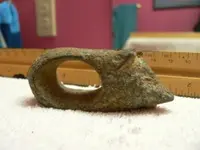
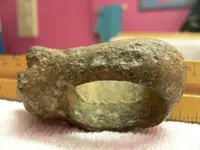
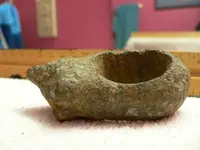
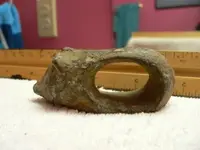
Mr. E. A. Lane, Keeper of the Department of Ceramics, Victoria and Albert Museum, writes: "The earliest reference to napkin-rings given in the New English Dictionary is 1839, and our Metalwork Department say that they can find no record of metal rings having been made before that date. It seems likely therefore that napkin rings were introduced in this country [England] in about the 1830s."
The DuPont Winterthur Museum mentions: "A glance at the Oxford English Dictionary reveals no reference to rings before 1839, and no reference to materials other than ivory (1860)." This museum also states: "The Encyclopedia of Domestic Economy (New York, 1845) which lists `the usual articles in silver required to furnish the table' . . . does not mention napkin rings. No mention of them is made in the listing of duties of various members of the household staff." Mrs. Kathryn Buhler, Boston Museum of Fine Arts, finds that in colonial times in New England: "In the inventory of Thomas Thacher (Suffolk Probate Court, Boston) in 1678, his plate included `& a napkin hooke.' In no other inventories have I chanced upon a similar silver piece."
Mrs. Duncan of Colonial Williamsburg Museum states: "The Williamsburg collection does not have a napkin ring in its collection. As far as I know there is no reference to them in our inventories nor are they advertised for sale in the 18th century Virginia Gazette published in Williamsburg."
One is inclined to believe that the napkin ring in the United States was employed during the latter part of the 19th century, possibly an influence of the Victorian age. Gibb, in his Harvard study, The White-Smiths of Taunton: A History of Reed and Barton, 1824-1943, reproduces the "Prices of Ware: Earliest Known Company Price List, 1837," reporting prices on over 20 items; no mention is made of napkin rings. Moreover, his table of "Sales by Product, September 1-October 20, 1857 for Plated Wares and Unplated Wares," mentions over 30 products; again no mention of napkin rings.
However, from the company's "Order Book, 1865-66," he shows that: "In 1865 Rogers and Brothers was one of the largest company customers, ordering 416 baskets, 32 pitchers, 37 fruit baskets, 25 vases, 38 syrups, 184 caster frames, 103 butter dishes, 28 urns, 307 goblets, 24 card stands, 131 napkin rings, 104 cups, 70 tea sets, and a large number of other items."
Thus, for the first time, napkin rings are mentioned.
Freeman and Beaumont, in Early American Plated Silver, claim: "The first patent for napkin rings was granted in 1869, and many subsequent design patents were registered until the early 1900s. Then the celluloid ring came into favor, all but eclipsing the silver type."
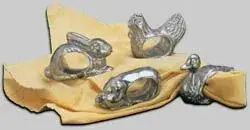
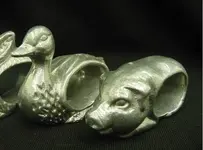
The Historical Research Library, The International Silver Company, a merger of early silversmiths in that area, reports: "We have looked back to our earliest catalogs dated 1853 and 1855 and there were no napkin rings listed at that time. Our next catalog is dated 1860 and there are three styles listed but not illustrated. These three were Oval, Concave, and Octagon, and they could be purchased plain or engraved. In 1871, the rings were still just plain bands, but by 1879 the era of very fancy napkin rings had set in and this period lasted until the 1890s. There were not only individual napkin rings but the rings were made in combination with other pieces such as a vase, butter dishes, or salts and peppers. Birds, animals and children were all very fashionable and the rings of this period were all very elaborate; many people have a hobby of collecting them."
Dauterman of the New York Metropolitan Museum of Art, a leading authority on antiques, writes in his Answer Box in the April 11, 1958 issue of the New York World-Telegram and Sun: "The history of napkin rings is one of the neglected areas of research among things collectible. Most napkin rings we have seen derive from the late years of the 19th century, when the designers of silver plate were having a spree."
As for cut glass napkin rings, it would seem they appeared late in the 19th century when cut glass was much in vogue. On the other hand, Daniel's excellent book, Cut and Engraved Glass, shows a photo of a cut glass napkin ring "probably made from Robinson glass by Eichbaum," who was a famous early Pittsburgh cutter around 1810.
The use of napkin rings was revived by some persons in the White House during the Eisenhower Administration as revealed by the Washington (D.C.) Sunday Star in its February 22, 1959 issue: "Although the Navy 'mess' at the White House was long for `men only,' it is now open to three women staff members. . . . Regulars at the `mess' have their own napkin rings, too, with their name in gold letters."
The convenience of paper napkins may be cited as the chief reason for the decline of napkin rings in private homes and boarding schools.
While it is beyond the scope of this study to trace the origin and development of table napkins, it may, be of some historical interest to record the brief statement of Good Housekeeping in their issue of December 1956: "The first table napkin made its appearance in Reims, France, in the court of Charles VII. From the beginning of the fifteenth century, napkins were a luxury, lace-trimmed and elaborately embroidered. They were used exclusively in the palaces of kings and princes. Later, in the seventeenth century, they began to play an important decorative part in table setting-folded and pleated to represent birds, flowers, and the like.