What's new

My First Gold Ring with Garrett ATX

Steve Herschbach

Hero Member
Joined
Apr 1, 2005
Messages
659
Reaction score
1,017
Golden Thread
0
Location
Nevada
Primary Interest:
Metal Detecting
Hi,

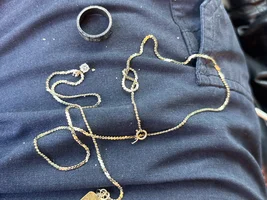
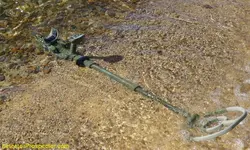
I have been using a new Garrett ATX a few days now. As part of that I went wading at Lake Tahoe testing how the detector handles black sands and hot rocks. No issues at all to report there, the ATX just ground balanced it all out and made no sound unless a target was under the coil. I got my first gold ring in the process, 14K with five little 1/10th carat diamonds.

atx04.webp

The depth of the ring was nothing exceptional, just a scoop deep. I got a handful of change and when hunting the dry beach, typical beach trash and a couple earrings, cheap jewelry type. Nothing momentous to report. The ATX ran clean as can be with no issues. It is an exceptionally well behaved detector, far more refined than the Infinium. Needless to say I was real happy getting a nice ring on my first water outing with it!
atx01.webp
 
Upvote 0

Congrats on your first gold ring Steve! :icon_thumright:
 
Well, far from my first gold ring I guess, that was back in the 1970s! But first with the ATX and a pretty nice one at that. Thanks Terry. Hope you are getting out and having some fun. I sure am glad I am not in Alaska now as I would be done detecting for the year. Never have to stop now except to catch my breath!
 
Hey, Steve. Could you explain a little bit about the "iron check" & "Disc" features on this machine, capabilities, limits, etc. And, have you had any time to do any kind of testing with it? Thanks!
 
Iron check is what Im interested in too.
 
The Iron Check is a simple push button control. You get a target. Then engage the iron check, and if as you wave over the target you get a low growling tone it is ferrous. The catch like all PI ferrous id systems so far it only works at maybe half of the full depth of the ATX. So it is great for shallow surface trash, but useless for deep stuff. Which is where I need it most. But at least it does eliminate some stuff. It also is geared on the safe side, and so will call some ferrous stuff good even at shallow depths as opposed to calling some gold ferrous.

The so-called discrimination is nothing more than the pulse delay. Garrett for ages on PI units has called this a discrimination control. It is not - it is a PI pulse delay control. As you increase the pulse delay, low conductive targets drop out. In theory according to Garrett if you advance the pulse delay and the target remains, it is probably trash. The ones that disappear are supposedly more likely to be good. "Reverse Discrimination". Well, yeah, sort of, maybe. If hunting gold nuggets this would cause a large gold nugget to be passed up as being a trash target. Or in the case of jewelry, a large ring. Very similar to the idea of rejecting high VDI targets as probably being coins and digging low VDI targets only with a VLF. Still, it is a tool, and between the tones, the Iron Check, and the Reverse Discrimination you get at least some ability to pick and choose targets. Note that on the ATX the pulse delay is not easily set and reset so it is not very practical to use it to spot check individual targets. More likely advancing it could be used to eliminate really small trash like aluminum bits/can slaw if it was a problem. But more pulse delay also means less overall sensitivity to low conductive targets.

When talking to people unfamiliar with PI detectors I insist as referring to them as all metal dig everything machines. Building any expectations they can be used like a VLF almost always leads to disappointment. I usually dig everything or at most employ the tones if I get choosy. When nugget detecting hi-lo is most gold and lo-hi large ferrous. Kind of sorta mostly but it will bite you if you get too lazy! Anyway I would rather have people say I said it is dig it all then nobody gets mad at me. If you buy a PI and get good reading targets that is like a bonus. That said the ATX has a lot of tricks it can play compared to a straight up non-ground balancing PI.
 
Last edited:
The Iron Check is a simple push button control. You get a target. Then engage the iron check, and if as you wave over the target you get a low growling tone it is ferrous. The catch like all PI ferrous id systems so far it only works at maybe half of the full depth of the ATX. So it is great for shallow surface trash, but useless for deep stuff. Which is where I need it most. But at least it does eliminate some stuff. It also is geared on the safe side, and so will call some ferrous stuff good even at shallow depths as opposed to calling some gold ferrous.

The so-called discrimination is nothing more than the pulse delay. Garrett for ages on PI units has called this a discrimination control. It is not - it is a PI pulse delay control. As you increase the pulse delay, low conductive targets drop out. In theory according to Garrett if you advance the pulse delay and the target remains, it is probably trash. The ones that disappear are supposedly more likely to be good. "Reverse Discrimination". Well, yeah, sort of, maybe. If hunting gold nuggets this would cause a large gold nugget to be passed up as being a trash target. Or in the case of jewelry, a large ring. Very similar to the idea of rejecting high VDI targets as probably being coins and digging low VDI targets only with a VLF. Still, it is a tool, and between the tones, the Iron Check, and the Reverse Discrimination you get at least some ability to pick and chose targets. Note that on the ATX the pulse delay is not easily set and reset so it is not very practical to use it to spot check individual targets. More likely advancing it could be used to eliminate really small trash like aluminum bits/can slaw if it was a problem. But more pulse delay also means less overall sensitivity to low conductive targets.

When talking to people unfamiliar with PI detectors I insist as referring to them as all metal dig everything machines. Building any expectations they can be used like a VLF almost always leads to disappointment. I usually dig everything or at most employ the tones if I get choosy. When nugget detecting hi-lo is most gold and lo-hi large ferrous. Kind of sorta mostly but it will bite you if you get too lazy! Anyway I would rather have people say I said it is dig it all then nobody gets mad at me. If you buy a PI and get good reading targets that is like a bonus. That said the ATX has a lot of tricks it can play compared to a straight up non-ground balancing PI.
Great info...thanks.
 
That's a beautiful gold ring find, Steve.:wav:

Congratulations on that find!


Lorraine
 
Congrats! :hello2::hello2::hello2:

That's a nice ring.

Steve: I'm slowly getting interested in the ATX ..how does it compare to the TDI? I'm looking to do wet beach sand 90% and gold fields 10%. What do you think?

I've been amazingly successful with my Dual Field and I'm thinking of maybe being even more successful with an ATX.
 
I have a TDI. Honestly, if you do not need waterproof I do not know that you need an ATX if you have a TDI. The ATX is slightly more sensitive and has a cleaner threshold. It also weighs over a pound more than the TDI, plus you can hip mount the TDI. The ATX does have a real nice feature in the iron check for some shallow ferrous targets. But I find the weight off-putting for dry land use.

For me it is all about the waterproof. The machines are close performance wise though I give the nod to the ATX. If you are happy with your TDI and do not need waterproof I cannot in good faith say you need to ditch your TDI. I thought I might sell my TDI now that I have the ATX but now I think I will hold onto it, at least for now. Up on the beach I like running it hip mounted. I will need more time running both to see how it rolls. Eventually maybe the TDI will stay at home but not yet.

Besides, you say you have been amazingly successful with the TDI. Don't mess with success! Unless you want to be cash poor and detector rich like me.
 
Nice ring, Steve. You got the ATX broken in right. How do you tell the carat size of diamonds, besides experience?
 
Good review Steve but where is the Beef!
By this I mean what are the tricks?
How do I justify such an expensive PI?

The Iron Check is a simple push button control. You get a target. Then engage the iron check, and if as you wave over the target you get a low growling tone it is ferrous. The catch like all PI ferrous id systems so far it only works at maybe half of the full depth of the ATX. So it is great for shallow surface trash, but useless for deep stuff. Which is where I need it most. But at least it does eliminate some stuff. It also is geared on the safe side, and so will call some ferrous stuff good even at shallow depths as opposed to calling some gold ferrous.

The so-called discrimination is nothing more than the pulse delay. Garrett for ages on PI units has called this a discrimination control. It is not - it is a PI pulse delay control. As you increase the pulse delay, low conductive targets drop out. In theory according to Garrett if you advance the pulse delay and the target remains, it is probably trash. The ones that disappear are supposedly more likely to be good. "Reverse Discrimination". Well, yeah, sort of, maybe. If hunting gold nuggets this would cause a large gold nugget to be passed up as being a trash target. Or in the case of jewelry, a large ring. Very similar to the idea of rejecting high VDI targets as probably being coins and digging low VDI targets only with a VLF. Still, it is a tool, and between the tones, the Iron Check, and the Reverse Discrimination you get at least some ability to pick and choose targets. Note that on the ATX the pulse delay is not easily set and reset so it is not very practical to use it to spot check individual targets. More likely advancing it could be used to eliminate really small trash like aluminum bits/can slaw if it was a problem. But more pulse delay also means less overall sensitivity to low conductive targets.

When talking to people unfamiliar with PI detectors I insist as referring to them as all metal dig everything machines. Building any expectations they can be used like a VLF almost always leads to disappointment. I usually dig everything or at most employ the tones if I get choosy. When nugget detecting hi-lo is most gold and lo-hi large ferrous. Kind of sorta mostly but it will bite you if you get too lazy! Anyway I would rather have people say I said it is dig it all then nobody gets mad at me. If you buy a PI and get good reading targets that is like a bonus. That said the ATX has a lot of tricks it can play compared to a straight up non-ground balancing PI.
 
Good review Steve but where is the Beef!
By this I mean what are the tricks?
How do I justify such an expensive PI?

Not sure how you do it. I have a lot of money invested in metal detecting equipment, but it pales in comparison to the RVs and ATVs my friends seem to have. Everybody has all these really expensive toys, or so it seems to me. All I have is a bunch of metal detectors. And mine pay for themselves so in a manner of speaking they do not cost me anything at all. My buddies can't say that about those fuel sucking land barges they drive!

I just put a new page up on my website at Garrett ATX Waterproof Pulse Induction Metal Detector with lots of information that might help. I am not a dealer or trying to sell anyone on the ATX. All I care about is I got mine. I love yakking detectors though so if you have a specific question fire away.
 
Thanks for that link, Steve. Hope you find enough great stuff to pay for the ATX soon.
Sandman, hope you're making a full recovery and feeling better. Glad you are posting again.
 
WTG Congrats on your first gold ring
 
Thank you for all the info on the ATX! Congrats on the gold ring!
HH!
 
I know this is an older post and hopefully there are more answers. How does the 20" coil do on the beach with gold rings? anybody using it successfully?
 

Users who are viewing this thread

Latest Discussions

Back
Top Bottom