What's new

Palmer Point

rock

Gold Member
Joined
Aug 25, 2012
Messages
14,751
Reaction score
8,933
Golden Thread
0
Location
South
Detector(s) used
Coin Finder
Primary Interest:
All Treasure Hunting
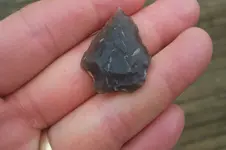
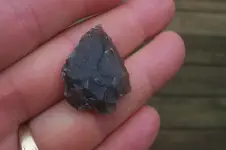
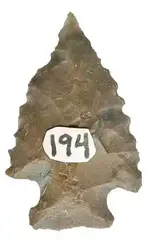
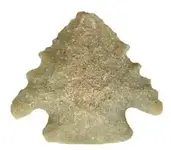
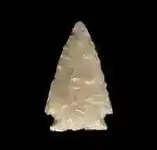
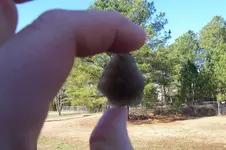
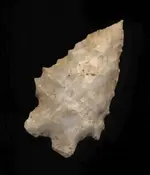
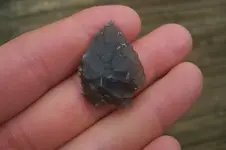
Well I finally got the I.D. on this one. Its Early Archaic and is called a Palmer. Its a corner notched point. Just wanted to give a update.
Dates 9500-8000 B.P.
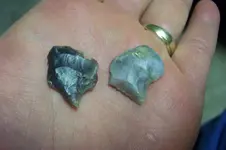
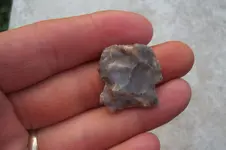
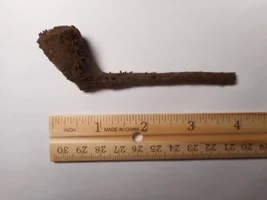
I added the Gravers to the pic with the Blunt to show the flaking. They look to of been made by the same person.
 

Attachments
  • 100_2906.webp
    100_2906.webp
    120.1 KB · Views: 165
  • 100_2905.webp
    100_2905.webp
    127.4 KB · Views: 178
  • 100_2904.webp
    100_2904.webp
    121.8 KB · Views: 174
  • 100_2552.webp
    100_2552.webp
    190.5 KB · Views: 165
  • 100_2724.webp
    100_2724.webp
    124.9 KB · Views: 160
Last edited:
Upvote 0
Every Palmer I've ever seen was serrated ..alot are deeply serrated. Also all have ground or substantially thinned bases. Almost positive that's not a Palmer.
 
Looks like some nice material that point is made from. The hinge fractures appear to be abundant and fresh, like they often do on authentic Knife River Flint pieces.

Whats the material?

Joel
 
Palmer points have deeply barbed ears. I'm curious about that material also..looks different than Georgia material I've seen.
Here is a couple Palmer points

palmer194w.webp


palmer232w.webp
 
Here is a Brewerton from Georgia.

BrewertonCorner.webp
 
The little legs have been re chipped off just like this one I found probably 100 ft away. I will add the photo to the top.
@ quito, it was found in a field where the plow has it hit a few times or more.
 
Is the base ground??
 
Is the base ground??

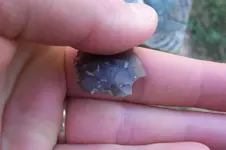
When you say ground ( you know I am still learning) does that mean flaked? It has the same shape as the sides kinda worked down to a thin edge. But shows flaking to get it to that point. Well all the pics I took came out blurry. I will try tomorrow maybe better luck then. The material is translucent.
 
No.. grinding is something that was done on early points to help prevent the cordage or sinew from being cut by the sharp edges of the base of a point. Its a tell tale trait of paleo and transitioned into early archaic points. If you look up Palmer and actually read a description of the point it will be described as a trait of that type. It was the grinding down of the sharp edges on the base of a point usually up the sides and into the notches on a point of that style... simply put "dulled"
Please use the link... I know you're still learning so am I... That link gives a good description. There's a lot more To typing a point Than the general shape.
 
Last edited:
See if this helps any to tell.
 

Attachments

  • 100_2922.webp
    100_2922.webp
    117.2 KB · Views: 120
  • 100_2927.webp
    100_2927.webp
    375.8 KB · Views: 138
There are still hinge fractures so no its not ground.
That also gave a much clearer view of the base..which is bifurcated.
That looks much more like a bifurcated Kirk than anything else. IMHO. It's considered a notched expanding stem point and not a corner notched point. And is still a very old type from the early archaic.
 
Last edited:
Second pic down from the numbered point (194) looks like a serrated kirk to me. This type was the first point I ever found, so you can guess I asked all the long time collectors their opinions to correctly id it. Love the material you are finding..
 
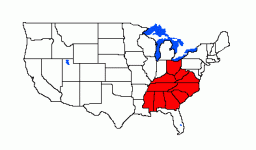
9000-7000 B.P. and that also is close to the Pickwick which is 6000-3000 B.P. according to Ga point I.D. So I would guess probably they are dated around 6000 B.P. cause I found them together. Which is the same time period for the Morrow Mountain base I found in the same close area. So as for dating the finds from that spot I would say 6000 B.P. in that part of the field anyway.
 
You're on a real good spot.. I'm happy for you. Good luck.
 

Users who are viewing this thread

Latest Discussions

Back
Top Bottom