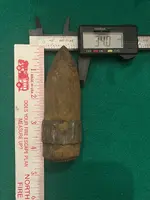
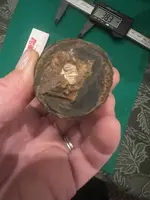
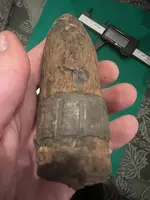
After the St. Petersburg Declaration of 1868, which sought to ban the use of explosive small arms bullets, most European armies settled on 37mm in diameter and 400 grams or 14 ounces in weight as the smallest explosive projectile allowable. Almost every country in Europe, as well as commercial manufacturers such as Hotchkiss, used 37 mm as their standard for light guns. It is easy enough to identify a 37mm 1 pound projectile when accompanied by its brass case but hard to identify when it is not. Perhaps the best way to tell whether a projectile was made for or used in a single-barreled or five-barreled Hotchkiss 1 pounder, a Maxim-Nordenfelt 1 pounder machine gun, a British 1 pounder Pom Pom or any of the many varieties of 1 pounder used in the late 19th / early 20th century is to look at the number and size of the driving bands. I have observed, for example, that projectiles identifiable as Pom Pom rounds by the head stamps on their cases usually have three narrow copper bands, while cases identifiable as for the French M1916 are fitted with projectiles having one wide band which is still narrower than the band on Hotchkiss projectiles. As the projectile in question has the medium wide band, and assuming that a round used by US forces would be more likely to turn up in New England than one that was not, I believe that it is the French M1916 bottom-fused projectile. However, I am not so sure that I would bet my life on it.