What's new

Researching history of your local towns

qdp diggers

Full Member
Joined
May 17, 2017
Messages
105
Reaction score
254
Golden Thread
0
Location
Rochester ny
Detector(s) used
At pro
Primary Interest:
All Treasure Hunting
Anyone have any quick internet tips for researching local town in your general area for old homesites etc... vacant properties . I'm new to the hobby and just wondering how to find old places ?

Sent from my SM-N920V using TreasureNet.com mobile app
 
Start with historicaerials.net. see if you have a local historical society. Search Google for historic maps of your area. Your local courthouse may have information as well.

Sent from my XT1650 using Tapatalk
 
Contact your county's historian. Usually you can locate that person by inquiring at your local library's Reference Desk.Also ask your Q. at the Ref. Desk.
Don.....
 
The best way to research your local area is not through the internet but with your eyes, ears and feet.
 
Your local library should have info of interest, but much of it may not be eligible to be signed out, you may have to read it there and if you need some of it, maybe you can make a copy.
 
Talk with the old folks in town. They tend to be more accurate and reliable than the internet at least in my experience. You can also try to find historical maps of your town these can be located on the internet sometimes.

HH, RN
 
If already broached pls disregard.
For just sittin on your butt, no legwork I find your states' historical almanac, Tx refers to it as a 'historical handbook' is hard to beat. It'll keep you from goin off 1/2 cocked. Knowin how many times your physical residence has been in a diff county is sorta crucial when lookin 4 stuff whether at the courthouse or www. My place changed counties 3 times as it evolved,still looks the same as it did in 1850. My farm was once part of a community of immigrants known as Brushy Knob, highest ele. in the county. So, it was favored by natives for a lookout, due to elevation a river cobble is an artifact layin on the ground or in a leather pouch carved like a buffalo. All kinds of info as to schools, fraternal orders,cotton gins,skirmishes civil or un. can generally be found all condensed from myriad official state records. Check out .gov
 
Two things.... Look through the large book stores by entering as much info for your area to see if local history books might be available. Second: Seek and find the local historians for your town/county. Judith Marvin, about mid eighties, lives down the road. She authored some Image of America series books. She lives in an old house from the 1850s. Her area is part of the ghost town of Brownsville, the eastern end of Murphys. She is out and about a lot but Judy knows her so I have telephone rights! TTC
 
Go to the local history room of library, county offices, etc. and look for old maps of the town. Compare them to Google Earth aerials of the same scale and "blink" back and forth to see old stuff or open spots. TTC
 
That's where historicaerials is good. There is a slide feature that allows you to compare old images to new ones.

Sent from my XT1650 using Tapatalk
 
Winters are long here so I use the non detecting months to surf the net and do local research. Once you find maps you can overlay them to find where schools, parks and playgrounds were, but aren't any more. I also google existing parks looking for pictures of what they used to look like. Play areas and park buildings have frequently changed locations, and even swimming beaches may have been moved. I also use google earth to look down at parks. Sometimes you can see the outlines of old ball fields and play areas that way.

In addition if you live in the same city where your parents or grandparents grew up you can ask them, or older neighbors when they went swimming, sledding or playing when they were young.
 
Contact your county's historian......

Better yet: BECOME a "historian" in your local "county".

Why does all us md'rs leech off of historians, relying on museum's and historian's hard work, while never lifting a finger ourselves ?? FOR PETE'S SAKE let's get off our duff's and volunteer some time .... JUST LIKE THOSE "county historians" did decades ago when THEY TOO just started.

Join historical societies. Docent/volunteer your time @ museums. Might require (gasp) 6 hr. p/month manning a desk or archiving papers, etc.... Then you have carte-blanche to back-room archives. THEN you have "respect" and "kinship" with those other long-timers. Who will see you as not simply leech. And the credentials it provides go a long way into getting "in's" into sites.

Everybody always goes to museums, reads books, ask historian's questions, etc.. Yet never asking "how does these tools and platforms get into place" ? Who frickin' wrote the book I'm capitalizing on?

Sometimes a little embarrassed at the one-sided-ness of md'rs. Of all people to write history and contribute to the research IT SHOULD BE US !

And think of it: Those "county historians", how the h*ck do you think they got THEIR information ?? They simply studies previously existing work, studied, interviewed long-timers and put that into print for museum archives, etc...

C'mon md'rs, get off your @sses !
 
qdp diggers. When I joined, I lurked and read the current posts, but my appetite for knowledge drove me into searching threads for key phrases. This subject is covered almost monthly. This site has been here for millennia :tongue3:

see the pic below it shows where to enter your search word or phrase.

tnetSearch.webp
 
Better yet: BECOME a "historian" in your local "county".

Why does all us md'rs leech off of historians, relying on museum's and historian's hard work, while never lifting a finger ourselves ?? FOR PETE'S SAKE let's get off our duff's and volunteer some time .... JUST LIKE THOSE "county historians" did decades ago when THEY TOO just started.

Join historical societies. Docent/volunteer your time @ museums. Might require (gasp) 6 hr. p/month manning a desk or archiving papers, etc.... Then you have carte-blanche to back-room archives. THEN you have "respect" and "kinship" with those other long-timers. Who will see you as not simply leech. And the credentials it provides go a long way into getting "in's" into sites.

Everybody always goes to museums, reads books, ask historian's questions, etc.. Yet never asking "how does these tools and platforms get into place" ? Who frickin' wrote the book I'm capitalizing on?

Sometimes a little embarrassed at the one-sided-ness of md'rs. Of all people to write history and contribute to the research IT SHOULD BE US !

And think of it: Those "county historians", how the h*ck do you think they got THEIR information ?? They simply studies previously existing work, studied, interviewed long-timers and put that into print for museum archives, etc...

C'mon md'rs, get off your @sses !
Very good info, Tom. ╦╦Ç
 
... sledding ....
Now THERE's an untapped spot in CA. People here need to follow the coastal people up to the winter snows to detect in the warmer months. ╦╦Ç
 
I metal detect all public land that's in my area. Simple premise, but it works...
 
I usually give my legs a rest after dark. My state DOT has aerial photo's of the whole state starting from the 30's. Helps in some park because some area's were used more then and now are overgrown or laid out different. Found a area that's just a wide spot along a bluff now but was a trolley/bus stop. Edit It was a DNR site not DOT, sorry.
 
Last edited:
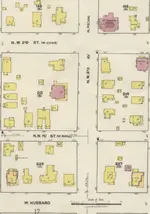
Look for Sanborn Fire Insurance Company maps if you can find them. They were compiled to show the layout of structures and some information on their construction for fire insurance purposes. In Texas (where I am) the state university has a very complete set for Texas available online (seemingly, every county seat in the state at least). In California (where I used to be), my local public library had them in the local history room. The oldest ones I've seen (and I used to use them for work) were from the 1880s, and the latest I ever saw were from the early 1980s. They usually cover the central parts of town (for towns of a certain size) and show residential as well as industrial and commercial structures. The original ones were hand-colored (yellow for frame construction, blue for stone, red for brick etc.). Number of stories, outbuildings and so on are also shown. I hunt houses with a book of Sanborns in the car...the latest available for my home town is 1921, so if it's on the map, and configured about the same as the map shows, it's a target. Where they're available Sanborn maps are among the best resources you can find.
Attached is an example from another town, also a 1921 map. D = Dwelling on these maps. Useful no?
 

Attachments

  • Sanborn example 1.webp
    Sanborn example 1.webp
    72.1 KB · Views: 104
I metal detect all public land that's in my area. Simple premise, but it works...

Same here. As an American tax indentured slave I figure it's the best way at recouping all the money they suck out of my hard earned wages.:BangHead:
 

Users who are viewing this thread

Back
Top Bottom