What's new

Resistivity machines...for real?

Thanks Jim,
You are correct.
I was keeping it simple to avoid a book. Many books out there on the subject.
Yes, the two probe resistance method is simple, but simplicity does not create a pseudosection.
We can get into pseudosections and create 3D grapics but that's another book! :)
- Geowizard
 
On the subject of buried treasure;

IF the buried treasure is contained in a chest, it probably won't be detected by either the resistance or resistivity method. The method of choice is the electromagnetic methods using FDEM or TDEM. Zonge Engineering or Geonics and others can elaborate to avoid another book. :)

- Geowizard
 
Last edited:
It takes relatively high voltage to make electric current flow in dirt and rock. That's what a megger does quite well! The megger produces a high voltage. Next, we need a means of measuring the current flowing in the circuit from megger to earth. Digital multi-meters most often can measure current (and voltage).

Drive two metal (preferably stainless steel ) rods into the ground 50 feet apart and connect the megger with a DMM current meter in series. Connect a voltmeter to two other metal (preferably stainless steel) rods centered between the first two rods and 10 feet apart.
A good Earth Resistivity Meter does not work this way. Instead, it uses 2 probes to inject a constant AC current (not a constant DC voltage) into the ground, and 2 more probes to measure voltage drops between the current probes. Current injection is used to avoid variable contact resistance and AC is used to prevent ionic build-up and polarization losses.

Using one to find treasure of any ilk, is as farfetched as any idea I've ever heard.
Unless you are looking for a truly massive treasure, probably so. In scammier days, poor-man resistivity meters marketed to treasure hunters -- like the Accumeter VI, Kellyco GPL, and Mother Load (sic) Locator -- all sported a meter that had silver and gold ranges on them. This was, of course, pure bull-snort but it helped sell a lot of ERMs to folks who had no idea how an ERM was supposed to work.

But a good-quality ERM can be useful if you are looking for a large underground void. For those people who believe massive treasures are buried in underground vaults. It's also very useful in archaeology for mapping soil compaction due to long-gone structures. In either case, you need to log a lot of measurements and then map it all out. It's a tedious job.
 
Dipole-dipole is probably the most common electrode configuration;

The four electrodes are spaced equally at distance "a". This distance is decided by the depth desired and transmitter current. Two electrodes are applied current (C) and the other two electrodes are voltage sensing (V). Spacing between electrode pairs is called "n" for number of multiples of "a".

Depth of measurement is controlled by the number of spacings "n" between the electrode pairs.

In the following case, the measurement point on the surface is defined as the midpoint between C2 and P1. The depth of measurement is defined as the line N1 for V measurement at R1. N2 for measurement at R2 etc. note the voltmeters are not connected to each other. One voltmeter is moved from position R1 to R2 and R3 etc. producing increasing depth from N1 to N2 etc. in sequence.

Actual vertical depth of measurement = 0.707 * a * n

N1 depth = intersection of lines from middle of pair C1-C2 to the line from middle of pair P1-P2.

This takes time to digest - it isn't Rocket Science! :icon_study:

Screenshot 2026-08-27 at 15-06-42 Model - dipole_dipole.pdf - dipole dipole.pdf.webp


- Geowizard
 
Last edited:
A good Earth Resistivity Meter does not work this way. Instead, it uses 2 probes to inject a constant AC current (not a constant DC voltage) into the ground, and 2 more probes to measure voltage drops between the current probes. Current injection is used to avoid variable contact resistance and AC is used to prevent ionic build-up and polarization losses.
I use a DC current, Carl, but the polarity reverses, at an adjustable rate, to prevent the fixed polarity losses. So far, it seems to work well.
Jim
 
Bipolar current;

Yes of course! :hello:

The discussion had not gotten that far yet. This is why I ignore Carl. "No, it doesn't work that way".

We were progressing to the subject of Induced Polarization and time decay. Books have been written on the method. Tutorials all over the internet. It's been around a long time. I have webinars on the subject at my instrumentation company, Wellog that were written decades ago.

- Geowizard
 
Then that is AC, not DC.
LOL...yup...really slow A/C, Carl. I have no idea what pace the change needs to be to prevent the polarity losses at the probes. We're limited in the pace by the speed of the readings we need...go too fast, and the meters can't keep up. Currently using about .5hz
Jim
 
Polarity Losses?

Electrode contact with the earth/soil has to do with making a good electrical contact. In the industry, salt water is used to saturate the soil around the electrodes. A shallow hole/depression is also used with a sheet of aluminum foil for the electrode. The depression is saturated with salt water, lined with foil and filled with dirt. A third method used on the current electrodes is using a cluster of multiple electrodes serving as a single electrode.

The other factor is polarization of the voltage electrodes due to galvanic charges. Copper is galvanic and produces a polarizing voltage when in contact with soil. Aluminum and stainless steel rods not so much. I have recommended on other threads using non-polarizing electrodes.

Non polarizing electrodes are used in application of a charge to reduce and prevent corrosion (corrosion control) in buried steel/iron and other structures due to destructive galvanic erosion of the metals. Same thing happens in ships. It's another book. - search "non-polarizing electrodes".

Construction is simple:
A short cylindrical plastic tube 3/4" to 3" in diameter and 6 inches long +/- has a porous ceramic tip on the end that is inserted in the ground. The opposite end has a copper section of 1/4" tubing cut to 4" that is mounted to a screw type wire terminal and sealed with a rubber grommet. The tube is filled with concentrated copper sulfate. Copper sulfate has many sources usually in the form of dry crystals. Add water and it's good to go! :)

- Geowizard
 
Alternating DC;

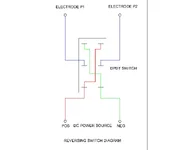
The system needs time to settle between alternating current pulses. The switching sequence is "on positive", "off", "on negative", off... repeating. A simple DPDT switching circuit does the job and is low cost. For automation and precision, I use DPDT relays with a microcontroller.

dpdt.webp<--Click me

This DPDT relay (R1) does the current reversal. A second DPDT relay (R2) in series does the On-off switching. The relay sequence is R1 ON, delay, R2 ON, delay, R2 OFF, delay, R1 OFF, delay, R2 ON, delay. R2 OFF. Repeating...

- Geowizard
 
Last edited:
Just for the record... The resistivity of soil is not consistent by any means. In fact, measurements just a few feet apart can vary by kiloohms, perhaps megohms. That fact alone, doesn't mean there is something buried between the probes. This inconsistency is one of the reasons amateur radio operators use radials to ensure a meaningful ground return current.

The argument is similar to folks who are convinced one specific detector and/or setting yields greater depth than another. While there is a possibility there might be a treasure between a pair of megger probes, soil conditions (acidic, alkaline, mineralization, etc.) are the main determining factors.
 
The microcontroller;

I have mentioned in other threads, the Arduino UNO or NANO microcomputers as low cost, simple to program (kids learn Arduino programming in elementary and high school). Do a search on "Arduino". We can write a book here if needed!

The Arduino can provide precision switching measured in seconds and fractions of seconds (milliseconds). There's a sheet of instructions on line and YouTube has hundreds of instructional videos.

The Arduino can do accurate (analog) voltage measurements! Voltage measurements can be precisely timed after or during each switching event. The voltages can be stored on a Micro SD card and downloaded to a laptop or Desktop.computer.

I will provide program examples in coming posts.

- Geowizard
 
K0bgalan said,

"Just for the record... The resistivity of soil is not consistent by any means. In fact, measurements just a few feet apart can vary by kiloohms, perhaps megohms. That fact alone, doesn't mean there is something buried between the probes. This inconsistency is one of the reasons amateur radio operators use radials to ensure a meaningful ground return current."

Brilliant! :thumbsup:

I would like to share my experience having spent many years and tens of thousands of hours viewing many thousands of miles of survey data that supports this statement with the exception of the conclusion.

The conclusion may need reconsideration. Here's why!

Resistive soils are "Conductive". We are looking for conductive, high conductivity soils! Yowzah!

High conductivity soils have resistivities approaching zero! Zero is a short circuit in the earth! There are references on "normal" ranges in resistivities published at Geonics' website in their "Technical library" for the full range of soils and mineralization.

After serving in the USAF, I worked at Schlumberger offshore, in Alaska... :icon_salut:

Schlumberger built a billion dollar corporation on the shoulders of the Schlumberger brothers, Conrad and Marcel. Do a search on Schlumberger! The story of Conrad and Marcel is legendary.

There are "Anomalies"! Those bumps in the voltage. Little bumps, big bumps! Bigger bumps!

Mineralization is Conductive = Low resistivity! Zero is a short circuit in the earth!

- Geowizard
 
I like this disscussion BUT it's way above my ole brain now-a-days ! Maybe 30 years ago I could cupulate it but now I'm doing whatever I was doing!
russau,
Exposure to these things is part of a larger experience! :occasion14:

Members and readers of the posts on Treasurenet are above average for having taken the opportunities found here to further their view of the world and the things going on in it!

Thank you,

- Geowizard

 
"G". Your assumption about resistive coils is not correct.

What I was trying to convey was about the resistive nature of soil at any one given point, time, and ambient. In other words, you cannot assume lower resistive coil measurement means or implies that there is any type of "thingy" between the measurement rods. Over a large statistical area, soil resistivity tends to be within a given range. This doesn't infer that over a small statistical area, the soil resistivity is constant. As I implied, even a foot or so displacement, can make a rather large change (up or down) in soil resistivity. Relaying on such a measurement as an indication of a treasure lying between the probes, is pure folly.
 
You lost me. "resistive coils"?

You might want to explain that to the thousands of people world-wide that do this everyday and those that have been doing it successfully for most of the past century. It's a very mature science.

Working at Schlumberger fifty years ago we measured electric resistivity in oil wells using this method. Schlumberger had been doing it fifty years before then. Just a suggestion.

- Geowizard

 
Last edited:
Arduino Software;

Free relay switching and analog voltage input (Data Acquisition) that streams data to serial port/SD Memory.
Works on Arduino UNO.
Contact me by PM.

- Geowizard
 
Last edited:
At my 79 years I don't remember very well what I learned in colledge BUT that was then and this is now ! I'm starting to like my rocking chair mode ! Most of my electronic testing gear (Megger, 2 "O' scopes, meters ,etc. are gone now!
 
Well then... recline in your rocking chair...grab a refreshment and join the crowd! You have me beat by a few years! :occasion14:

I appreciate readers and viewers like you that take time to chat, ask questions and sometimes give a "like"! Sounds like your background is in line with mine. I enjoy "facilitating learning" and helping others gain understanding of things related to our earth and technology. Schools avoid science, technology. engineering and math (STEM). I realize we are surrounded by a community that "skipped" all of those unnecessary courses or slept through them because they were told they are boring. To them, I say, "Hello". A belief in life-long-learning affords an opportunity to fill in the blanks in the learning experience. It's free right here on Treasurenet! :hello:

- Geowizard
 

Users who are viewing this thread

Back
Top Bottom