What's new

✅ SOLVED Silver token type item.

GaRebel1861

Gold Member
🥇 Charter Member
Joined
Jun 16, 2011
Messages
6,152
Reaction score
7,991
Golden Thread
4
Location
Georgia
🥇 Banner finds
4
Primary Interest:
All Treasure Hunting
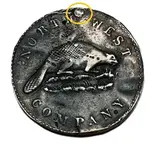
I found this while going through a box in my shop yesterday. It is about the size of a U.S. half dollar and appears to be made of silver. I'm not
100% sure that it's all that old. What is it?
Front 3-9-2026.webp
Back 3-9-2026.webp
 
That's an interesting item.

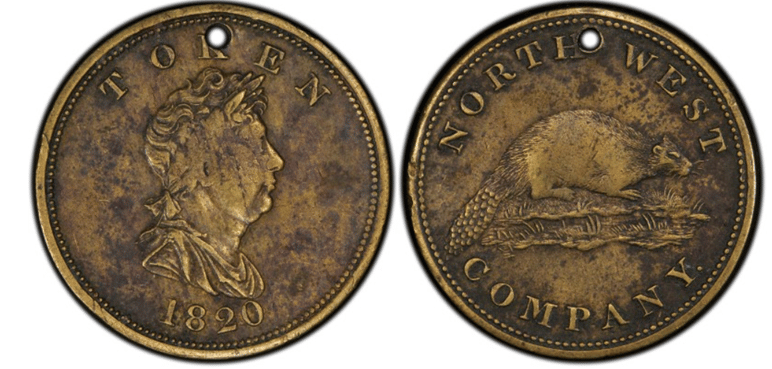
The North West Company was a fur trading business organized in Montreal, Canada and operating from 1784 until 1821 when it merged with the Hudson's Bay Company. In the absence of steady coin supplies, they created tokens for their agents to purchase beaver pelts from trappers and indigenous natives that could later be redeemed at trading posts for provisions, tools and other items. The tokens were good for one pelt.


I’ve never seen one in silver, nor with a blank obverse. They were usually brass, and occasionally copper, with a portrait of George III and dated 1820 on the non-beaver obverse. Struck by John Walker and Company of Birmingham, England. They’re almost invariably holed, with just two examples known without holes, and usually in worn or damaged condition.

If yours is authentic and in silver, I would guess it to be rather rare. Perhaps it's not a token, but served some other purpose such as identification for one of their agents.
 
Last edited:
Upvote 0
photos can be mis-leading, & any valid analysis should be done with the item in hand.

...That being said, the center details appear a bit 'mushy', which could indicate a mold-cast copy , rather than genuine, machine struck.

...Notice the area, center, top, that appears to have been a plugged hole. There's no evident polishing or filing around the plug. To me, this also may indicate that your specimen was cast from a genuine token that had a hole in this location. ( Wearing coins around the neck for display or tucked inside clothing for safekeeping, was a common practice in that day. ) Of note: many of the online pics of this token (genuine examples) have a hole around the 12:00 position ...

...from Coins & Canada : ..."These tokens were probably struck in 1820 in Birmingham, England, by John Walker & Co. for Canadian and American markets ..."

...All references that I could locate mention this token struck in brass, & more rare, copper. I could find no mention of silver being used (which only means I could find no ... "). What was mentioned, in a few references, was the fact that more modern copies had been made, but no further info on this topic (of copies).

...It's a cool find ... hope you can find someone knowledgeable to help ...
 

Attachments

  • msd.webp
    msd.webp
    23.3 KB · Views: 41
Last edited:
Upvote 0
A medium of exchange was a made beaver.
The N.W.Co. had it's strong position and unique roll in the fur trade.
It's medium obviously could be represented by such a token.

Let's suggest someone had more plews (and beaver were not the only furs involved but again can be considered a standard of sorts) than desire to spend their value. Or needed change/more value returned than actually spent. Then comes options of small items or volumes.
And an introduction to trade silver!
A small blanket style pin in exchange for change worn on a hat could tell of a man who wasn't broke/so poor he had no value. An earring. A pin. A fun subject. And a valuable one.
A few beaver pelts not spent to resolve debt or to acquire what was needed could be condensed into a simple few tokens.

The question on yours is it's pedigree of course. It wants to be a living history repro type piece but I can't prove that from here. I do like it though. And would drill and wear it if a replica.
( The bare back want's it to be so.) Also note what looks like it was pressed with a file to add scales. Scales well beyond the beavers tail (the tail which looks scribed rather than file pressed) which would be the only place to expect a scaled appearance usually.
Then you have the multiple drill pocks. Not really deep enough to test for silver content being all the way through but perhaps a tip of the hat to the concept. (Or they could just be voids from a poor quality casting that should have been remelted. Or...)

Reproductions have long be welcomed and emulated for love of history. And for more nefarious reasons too it may be suspected.


(There are more pics online.)
 
Last edited:
Upvote 0
Thank you all for the replies. Im going to marked this one as solved. I now believe that it is in fact a replica. At least it’s silver!
 
Upvote 0
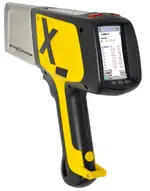
Hi, GaRebel1861 ... Have you had the metal verified that it is silver?...it would be interesting to know what is the composition / ratio of the alloy (.999 / .931 / .925 / .900 / .800,...etc?) ... if possible ... someone with a good analytical scanner (jeweler / pawn shop) could easily give you a read-out.
 

Attachments

  • Olympus_1-808x1024.webp
    Olympus_1-808x1024.webp
    38.3 KB · Views: 29
Upvote 0
Mrwhiskers - Im basing my opinion on the look, weight, and feel of the token. I may have it tested. Right now, it’s just sitting in a container with my other silver jewelry finds.
 
Upvote 0
@GaRebel ...got'cha ... the metal (as photo'd) has the look of older silver. The more metals present in the mix, the likelihood of an older piece, as refining in the early 1800s was not as "refined" as present day. An assay of the mix could lead to a good guess as to when & where it may have been made.

...older (17-1800s) British sterling (.925) may also contain traces of zinc, nickel, &,or lead. the same newer refined silver (1950s -on) rarely contain trace metals.

...older silver (1500s-1900) from the Central & South American (as well as European) mines often (depending on the location) contained trace amounts of gold, platinum, nickel, zinc, lead, iron, along with copper ...
(In my experience) most jewelers with a good scanner will do this at no charge. Pawn shops will scan it if you are trying to sell ...
 
Upvote 0
Still this is a really cool recovery. I'd get it tested as the appearance of silver isn't always the real deal as the counterfeit are pretty good.
German Silver, Tribal silver, and even pewter can fool a lot of people
 
Upvote 0

Users who are viewing this thread

Back
Top Bottom