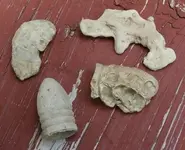
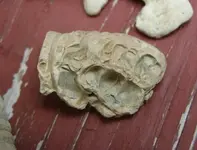
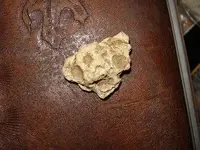
Re: Talk about "Chewed".....
Just to get our "facts" straight.
Wild hogs have been in North America for about 500 years. There were plenty of feral hogs during the civil war. No matter where you were.
From -
http://museum.nhm.uga.edu/gawildlife/mammals/artiodactyla/Suidae/sscrofa.html
Wild Pigs, also called Feral Hogs, have been established in North America since 1539, when the first European settlers brought them to Florida as domestic pigs. Another race of wild pig, the European Wild Boar, was released in New Hampshire, North Carolina, Missouri, Arkansas, and Tennessee in the late 1800s and 1900s for the purposes of hunting.
Bullets that appear to be chewed during surgery have been misidentified. Soldiers did chew bullets to maximize salivation just as Indians put pebbles under their tongues for the same reason.
From:
http://antiquescientifica.com/alerts.htm
So-called medical chewed or pain bullets are mis-identified. An easily swallowed bullet is the last thing that one would want to put in the mouth of any anxious patient. To bite the bullet is not a medical phrase, rather it is an old military term referring to loading a muzzleloader. The tip of a preloaded ball and powder paper cartridge was opened with the soldier's teeth, the powder and ball were then poured into the muzzle, the paper cartridge, itself, came next as packing, lastly, all was tamped down with a ram rod. In the heat of battle, it is possible that soldiers may have bitten the paper cartridge at the wrong end (bullet end) and this may have caused some of the marks.
The notion that a bullet was better than a belt or other large soft (relative) is a civil war myth.
From -
http://www.medscape.com/viewarticle/418268
Book Reviews
Civil War Medicine: Challenges and Triumphs
January 22, 2002
from Medscape General Medicine [TM]
Reviewed by: Thomas P. Lowry, MD
Another widely believed myth is that of patients biting on bullets during surgery. General anesthesia was widely (and safely) used by both North and South. To further dispel the mythic ignorance of our medical ancestors, there were specialized hospitals for ear and eye injuries, plastic surgery, smallpox, and syphilis.
Civil war muskets were fired using a paper tube holding the powder with the bullet attached at the end.
From -
http://www.civilwarguns.com/9110b.html
Ordnance Questions & Answers
Since I began this column several months ago I have been queried both in person and via correspondence on a number of Civil War arms topics. Several of these queries on the historical and modern use of Civil War guns have wider import, and I'll try to answer a few on ammunition in this month's column.
Q. How were Civil War musket cartridges constructed? How were they used?
A. Civil War cartridges for the U.S. .58 caliber Springfield rifle musket, and American made cartridges for the .577 caliber British Enfield rifle musket, contained a paper wrapped powder charge with a grooved, lubricated minie ball sitting on top of it pointing up. The whole was then wrapped in another piece of paper to make a completed cartridge. In loading, the soldier bit off the end of the cartridge, then dumped the powder charge, 60 grains of musket powder, down the muzzle of his gun, discarded the remaining paper, inserted the bullet, rammed it down the barrel and then placed a percussion cap on the gun's nipple, or "cone."
British (and some Confederate) made Enfield cartridges, although paper, were constructed differently, with an ungrooved bullet, more undersized than the Springfield style projectile, wrapped in lubricated paper and pointing downward. After biting the end off the Enfield cartridge and dumping the powder down the muzzle of his gun, the soldier reversed the cartridge and seated the bullet, still wrapped in the lubricated paper, in the muzzle, discarded the excess paper, rammed it home and capped his weapon.
Just so more information to consider.
Daryl