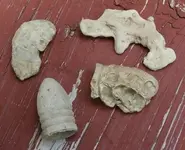
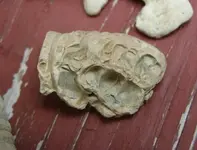
Re: Talk about "Chewed".....
Seems there are alot of eyewitness reports out there,in books and the web about soldiers actually chewing the bullets......Just a small google search came up with these few......
I also have these books thats talk about soldiers chewing on bullets .....
Lee's Lieutenants A Study in Command Douglas Southall Freeman
The Civil War Strange and Fascinating Facts Burke Davis
Civil War Treasury B.A. Botkin
...On the third day of his ordeal, the boy felt that death was near. "I chewed bullets, trying by these means to excite the salivary glands," he remembered, "the very air was dry, my lips and throat parched."
http://www.forttours.com/pages/peralta.asp
By the time enlisted men of the Seventh United States Cavalry had begun to perform deeds warranting consideration for the Medal of Honor, Lieutenant Colonel George Armstrong Custer and the more than two hundred troopers of his immediate command were dead on bluffs overlooking the Little Bighorn River.According to trooper testimony, soldiers chewed the lead of bullets, gnawed on the thick leaves of prickly pear cactus, and held pebbles in their mouths to slake their thirst. Tongues were so swollen and throats so parched that soldiers could not close their mouths. "The sun seemed fairly to cook the blood in our veins," one said. Private Cornelius Cowley went insane from lack of water and "did not recover for some time," another recalled. However much the uninjured soldiers may have ached for water................,
http://findarticles.com/p/articles/mi_qa3951/is_200001/ai_n8884751
The Indians chewed the bullets they used in battle, that wounds created might be more lacerating. This partially accounts for the large mortality among the wounded.
http://www.rootsweb.com/~usgenweb/ky/tippecanoe/chapter6.html
The Battle of Monmouth is recorded as a victory for the Americans, but it wasn't an easy one. The musket and cannon fire was terrible for the 30,000 Americans and British soldiers who collided on the plains of Monmouth Courthouse, New Jersey on June 28, 1778. Even more terrible was the record heat -- a heat that reached 96 degrees in the shade by afternoon, turning the white, sandy battlefield into an oven -- a heat so terrible that fully one half of the 501 men who died in the battle were killed by heat stroke. In all, l99 Americans and 302 British troops died that day before the British withdrew under cover of night.
An interesting sidelight to the battle is seen in the musket balls found by the Deep Search Metal Detecting Club. Some of the balls show teeth marks, suggesting they were chewed. These particular teeth marks are shallow and entirely different from the deep marks made by wounded soldiers to endure the pain of battlefield surgery. After participating in several reenactments of Revolutionary War battles, Sivilich believes he knows how the musket balls became slightly chewed. Firing a musket requires a soldier to bite off the rounds, leaving a taste somewhat less enjoyable than grandma's apple pie in the mouth. Sivilich believes the musket balls were chewed to keep saliva in the soldiers' mouths, allowing them to bite off the rounds and continue firing during the long, hot day. Without enough saliva, tongues can swell and choking can result, Sivilich said
http://www.protecthehobbynow.com/how_to_volunteer_for_archeologic.htm