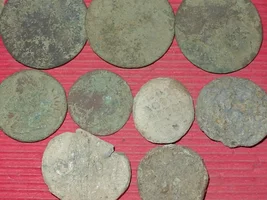
Hello Musclecar.
Interesting section and have just seen your picture. Im pretty sure there would be 2 of these(one either side). My Mech Eng experience leads me to that at the very least.
Im pretty sure this is mechanical counter that is used to detect, totalize and indicate a sequence of events. It does not use any electrical power source. There are four basic types of counter revolution counters, rotary counters, stroke counters, and pushbutton or manual counters. Revolution, (count each revolution of a shaft) Rotary, (record a specified number of counts per rotation) Stroke, (record one count for each stroke). Pushbutton, ( used for manual counting by the operator and records one count for each actuation. Most pushbutton counters or manual counters are handheld devices.
Mechanical counters can be reset with a manual knob or lock and key (should be a small opening to fit the key or "stop device". The number of digits will be in the display. This determines the counting range. These type of mechanical counters may be able to perform both counting and timing functions. Some of these are equipped with double shafts can have left and right extensions for separate left and right. Specialized mechanical counters may use a dial indicator in place of rotating digits on a wheel.
Mech Counters are used in copy machines, printing presses, cut-off machines, and part-counting applications and can be used with material handling equipment, rapid transit vehicles, street sweepers, farm machinery, carts for recreational use, and construction equipment.They are also used in gaming machines, vending machines, and depth-flow meters.
Well, what does this mean? The answer is I cant tell you exactly what application this couter was housed in and for but I am certain that given its size its definately not used in a vending machine as it is a visual counter. I hope this may jog maybe a farmers memory. A clue would be in where it was found and the history determing the site from whence this was found.
Good Luck! Great Post


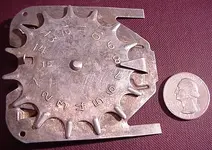
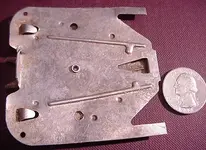
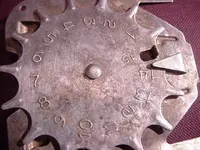


 too funny!


![ufo130130CLR[1].gif](/data/attachments/33/33097-5c655aaa0c1c44013758f49c64258bec.jpg?hash=XGVaqgwcRA)
![ufo130130CLR[1].gif](/data/attachments/33/33103-5c655aaa0c1c44013758f49c64258bec.jpg?hash=XGVaqgwcRA)


 Too funny.