What's new

Think I found my oldest coin ever...

Joe G

Sr. Member
Joined
Dec 3, 2004
Messages
403
Reaction score
7
Golden Thread
0
Location
Long Island
Detector(s) used
Exp II, Fisher CZ-21
Primary Interest:
All Treasure Hunting
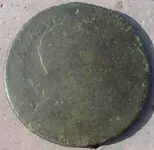
Went back to that old park where I found some large cents, the colonial copper, musket ball, and colonial buttons. Found another flat button like the others (late 1700's early 1800's). Dug another good deep signal and found this. I thought at first it was another large cent but they don't look like this that's for sure. While I'm not sure if it's the exact coin I've got posted below, I think it's safe to say it's pretty dang old and it's British. The one I posted is a 1694. So? Whatcha think?

Britishhalfpenny.jpg
BR-WMHD-1694obv.jpg


Now it's tough to tell on the pic but here's the back. Before I cleaned it a little I could just make out the form and that was before I found this pic.

britishhalfpennyreverse.jpg
BR-WMHD-1694rev.jpg


Here's another sample I found:
imagemagic.php
 
Upvote 0
Joe G said:
CRUSADER said:
I have never seen a Wiliam & Mary copper flake like that. I seen hundreds. I wonder if this might be a contemporary fake. More interesting than a normal copper.


Hundreds?? Ah, you're from across the pond where there is real history :lol: I trust your expertise but every copper I've ever dug (all 4 or 5 of them :) ) are as bad as this one. This coin was found in a wooded shrubbed area about 9" down. There is no human "footprint" here i.e., no trash, pulltabs, clad coins, NOTHING. So I doubt it's contemporary. A friend and I have also pulled out musket balls, colonial buttons, and a couple of large (dateable) large cents; I got what's left of a connecticut copper. Historically, this particular area goes back to the 1600's with British movement in the area. That's my only thoughts on why I think the coin is as old as it is (no matter what coin it is)

Thanks!

Why is it that when ever I use contemporary, people think modern. Contemporary means at the time of the real thing. So it was couterfieted at the time.(Possible)

Anyway, just looked at my book & you may have a VERY RARE Tin & Copper W&M, date range - 1690-1692. They start at £60 ($120) in fair condition. I have nothing to campare it to as I have never found one or can afford to buy one for my collection. In EF they are £2000. (£4000). This needs a coin expert to look at.

But its not pure copper!
 
this really amazing i,m holding the same coin i dug a few days ago .sam
 
CRUSADER said:
Joe G said:
CRUSADER said:
I have never seen a Wiliam & Mary copper flake like that. I seen hundreds. I wonder if this might be a contemporary fake. More interesting than a normal copper.


Hundreds?? Ah, you're from across the pond where there is real history :lol: I trust your expertise but every copper I've ever dug (all 4 or 5 of them :) ) are as bad as this one. This coin was found in a wooded shrubbed area about 9" down. There is no human "footprint" here i.e., no trash, pulltabs, clad coins, NOTHING. So I doubt it's contemporary. A friend and I have also pulled out musket balls, colonial buttons, and a couple of large (dateable) large cents; I got what's left of a connecticut copper. Historically, this particular area goes back to the 1600's with British movement in the area. That's my only thoughts on why I think the coin is as old as it is (no matter what coin it is)

Thanks!

Why is it that when ever I use contemporary, people think modern. Contemporary means at the time of the real thing. So it was couterfieted at the time.(Possible)

Anyway, just looked at my book & you may have a VERY RARE Tin & Copper W&M, date range - 1690-1692. They start at £60 ($120) in fair condition. I have nothing to campare it to as I have never found one or can afford to buy one for my collection. In EF they are £2000. (£4000). This needs a coin expert to look at.

But its not pure copper!


Just so this thread doesn't twist any more than it has the answer to it being the tin variety is absolutely not.
 
How are you ABSOLUTELY sure it is not the tin variety?

Daryl
 
BioProfessor said:
How are you ABSOLUTELY sure it is not the tin variety?

Daryl


Because I have seen atleast 20 sell and that is obviously a solid coin, not thin frail tin.
 
The coin would not be thin and frail tin but an alloy used by counterfeiters that contained copper and tin. Copper was worth more than tin. The coin would be the same size and thickness just not all copper. The copper and tin mix may not have been alloyed well and that would result in "layers" or "swirls" of copper and tin. Since they are not mixed into a single alloy, the layers are there and may separate as the chemicals in the soil react with the coin. When the "ill-mixed" copper/tin release from one another, it flakes. Roman coins do the same thing. Especially the large 1st century ones.

Daryl
 
[/quote]
Why is it that when ever I use contemporary, people think modern. Contemporary means at the time of the real thing. So it was couterfieted at the time.(Possible)
Anyway, just looked at my book & you may have a VERY RARE Tin & Copper W&M, date range - 1690-1692. They start at £60 ($120) in fair condition. I have nothing to campare it to as I have never found one or can afford to buy one for my collection. In EF they are £2000. (£4000). This needs a coin expert to look at.
But its not pure copper!
[/quote]

I was just in the wrong time, that's all :) Thanks for the info! VERY intersting!
 
ramblinsam said:
this really amazing i,m holding the same coin i dug a few days ago .sam

Go figure! What shape is your's in?
 
BioProfessor said:
The coin would not be thin and frail tin but an alloy used by counterfeiters that contained copper and tin. Copper was worth more than tin. The coin would be the same size and thickness just not all copper. The copper and tin mix may not have been alloyed well and that would result in "layers" or "swirls" of copper and tin. Since they are not mixed into a single alloy, the layers are there and may separate as the chemicals in the soil react with the coin. When the "ill-mixed" copper/tin release from one another, it flakes. Roman coins do the same thing. Especially the large 1st century ones.

Daryl

As I said I have seen atleast 20 dug tin coins sell so have a pretty good idea of what they look like. But I'm not an expert so people can and should draw their own conclusions.
 
Tin coins are different than copper/tin coins. No real comparison.

Daryl
 
Joe...I know nothing about coppers but that is one neat coin. Congrats.
 
To verify what Iron Patch has said, it is NOT tin :) The ribbons are nowhere near the same on the Tin variety versus the 1694 Copper variety, so by the photo posted it is a copper William and Mary Halfpence.

The ribbon style is usually the last part of any William III or William and Mary copper to wear away, and the type of wear and corrosion on the one posted seems to me to be rather typical of an old copper exposed to corrosive soil, such as from fertilizer or excess moisture.
Almost all of the William III coppers I have found are considerably worn, they must have circulated for a long time, most likely into the mid to late 1700's.

There are known Cast Counterfeits, read the story of the I-95 Philadelphia hoard that was discovered during the construction of the I-95 area .

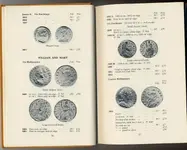
I am attaching the link for the William III hoard recovery and also attaching a photo of two pages from "British Copper Coins and their value 1965" I believe the author's name is PECK. If you look at the Tin W&M coins, the busts are different, especially the ribbons.

http://www.coins.nd.edu/ColCoin/ColCoinIntros/CtfBrit.intro.html#Counterfeits.in.America


Don
 

Attachments

  • WillieMaryHaplpennies.webp
    WillieMaryHaplpennies.webp
    70.3 KB · Views: 472
Good and interesting Info. Don. A tin coin is to copper what a pewter button is to a brass one, tin & pewter just don't hold up well in the ground. (in most cases)
 
Don,

Yeap, good info, as you say not a tin & copper type.

Still I have never seen a copper one go like that in any ground over here. Have you? Can you picture any looking like that?
 
It seems that there were 3 different types - Copper, tin, and copper and tin. I thought we were talking about a copper AND tin coin. Not a tin coin.

Charles II (1660-1685) first produced copper halfpence and farthings in 1672. Minting began on August 5th with the production of farthings on four presses. A fifth press was used for halfpence but production of those coins did not begin until after Christmas. Interestingly, Charles displayed a bust right (that is, a right profile) on all his gold and silver coins but used a bust left on his coppers. He produced copper halfpence dated 1672, 1673 and 1675 and copper farthings dated 1672-1675 and 1679. In order to produce these coins the mint need blank planchets of the proper size and weight. However they did not have the capability of producing the rolled sheets of copper from which the blanks would be cut out. Therefore the mint was forced to import finished planchets, which they contracted with Abraham Cronstrom of Stockholm, Sweden. The initial run of coppers was produced at 40 halfpence to the pound (175 grains), with farthings proportional. However, Cronstrom had contracted to provide the copper metal at 14.5d per pound but he discovered there was a Swedish export tarrif of 2.5d per pound, raising the price to 17d a pound. The Mint would not revise the contracted price for the first shipment but they did agree to pay the increase for subsequent shipments. To offset this added cost the weight of the coins was reduced slightly during this first year of production (1672) so that halfpence were made at 44 to the pound avoirdupois or about 159.1 grains each. Near the end of his reign Charles began a process that would free the mint from dependence on imported copper. Hoping to assist the ailing British tin industry as well as obtaining a higher minting profit for himself, Charles began minting tin farthings. The contract (the document is actually called a warrant in Eighteenth century legal terminology) to produce these coins was awarded to the partnership of John Buckworth, Thomas Neale, Charles Dunucombe and James Hoare on June 20, 1684. A square plug of copper was added to the center as an anti counterfeiting measure. The tin farthings were produced from 1684 through 1685

James II (1685-1688) started the production of a plugged tin halfpenny in 1685 and continued production through 1687.

http://www.coins.nd.edu/ColCoin/ColCoinIntros/Br-Copper.intro.html

Daryl
 
CRUSADER said:
Don,

Yeap, good info, as you say not a tin & copper type.

Still I have never seen a copper one go like that in any ground over here. Have you? Can you picture any looking like that?

Without going into my archived CD's I did have this one on my hard drive, a William III copper my son found, it has some of the apparant "flaking" you mention? Our soil conditions in general are not producing a lot of coins like that but we do get some from time to time. If I come across a very good example I will add it to this post.

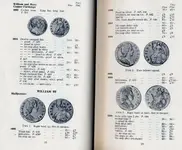
Also, for education purposes I am am including the two pages from the Peck book that show the 3 types of William III copper halfpences, which can help a person narrow down the year of the copper if date is not showing.
Don
 

Attachments

  • Dan 1699-1701.webp
    Dan 1699-1701.webp
    97.4 KB · Views: 445
  • William III coins.webp
    William III coins.webp
    114 KB · Views: 405
I am not sure if my idea of flaking is the same as others. My definition is more like delamination. On some of the old Roman coins I have seen, the entire obverse will "flake" off as one thin piece. All the detail is gone from the coin and only the "flake" has any. It's sort of like a stack of pancakes and the top one comes off. One of the large Roman coins I found in the UK had layers you could see from the side. You could take a knife or some other sharp object and "flake" off parts of the coin from the edges.

I am not that familiar with the coin book references to the coins. Which one of the types is the copper? Which is the tin? And which is the tin/copper combination? That would really help.

Thanks,

Daryl
 
yep I'd say so! Congrats on a very nice find! ;D
 
Don, Bioprof, Bookfisher and Iron Patch:

Thanks so much for all of the information. Where else can you find a corroded, dirt covered coin and learn so much from it. That's what I truely love about this hobby. One find leads to research and more research...

Thanks again for all you help. I'm going back again in an hour. Hopefully I'll find something to keep the conversation going :)

HH
 

Users who are viewing this thread

Back
Top Bottom