

You are using an out of date browser. It may not display this or other websites correctly.
You should upgrade or use an alternative browser.
You should upgrade or use an alternative browser.
This may be one that never gets IDed so I will call it an un-SOLVED MYSTERY
- Thread starter creskol
- Start date

Breezie
Gold Member
- Joined
- Oct 3, 2009
- Messages
- 6,278
- Reaction score
- 2,120
- Golden Thread
- 1
- Location
- North Carolina
- 🥇 Banner finds
- 1
- Detector(s) used
- White's DFX & Spectrum~Garrett's Pro-Pointer~VibraProbe
- Primary Interest:
- Metal Detecting
Re: Has anybody ever seen a buckle like this?
Hey Cres,
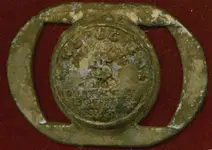
I think it says:
Inspected
United States
$
1801
Department of Leather Goods Association
Interesting find,
Breezie
Hey Cres,
I think it says:
Inspected
United States
$
1801
Department of Leather Goods Association
Interesting find,
Breezie
Upvote
0
creskol
Gold Member
- #3
Thread Owner
Re: Has anybody ever seen a buckle like this?
Thanks Breezie .. any idea as to what it went to or what the $ sign might indicate?
Breezie said:Hey Cres,
I think it says:
Inspected
United States
$
1801
Department of Leather Goods Association
Interesting find,
Breezie
Thanks Breezie .. any idea as to what it went to or what the $ sign might indicate?
Upvote
0
Breezie
Gold Member
- Joined
- Oct 3, 2009
- Messages
- 6,278
- Reaction score
- 2,120
- Golden Thread
- 1
- Location
- North Carolina
- 🥇 Banner finds
- 1
- Detector(s) used
- White's DFX & Spectrum~Garrett's Pro-Pointer~VibraProbe
- Primary Interest:
- Metal Detecting
Re: Has anybody ever seen a buckle like this?
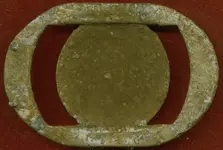
I'm looking now to see what U.S. Departments were present in 1801. I'm thinking Commerce Dept. Can you post a pic of the back of it? It could be an inspection for importing/exporting leather hides, and the $ sign may mean a 'tax' or customs. I think it is most interesting, Breezie
I'm looking now to see what U.S. Departments were present in 1801. I'm thinking Commerce Dept. Can you post a pic of the back of it? It could be an inspection for importing/exporting leather hides, and the $ sign may mean a 'tax' or customs. I think it is most interesting, Breezie
Upvote
0
Breezie
Gold Member
- Joined
- Oct 3, 2009
- Messages
- 6,278
- Reaction score
- 2,120
- Golden Thread
- 1
- Location
- North Carolina
- 🥇 Banner finds
- 1
- Detector(s) used
- White's DFX & Spectrum~Garrett's Pro-Pointer~VibraProbe
- Primary Interest:
- Metal Detecting
Re: Has anybody ever seen a buckle like this?
My best guess is a leather inspection tag used by the U.S. for exporting hides. I can't seem to find anything on the Internet on the Leather Goods Assoc. Breezie
My best guess is a leather inspection tag used by the U.S. for exporting hides. I can't seem to find anything on the Internet on the Leather Goods Assoc. Breezie
Upvote
0
creskol
Gold Member
- #7
Thread Owner
Re: Has anybody ever seen a buckle like this?
I sure appreciate your efforts, Breezie. You are truly an asset to the community! Many Thanks!
Breezie said:My best guess is a leather inspection tag used by the U.S. for exporting hides. I can't seem to find anything on the Internet on the Leather Goods Assoc. Breezie
I sure appreciate your efforts, Breezie. You are truly an asset to the community! Many Thanks!
Upvote
0
Breezie
Gold Member
- Joined
- Oct 3, 2009
- Messages
- 6,278
- Reaction score
- 2,120
- Golden Thread
- 1
- Location
- North Carolina
- 🥇 Banner finds
- 1
- Detector(s) used
- White's DFX & Spectrum~Garrett's Pro-Pointer~VibraProbe
- Primary Interest:
- Metal Detecting
Re: Has anybody ever seen a buckle like this?
Thank you Cres for the kudos.
I think I've found it . . .well, close anyway. It appears to be a hide tag that must remain on the animal. Here is an interesting paragraph:
ATTACHING THE HARVEST TAG
You must attach the alligator harvest tag to the alligator carcass within six
(6) inches of the tip of the tail (see diagram) immediately after it is killed
and before it is transported by boat or vehicle from the site of capture.
The harvest tag must remain attached to the alligator hide at all times.
Please note, it is difficult to cut through an alligator’s hide, so take your
time and be careful not to cut yourself.Also, be sure to clamp your harvest tag
across the underside of the tail to avoid jeopardizing the ability to skin the hide.
Here is the site:
http://www.dnr.sc.gov/wildlife/alligator/pdf/2010gatorguide.pdf
Something else occurred to me .. . .your tag may be a false/fake one made by people who are illegally collecting hides/animals because if not, I would think somewhere on the Internet would be information about the US Leather Goods Association. It's a thought.
creskol said:Breezie said:My best guess is a leather inspection tag used by the U.S. for exporting hides. I can't seem to find anything on the Internet on the Leather Goods Assoc. Breezie
I sure appreciate your efforts, Breezie. You are truly an asset to the community! Many Thanks!
Thank you Cres for the kudos.
I think I've found it . . .well, close anyway. It appears to be a hide tag that must remain on the animal. Here is an interesting paragraph:
ATTACHING THE HARVEST TAG
You must attach the alligator harvest tag to the alligator carcass within six
(6) inches of the tip of the tail (see diagram) immediately after it is killed
and before it is transported by boat or vehicle from the site of capture.
The harvest tag must remain attached to the alligator hide at all times.
Please note, it is difficult to cut through an alligator’s hide, so take your
time and be careful not to cut yourself.Also, be sure to clamp your harvest tag
across the underside of the tail to avoid jeopardizing the ability to skin the hide.
Here is the site:
http://www.dnr.sc.gov/wildlife/alligator/pdf/2010gatorguide.pdf
Something else occurred to me .. . .your tag may be a false/fake one made by people who are illegally collecting hides/animals because if not, I would think somewhere on the Internet would be information about the US Leather Goods Association. It's a thought.
Upvote
0
freddy williams
Hero Member
- Joined
- Oct 9, 2010
- Messages
- 885
- Reaction score
- 92
- Golden Thread
- 0
- Location
- Alabama/ Ohio
- Detector(s) used
- GTI-2500, Whites V3, xplorer XS Cortes & XLT Cibola Tesoro Tiger shark Now using a Xterra 705, Ace 350...
- Primary Interest:
- All Treasure Hunting
Re: This may be one that never gets ID'ed so I will call it an un-SOLVED MYSTERY
hey creskol maybe it went to a bag of military gold and held the top closed that would be cool wouldn't it. Just sayin hello man I have no idea what it is I would pound that spot some more maybe you will come up with something else to go with it. Good luck and HH freddy
hey creskol maybe it went to a bag of military gold and held the top closed that would be cool wouldn't it. Just sayin hello man I have no idea what it is I would pound that spot some more maybe you will come up with something else to go with it. Good luck and HH freddy
Upvote
0


Broken knee
Bronze Member
- Joined
- Dec 12, 2009
- Messages
- 1,909
- Reaction score
- 785
- Golden Thread
- 0
- Location
- in your back yard
- Detector(s) used
- excal 2
Fisher F75 SE
- Primary Interest:
- All Treasure Hunting
Re: This may be one that never gets ID'ed so I will call it an un-SOLVED MYSTERY
I think it is for a harness, from a maker denoting his affiliation with the leather goods association. Maybe it was a paid membership? HH
Broken Knee
I think it is for a harness, from a maker denoting his affiliation with the leather goods association. Maybe it was a paid membership? HH
Broken Knee
Upvote
0

TheCannonballGuy
Gold Member
- Joined
- Feb 24, 2006
- Messages
- 6,614
- Reaction score
- 13,465
- Golden Thread
- 0
- Location
- Occupied CSA (Richmond VA)
- Detector(s) used
- White's 6000, Nautilus DMC-1, Minelab
- Primary Interest:
- Relic Hunting
Re: This may be one that never gets ID'ed so I will call it an un-SOLVED MYSTERY
I've been watching this discussion since it first began, hoping somebody would manage to come up with a well-substantiated ID of the object. Because nobody has managed to do that, I think it's time for me to speak up with the observations and research I've done while watching the discussion ...and my efforts coincidentally happen to provide some Substantiation for Broken Knee's just-now-posted theory.
Most of my past 30-something years as a relic-researcher involved a lot of laborious effort in libraries and museums, digging through old paper records and microfilm/microfiche. Thus I've been delighted by the advent of electronic records, and especially computer keyword-search capability, which has freed me from the need to visit dusty archival basements and filerooms. In particular, keyword-searching has been helpful for investigating markings on known and unknown objects.
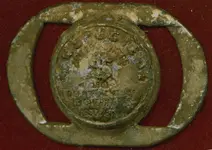
But first, please examine the object itself, as shown in the photos posted by Creskol. (I've re-posted one of his photos in this post, below.) The characteristics of the corrosion on this object indicate it is made of cheap potmetal, or a similar high-zinc-content alloy. Also, the object's front appears to have remnants of very thin brass (or perhaps nickel) plating atop the potmetal. A great many cheap souvenir belt-buckles have that composition and thin plating. This object does not strike me as being any sort of "official" (i.e., government-issued) Inspection-tag.
Next, let's examine the markings on the object. Very importantly, only two parts of the marking ("INSPECTED" and the "$" sign) are in raised lettering - which means that lettering was part of the object when it was manufactured (apparently by metalcasting in a mold). Therefore, the object was manufactured as a "blank" or "stock" item ...with empty spaces left for individualized markings to be added at some point after it left the original manufacturer.
Note also that the largest of all the markings is the $-sign. There must be some reason it is the biggest marking. That seems to indicate a commercial rather than governmental purpose.
The rest of the markings on this object are die-stamped, and are positioned in the spaces that were deliberately left blank by the object's manufacturer.
If this object was issued by one particular country's (or state's) government, why isn't its name in the raised, cast-in lettering ...but instead, the name of a country is die-stamped into one of the blank areas on the object?
Now, let's move on to keyword-searching. My google-searching produced no results for the phrase "Department of Leather Goods Association." Apparently, DoLGA does not exist ...or there'd be a mention of it somewhere on the vast internet. The DoLGA surely would be mentioned somewhere on the 'net if it was a government agency ...especially an agency in charge of inspecting products or the importation or export of products.
My google-searching did produce mention of six countries that have a "Leather Goods Association" ...which, rather importantly, is a commercial business/trade group, not any kind of government agency. Canada and the US have a Leather Goods Association ...but I think more importantly in regard to this object, most of the countries which have a Leather Goods Association are in Eastern Asia (Thailand, Pakistan, India, and China).
Noting the cheapness of the object's construction (junk potmetal), and it being a generic blank/stock type which allows you to die-stamp whatever name or info you wish onto it... I think the "most likely possibility" is that it was produced by a leather-goods manufacturer or Exporter in an East-Asian country as a way to "promote" the supposed high quality ("Inspected" with a nation's name and official-sounding "Department") of its large leather products such as luggage or a pack or totebag.
That is my interpretation of the evidence seen in the photos of the object, and extensive websearching. Other people's interpretation of the evidence may (and probably will) vary from mine.
I've been watching this discussion since it first began, hoping somebody would manage to come up with a well-substantiated ID of the object. Because nobody has managed to do that, I think it's time for me to speak up with the observations and research I've done while watching the discussion ...and my efforts coincidentally happen to provide some Substantiation for Broken Knee's just-now-posted theory.
Most of my past 30-something years as a relic-researcher involved a lot of laborious effort in libraries and museums, digging through old paper records and microfilm/microfiche. Thus I've been delighted by the advent of electronic records, and especially computer keyword-search capability, which has freed me from the need to visit dusty archival basements and filerooms. In particular, keyword-searching has been helpful for investigating markings on known and unknown objects.
But first, please examine the object itself, as shown in the photos posted by Creskol. (I've re-posted one of his photos in this post, below.) The characteristics of the corrosion on this object indicate it is made of cheap potmetal, or a similar high-zinc-content alloy. Also, the object's front appears to have remnants of very thin brass (or perhaps nickel) plating atop the potmetal. A great many cheap souvenir belt-buckles have that composition and thin plating. This object does not strike me as being any sort of "official" (i.e., government-issued) Inspection-tag.
Next, let's examine the markings on the object. Very importantly, only two parts of the marking ("INSPECTED" and the "$" sign) are in raised lettering - which means that lettering was part of the object when it was manufactured (apparently by metalcasting in a mold). Therefore, the object was manufactured as a "blank" or "stock" item ...with empty spaces left for individualized markings to be added at some point after it left the original manufacturer.
Note also that the largest of all the markings is the $-sign. There must be some reason it is the biggest marking. That seems to indicate a commercial rather than governmental purpose.
The rest of the markings on this object are die-stamped, and are positioned in the spaces that were deliberately left blank by the object's manufacturer.
If this object was issued by one particular country's (or state's) government, why isn't its name in the raised, cast-in lettering ...but instead, the name of a country is die-stamped into one of the blank areas on the object?
Now, let's move on to keyword-searching. My google-searching produced no results for the phrase "Department of Leather Goods Association." Apparently, DoLGA does not exist ...or there'd be a mention of it somewhere on the vast internet. The DoLGA surely would be mentioned somewhere on the 'net if it was a government agency ...especially an agency in charge of inspecting products or the importation or export of products.
My google-searching did produce mention of six countries that have a "Leather Goods Association" ...which, rather importantly, is a commercial business/trade group, not any kind of government agency. Canada and the US have a Leather Goods Association ...but I think more importantly in regard to this object, most of the countries which have a Leather Goods Association are in Eastern Asia (Thailand, Pakistan, India, and China).
Noting the cheapness of the object's construction (junk potmetal), and it being a generic blank/stock type which allows you to die-stamp whatever name or info you wish onto it... I think the "most likely possibility" is that it was produced by a leather-goods manufacturer or Exporter in an East-Asian country as a way to "promote" the supposed high quality ("Inspected" with a nation's name and official-sounding "Department") of its large leather products such as luggage or a pack or totebag.
That is my interpretation of the evidence seen in the photos of the object, and extensive websearching. Other people's interpretation of the evidence may (and probably will) vary from mine.
Attachments
Upvote
0


ivan salis
Platinum Member
- Joined
- Feb 5, 2007
- Messages
- 16,836
- Reaction score
- 3,816
- Golden Thread
- 0
- Location
- callahan,fl
- Detector(s) used
- delta 4000 / ace 250 - used BH and many others too
Re: This may be one that never gets ID'ed so I will call it an un-SOLVED MYSTERY
parker is the eastern & western treasure mag * whats it guru
parker is the eastern & western treasure mag * whats it guru
Upvote
0
Broken knee
Bronze Member
- Joined
- Dec 12, 2009
- Messages
- 1,909
- Reaction score
- 785
- Golden Thread
- 0
- Location
- in your back yard
- Detector(s) used
- excal 2
Fisher F75 SE
- Primary Interest:
- All Treasure Hunting
Re: This may be one that never gets ID'ed so I will call it an un-SOLVED MYSTERY
Broken Knee
exactly! Well put, CBG HHTheCannonballGuy said:I've been watching this discussion since it first began, hoping somebody would manage to come up with a well-substantiated ID of the object. Because nobody has managed to do that, I think it's time for me to speak up with the observations and research I've done while watching the discussion ...and my efforts coincidentally happen to provide some Substantiation for Broken Knee's just-now-posted theory.
Most of my past 30-something years as a relic-researcher involved a lot of laborious effort in libraries and museums, digging through old paper records and microfilm/microfiche. Thus I've been delighted by the advent of electronic records, and especially computer keyword-search capability, which has freed me from the need to visit dusty archival basements and filerooms. In particular, keyword-searching has been helpful for investigating markings on known and unknown objects.
But first, please examine the object itself, as shown in the photos posted by Creskol. (I've re-posted one of his photos in this post, below.) The characteristics of the corrosion on this object indicate it is made of cheap potmetal, or a similar high-zinc-content alloy. Also, the object's front appears to have remnants of very thin brass (or perhaps nickel) plating atop the potmetal. A great many cheap souvenir belt-buckles have that composition and thin plating. This object does not strike me as being any sort of "official" (i.e., government-issued) Inspection-tag.
Next, let's examine the markings on the object. Very importantly, only two parts of the marking ("INSPECTED" and the "$" sign) are in raised lettering - which means that lettering was part of the object when it was manufactured (apparently by metalcasting in a mold). Therefore, the object was manufactured as a "blank" or "stock" item ...with empty spaces left for individualized markings to be added at some point after it left the original manufacturer.
Note also that the largest of all the markings is the $-sign. There must be some reason it is the biggest marking. That seems to indicate a commercial rather than governmental purpose.
The rest of the markings on this object are die-stamped, and are positioned in the spaces that were deliberately left blank by the object's manufacturer.
If this object was issued by one particular country's (or state's) government, why isn't its name in the raised, cast-in lettering ...but instead, the name of a country is die-stamped into one of the blank areas on the object?
Now, let's move on to keyword-searching. My google-searching produced no results for the phrase "Department of Leather Goods Association." Apparently, DoLGA does not exist ...or there'd be a mention of it somewhere on the vast internet. The DoLGA surely would be mentioned somewhere on the 'net if it was a government agency ...especially an agency in charge of inspecting products or the importation or export of products.
My google-searching did produce mention of six countries that have a "Leather Goods Association" ...which, rather importantly, is a commercial business/trade group, not any kind of government agency. Canada and the US have a Leather Goods Association ...but I think more importantly in regard to this object, most of the countries which have a Leather Goods Association are in Eastern Asia (Thailand, Pakistan, India, and China).
Noting the cheapness of the object's construction (junk potmetal), and it being a generic blank/stock type which allows you to die-stamp whatever name or info you wish onto it... I think the "most likely possibility" is that it was produced by a leather-goods manufacturer or Exporter in an East-Asian country as a way to "promote" the supposed high quality ("Inspected" with a nation's name and official-sounding "Department") of its large leather products such as luggage or a pack or totebag.
That is my interpretation of the evidence seen in the photos of the object, and extensive websearching. Other people's interpretation of the evidence may (and probably will) vary from mine.
Broken Knee
Upvote
0


Featured Treasure Finds
Featured Treasure Finds
Similar threads
- Replies
- 18
- Views
- 2K

- Question
- Replies
- 3
- Views
- 710


Users who are viewing this thread
Total: 1 (members: 0, guests: 1)















