What's new

What I did on Summer Vacation

BioProfessor

Silver Member
Joined
Apr 6, 2007
Messages
2,917
Reaction score
85
Golden Thread
0
Location
Mankato, MN
Detector(s) used
Minelab e-Trac, White E-Series DFX
Well I made it back from the Netherlands in one piece. Got a chance to do a little metal detecting but not as much as I would have liked. They have such strict laws on metal detecting it is unreal. It is illegal to dig deeper than 14 inches. If you find anything, it must be reported to the local Archeology Committee. They will then inspect the area and decide if it is a significant area. If it is, they take it over and you can't do anything more to the property until they release it. Could be a long time. Consequently, I had a very difficult time hunting anywhere there was private construction going on. There were quite a few houses around where I was staying that were having their basement floors lowered. They were being dug out and exposing soil that contained items from the 16th and 17th century. I kept getting permission to hunt by the contractors and being kicked out by the owners because they were afraid I might find something and they would have to stop work on their house remodel. Not fun. Not much to hunt out of town as all the fields were still in crop. Not having a car didn't help much either.

Well anyway, I found a few things and got to experience a new place to MD. Here are some photos of some items that made their way under my coil.
 

Attachments

  • Basement dig.webp
    Basement dig.webp
    48 KB · Views: 714
  • Jetton.webp
    Jetton.webp
    55.7 KB · Views: 689
  • basment2.webp
    basment2.webp
    36.6 KB · Views: 694
  • seal2.webp
    seal2.webp
    1.4 KB · Views: 646
  • Westcoin.webp
    Westcoin.webp
    26.3 KB · Views: 653
  • silvercoin.webp
    silvercoin.webp
    25.8 KB · Views: 652
  • shot.webp
    shot.webp
    42.5 KB · Views: 667
  • scissors.webp
    scissors.webp
    16.7 KB · Views: 672
  • pin.webp
    pin.webp
    17.7 KB · Views: 686
  • Jetton.webp
    Jetton.webp
    55.7 KB · Views: 687
  • horsecoin2.webp
    horsecoin2.webp
    42.9 KB · Views: 687
  • guilder2.webp
    guilder2.webp
    78.9 KB · Views: 682
  • coinhead.webp
    coinhead.webp
    18.7 KB · Views: 687
  • basment2.webp
    basment2.webp
    36.6 KB · Views: 696
  • Basement dig.webp
    Basement dig.webp
    48 KB · Views: 703
Upvote 0
Wow Prof, those are some awsome finds! Too bad they wouldn't let you hunt more. That's still some really nice relics you came back with. Glad you had a safe trip.
Dave
 
great finds sorry you have so much trouble getting to lock onto a place there and stay with it. keep em comin
 
That kinda suck's on the Archeology side of it Bio....Still it look's like you had some great find's....Congrat's and HH!!
 
Glad you were able to bring some of your great finds back with you. From the way those guys act over there you would think they've been smoking that funny stuff. LOL ;D
 
Cool finds Prof... Welcome home!

Love to here what a few of them are and the stories about finding them. Congrats!

Smiles!
BDoo
 
You did great ,beautiful assortment and even a nice4th cetury Roman bronze.
 
I can't imagine the take you'd have without all the silliness. Nice finds there!
 
Very nice finds,the ground is saturated with goodies wow. :o
 
Very nice finds , sorry to hear all the obsticles you had to deal with
though :P
welcome home and keep a swingin :)

Doozis
 
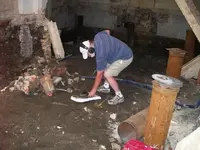
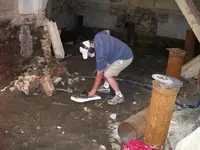
The first picture is what they do in a house in Amsterdam when they remodel. They dig out the basement. When they take out about a meter of soil, they are down to the soil that was there about 400 years ago. The soil is a very heavy, thick clay. It is almost black. It is different from the soil above and you start to "know it when you see it." There is so much water in the soil, they have to drive steel pilings in the ground to support the floor. They use these steel pipes now but when Amsterdam was first built, they used timber (whole trees actually) to support the weight of the buildings in the water-logged soil. Those original 700 year old timbers are still there and many of the houses in Amsterdam built around the canals still depend on them. I was lucky to be able to stay in this basement for several days and search most of the deep soil. Good searching but I had to work at night when everyone was gone and no work was going on.

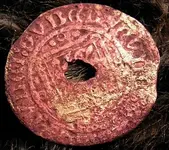
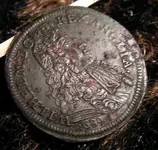
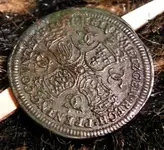
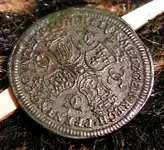
Before the 1700's, most people could not read or write. They couldn't count either. In order to be able to go into a store and buy things, they had to be able to know how much they bought and how much to pay. They did this with items like this Jetton. The merchant had a board with slots on it and the Jettons were moved in the slots according to what amount was represented. It worked somewhat like an abacus. When the transaction was finished both the customer and merchant could "read" the pattern and know what money was owed. This jetton is one produced by a master jetton maker and may be what they call a demonstration Jetton which is like a proof coin and is meant to show the skills of the maker. It is a very superior strike and the detail is much better than a "normal" Jetton. It shows best on the reverse side. I'll post a photo.

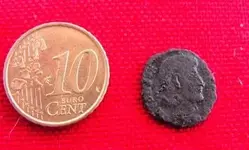
The second coin is a Roman Coin. As best I can tell, it is coin of Constantine the Great, about 310AD. For coins of that time, it is still in good shape.

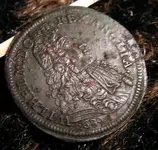
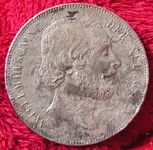
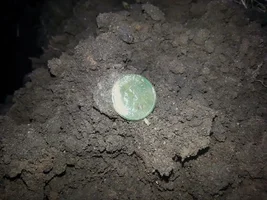
The third coin is an 1869 2 1/2 guilder silver coin. It is slightly larger than a silver dollar. It was dug from a place that receives all the dirt from Amsterdam. They say that the soil in Amsterdam is so polluted that all of it must go to special places to be stored until it can be tested. The soil they take to these places is just put into large piles to dry. It is full of lots of good stuff. Problem is, it is illegal to search it. You have to wait until all the workers are gone and search it then. You dig out a pile of it and then use your metal detector to search it. You just keep digging and searching. Not a lot of fun. Lot of glass, pottery, tile, pipes, and other pretties to take if you can't find any coins. The best coin found in the pile this coin came from was a gold coin from the 16th century.

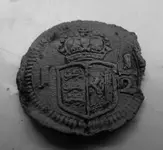
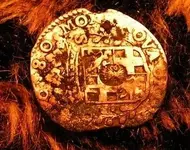
The next coin is a silver "Rijderschelling" from the province Utrecht with a "KLOP" in the center of the coat of arms. That mark indicates the ruler under which the coin was minted has died and the coin is being used by another ruler.

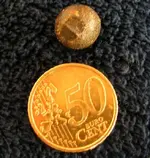
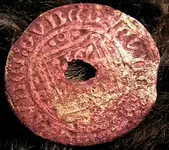
The next item is another Jetton. Many Jettons are found with holes in the middle. Some say that when they were no longer needed, people learned to count, read, write, they were useless and people tried to find uses for them. One use was for decoration and they were nailed to surfaces to make it look nice.

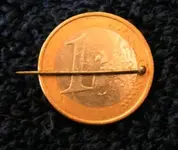
The next item is a hand-made silver straight pin from the 17th century. Only rich people could afford these and they were kept with needles in a special tube that looked much like a lipstick holder does today.

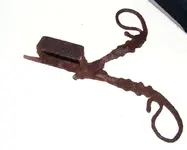
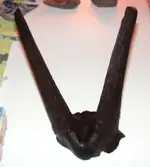
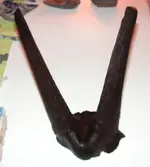
The next item is a pair of silver wick scissors. These were used in a church to trim the wicks on the candles. The metal box would catch the hot wick. It is missing the lid that would be attached to the other piece and close over the box. It is heavily engraved with religious symbols on all sides of the box.

Next is a common musket ball.

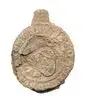
The next item (as well as the last item) is a lead tax seal. Everything sold and shipped that was taxed, had to have these tax stamps attached. Strips of them were attached to add up to the amount of tax paid. Much like stamps are put on envelopes for postage today.

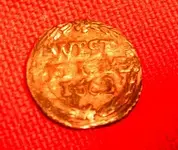
The next item is a coin from West Friesland (Province in the Netherlands) called a Duit. They are common but most times the detail is either worn off or "eaten" by the bad soil.

Well that is what they are. Kind of neat things to find and have.

Daryl
 

Attachments

  • basement 1.webp
    basement 1.webp
    42.1 KB · Views: 565
  • basement 1.webp
    basement 1.webp
    42.1 KB · Views: 543
Professor, the finds look great. It does sound like you had to really work for them.

Don't people detect, find stuff and then never report it? Seems like this would be very easy to do at private home sites.

Bob
 
Wow those are some really nice finds. Shame that people have to be that way. Imagine the treasures that are lost by not being able to detect.

WOW.
 
Nice finds! Too bad they're so strict in their "rules".

lol, I gotta admit, when I read the title, it reminded me of the old Cheech & Chong days....."The 1st day of my summer vacation I got out of bed and went downtown to look for a job.....then I hung-out in front of the drugstore."

Smitty
 
When they finish with the dirt from Amsterdam, they burn it. Thousands of coins and other artifacts up in smoke.

An interesting tidbit that I can't figure out is that every time I dug in a basement, I found goat horns. 400 year old goat horns. 7 in one place. Weird.

Daryl
 

Attachments

  • goatshead.webp
    goatshead.webp
    17.2 KB · Views: 519
  • goatshead.webp
    goatshead.webp
    17.2 KB · Views: 515
cool goat horns! What a waste that they just burn it! i mean, one mans trash could be an entire countries treasure. Just think of all that history just being burned! Ive got a friend who lives in the southern part of NL, if you go back i am sure that her family would have no problem with you diggin around :)
Fantastic finds!
 
Couldn't bring them back though. No animal parts through customs.

Yeah they burn a lot of history. People who work at the places have tried to save some of it and they always get fired. It's burn it or lose your job.

I'm going back next summer. If their land has been dry long enough, there should be stuff there. Problem with a great deal of the Netherlands is that it has been reclaimed from the sea. Hard to find places that have been inhabited very long. Where do the live. Anywhere around Eindoven?

Daryl
 

Users who are viewing this thread

Back
Top Bottom