What's new

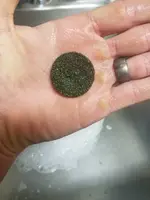
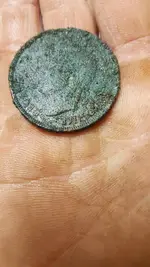
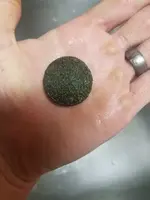
What is this "coin" and how should I go about cleaning it

Just_curious

Sr. Member
Joined
Aug 27, 2017
Messages
332
Reaction score
273
Golden Thread
0
Location
Georgia/Alabama
Detector(s) used
Minelab GM1000
White's GMZ
White's Spectrum XLT
Primary Interest:
All Treasure Hunting
Found this today just north of the Florida/Alabama border. I was using my whites spectrum XLT. It registered as 80-90 which usually indicated silver, and was probably 6-7 inches down. When I pulled it out of the ground and swung it over my detector, it registered as 0.00 which is indicative of either iron, foil, or gold. Not magnetic, so I'm leaning away from iron.
 
20180218_210627.webp20180218_210617.webp
 
Upvote 0
Hydrogen peroxide soak is my first step to clean up
 
Upvote 0
I've used peroxide before and it turned the coins black! My main concern is, if this is some sort of bronze or copper ancient piece, I don't want to rid the patina. The green color makes me think it could possibly be something like that. I'm baffled. Like, it wasn't found on a beach or by the ocean...but was found not too far off of alabama's gulf coast. It also is right along the Spanish' expedition trails...so who knows. I want to make sure I am very careful just in case. I have it soaking in soapy water right now, and who even knows if that's a bad idea.

I've heard of peroxide before..it just hasn't worked for me in the past. I've also heard of olive oil. Some people are completely for and against both, so it's a tough decision to make.
 
Upvote 0
Did you forget the coin in the hole that set your whites off at 80-90?

Most times I'll soak a coin and heat up in toaster oven at 200 degrees for 10 minutes. The crap drys quick. The coin expands and breaks the bond with the dirt encrusted corrosion enough to get it clean with toothpick.
 
Last edited:
Upvote 0
I swung my detector over the ground and got a high signal jumping between 79 and 90. I dug, used my carrot, nothing. Swung my detector again, and it was still in the hole. So I dug and dug, until finally it came out. Just to make sure that it was indeed the target after seeing it out of the hole, I swung it under my coil. Nothing but 0's. Swept my coil over the hole, and got nothing. My assumption is that the detector was going off of shape more than type of metal until I actually got it out of the hole.
 
Upvote 0
Not being a pro at cleaning coins, i would say mild soap and water scrub with a toothbrush. Then soak in olive oil if further cleaning is needed.
 
Upvote 0
Not being a pro at cleaning coins, i would say mild soap and water scrub with a toothbrush. Then soak in olive oil if further cleaning is needed. Not sure how your particular machine works but some are focused more on shape/size, than metal conductivity. So what ID's as silver sometimes may not actually be silver.
 
Upvote 0
First off, what you have right now is a worthless, coroded copper disc. Until it is cleaned enough to determine IF its a coin nothing can be determined. You have nothing to lose, so get as tough as you want. Secondly, with as mucb corrosion as that has, you could have literally nothing left underneath. Lastly, if you detector gave a 0 response??? I would have the detector checked out.
 
Upvote 0
Can you make out any words or symbols? Have you weighed it and compared with other coins of similar size? Other than that maybe send it to a professional service for cleaning . Reminds me of the only large cent I have found as far as condition. I did not know what it was until I looked carefully with a jewelers loupe under a bright lamp and started to see words. Then I soaked it in water and cleaned lightly with a soft bristle toothbrush. Good luck !
 
Upvote 0
I had no luck cleaning a copper coin toasted like that. You could "kind of" see "something" but nothing I could use for I.D.. Your mind can see many shapes. You might try getting good measurements and weights. There are some amazing people here that can probably get close to figuring out what you have. Always wonder HOW those old coins ended up where you find them. Good luck.
 
Upvote 0
I can see a "lip" around the outside edge, and then on the faces of the coin, right under the "lip", is some sort of decor. It's a bunch of indentations or notches. There so much old sand stuck to it that I'm trying to break loose. I'm wondering about maybe a high-pressure little nozzle? Like power washer, but on a WAY smaller scale. Just to try to break that sand free. I haven't done any rubbing or scraping away at it. Trying really hard to leave any patina and not bring it down to bare metal.
 
Upvote 0
Hammer and chisel :violent1:
 
Upvote 0
I like Rick67's idea of expansion and contraction to break free the encrustation.
 
Upvote 0
All of my old coppers have come out of PA clay/dirt. Game plan here is to not get them wet as keeping some dirt often helps capture detail. I have found some coins and jewelry at the beach with the sand cement. Basically just chipped the cement away with wooden skewer. Maybe someone with more old copper coin experience recovered on the beach will chime in. My advice is to take pics along the way with whatever process you choose in case thing go badly. Let us know how it goes.
 
Upvote 0
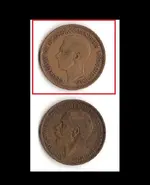
I'm done messing with it. I'm going to bring it to a professional. I think it may be a lavrillier pattern penny. Resized_20180219_195737.webp

I've cleaned it enough to know that the man has a mustache, and the letters IMP-GEORGE at the bottom. Fingers crossed!!
 
Upvote 0
What does the other side look like, date should be under figure center bottom, hope for 1933!
 
Upvote 0
George V1 penny modern

SS
 
Upvote 0
The bust matches the George VI pattern (struck 1937 - 1945)
 

Attachments

  • lavrillier.webp
    lavrillier.webp
    53.1 KB · Views: 76
Upvote 0

Users who are viewing this thread

Back
Top Bottom