What's new

🔎 UNIDENTIFIED What Is This - No Idea ??

Cariboo5

Bronze Member
Joined
Oct 27, 2011
Messages
1,115
Reaction score
2,660
Golden Thread
0
Primary Interest:
Prospecting
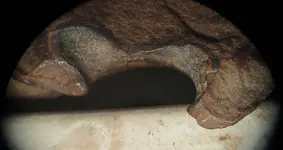
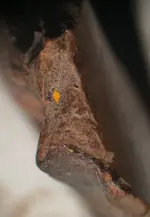
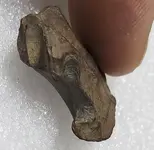
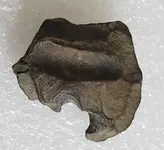
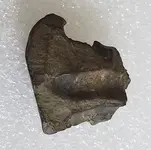
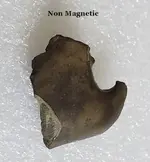
When down to the river to classify some material and do some gold panning. Walked down stream 300 yards from the bridge and dug 5 feet up from the waters edge. Found this piece that I am not sure what it could be. It is light weight,non-magnetic, looks polished, has grooves in it and of all the things what looks like some bright yellow paint chips.

Yellow paint chip appears to be similar colour as the highway divide lines, could this piece been part of the ash fault, could there have been over spray and some got on this piece or ?? During high water it was carried down stream from some where and deposited where it was found.

Any and all thoughts welcome ...... Thanks to all in advance .....
 

Attachments

  • What 1.webp
    What 1.webp
    37.3 KB · Views: 159
  • What 6.webp
    What 6.webp
    156.8 KB · Views: 143
  • What 5.webp
    What 5.webp
    164.8 KB · Views: 134
  • What 4.webp
    What 4.webp
    43.2 KB · Views: 127
  • What 3.webp
    What 3.webp
    37.9 KB · Views: 138
  • What 2.webp
    What 2.webp
    41.9 KB · Views: 126
What you have is a classic piece of "Leaverite." Congratulations on a classic find!:laughing7:
 
Upvote 0
IMO it's just a plain natural rock. Rocks in rivers frequently look polished, so that doesn't necessarily indicate anything. Same with "paint chip" -- could be from any random incidental contact, and does not appear to have been intentionally painted.
 
Upvote 0
IMO it's just a plain natural rock. Rocks in rivers frequently look polished, so that doesn't necessarily indicate anything. Same with "paint chip" -- could be from any random incidental contact, and does not appear to have been intentionally painted.
Yes robertk we are leaning towards that same conclusion .....

 
Upvote 0
I agree with Robert's thought's ! But it looks like it could possibly be a piece of slag ....... MAYBE from a old smelter ? Crush it up to powder and then look at it through a 10 or 20 power loop to see if there is any gold specks !

 
Upvote 0
I agree with Robert's thought's ! But it looks like it could possibly be a piece of slag ....... MAYBE from a old smelter ? Crush it up to powder and then look at it through a 10 or 20 power loop to see if there is any gold specks !

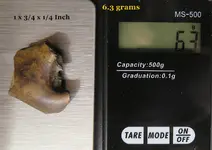
I understand why you mentioned possibly slag as in some pictures there appears to be on the edges possible tiny fusion crusts. The weight of this piece is very light at 6.3 grams and I would expect slag of this size to be some what heavier. It is unique and one of a kind for me so it will remain in one piece.....

 

Attachments

  • What 6.3 Grams.webp
    What 6.3 Grams.webp
    213.8 KB · Views: 78
Last edited:
Upvote 0
I understand why you mentioned possibly slag as in some pictures there appears to be on the edges possible tiny fusion crusts. The weight of this piece is very light at 6.3 grams
and I would expect slag of this size to be some what heavier. It is unique and one of a kind for me so it will remain in one piece.....

I'm now thinking a piece of root ball (wood) or bone.

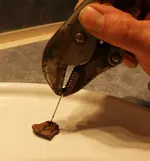
Have you thought about testing it with a hot needle. If it was wood/or some other material as a plastic it would melt/burn a hole quick enough.
 
Upvote 0
I'm now thinking a piece of root ball (wood) or bone.
Have you thought about testing it with a hot needle. If it was wood/or some other material as a plastic it would melt/burn a hole quick enough.
This river is about 60 miles long and has a rich gold rush history dating back to the 1860's. One will never know if this was first miles and miles upstream and
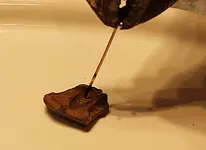
took years to travel down stream during spring flood and be deposited where it was found. I followed up with your idea pepperj and took a hot needle (see attachments)
and it had no effect what so ever. Looks like the first thoughts of being a rock is correct......
 

Attachments

  • Needle 1.webp
    Needle 1.webp
    110.1 KB · Views: 48
  • Needle 2.webp
    Needle 2.webp
    93.4 KB · Views: 56
Upvote 0
It could be bone possibly.

Why Paleontologists Lick Bones
Licking is a standard field identification technique used to distinguish fossilized bone from common rocks or petrified wood.
  • Stickiness: Real fossilized bone is highly porous. When you touch your tongue to it, these microscopic pores act like tiny sponges and suck up the moisture from your tongue, causing it to stick. Most rocks and petrified wood are not porous and will not cause this sticking sensation.
  • The Silt Test: Geologists also put samples between their teeth to detect grain size. If the specimen feels gritty, it contains silt; if it feels smooth, it is clay.
 
Upvote 0
It could be bone possibly.

Why Paleontologists Lick Bones
Licking is a standard field identification technique used to distinguish fossilized bone from common rocks or petrified wood.
  • Stickiness: Real fossilized bone is highly porous. When you touch your tongue to it, these microscopic pores act like tiny sponges and suck up the moisture from your tongue, causing it to stick. Most rocks and petrified wood are not porous and will not cause this sticking sensation.
  • The Silt Test: Geologists also put samples between their teeth to detect grain size. If the specimen feels gritty, it contains silt; if it feels smooth, it is clay.
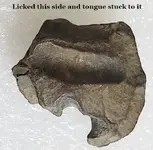
Well I'll be darned, you're taking this down a very different path than expected pepperj. I did lick the unpolished side and it did stick... Amazing..
 

Attachments

  • What Licked.webp
    What Licked.webp
    43.1 KB · Views: 69
Upvote 0

Users who are viewing this thread

Back
Top Bottom