What's new

And you wonder how coins get so deep!

deepskyal

Bronze Member
Joined
Aug 17, 2007
Messages
1,927
Reaction score
62
Golden Thread
0
Location
Natrona Heights, Pa.
Detector(s) used
White's Coinmaster 6000 Di Series 3, Minelab Eq 600
Primary Interest:
Metal Detecting
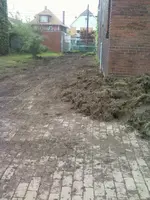
Dumb luck I'd say finding this place...didn't find a thing. Went to vote yesterday and right across the street is this old school from 1921. As you can see from the pics, there is/was a good 4-5 inches of dirt and grass on the old patio/walkway.
This is the 2nd place in this town I've detected and found the old walkway about 5" under the dirt....except this time the current owner is trying to clear it off.
So when you ask the question of how do coins get so deep...this shows years of dirt just accumulate in some places. :dontknow:

Al
 

Attachments

  • 0517111548.webp
    0517111548.webp
    94 KB · Views: 822
  • 0517111549a.webp
    0517111549a.webp
    178.1 KB · Views: 804
  • 0517111549.webp
    0517111549.webp
    78.1 KB · Views: 811
There is a park that I go to all the time and over by the tot lot there is sand and over the years they have put more sand over the sand and then wood chips on top of that. That really sucks because that is a old park over 100 years old. Imagined all the stuff that is underneath there.
 
Hoze513 said:
There is a park that I go to all the time and over by the tot lot there is sand and over the years they have put more sand over the sand and then wood chips on top of that. That really sucks because that is a old park over 100 years old. Imagined all the stuff that is underneath there.

Seriously! I'd love to see them yank these bricks up. Imagine what might have gotten dropped between them or before they were layed down.
 
It's all a natural cover up. Vegetation decays and turns to dirt. In my area of Maryland 31/2" to 4" down is finds from the '40s. 13" down is finds from 200 years ago. There are plenty of exceptions like gravel drives or flood prone areas. Frank
 
I detect at a location in NW Pennsylvania. Supposedly one of the oldest houses in the county. Never had soil brought in (at least since the 1960's), but I find memorial cents buried 5" +. The only thing I can figure is that the ground out there is very wet, and often saturated. Maybe that makes heavier items sink faster than they would in a dryer lawn. The really old things may be almost beyond reach.
 
Scott, nothing sinks in the ground, it gets covered up by decayed vegetation. wind and water erosion and coverage etc. Look in the cemeteries, the heavy headstones are still where they were placed, some over 100 years ago. I don't know where this misconception came from but the new guys seem to fall for it. Frankn
 
If you're in the Pittsburgh area, it doesn't surprise me. In the old days the steel mills put out a lot of particulate matter (aka dirt) in the air, which had to fallout somewhere. I have noticed the "sunken" sidewalks near the steel mills in my area.
 
In the link below we have Charles Darwin describing how earthworms drag leaves, sticks and stones weighing as much as 2 ounces into their burrows. Somewhere I saw an estimate that as much as a ton of earth is moved this way per acre per year, and that one acre of meadow could hold nearly a million earthworms.

Really, read just this one page and you may want to go back and start from the beginning.
http://charles-darwin.classic-literature.co.uk/formation-of-vegetable-mould/ebook-page-13.asp
 
Yes, it doesn't take Mother Nature long to start reclaiming everything once people move out.
 
Batcap, I read the Darwin story and found it hard to swallow. A worm, a creature with no arms or legs, Dragging sticks and stones into its burrow! It's like the old theory that worms ate the earth in front of it and excreated it in the rear. This theory was disproven when it was discovered that the worm moves ahead by expanding it's "head" portion after compressing it and forcing it forward.
Some of Darwin's theory's have come into question lately. A fish has been discovered in the Indian ocean that was thought to be extinct . It's fossil remains are in rocks millions of years old. It is exactly the same as it's fossil remains. So much for evolution. Frank
 
Frankn said:
Batcap, I read the Darwin story and found it hard to swallow. A worm, a creature with no arms or legs, Dragging sticks and stones into its burrow! It's like the old theory that worms ate the earth in front of it and excreated it in the rear. This theory was disproven when it was discovered that the worm moves ahead by expanding it's "head" portion after compressing it and forcing it forward.
Some of Darwin's theory's have come into question lately. A fish has been discovered in the Indian ocean that was thought to be extinct . It's fossil remains are in rocks millions of years old. It is exactly the same as it's fossil remains. So much for evolution. Frank

I know, some people refuse to admit that Darwin could have been right about anything, and are quite sure that he's endlessly burning in Hell for writing "On the Origin of Species". :blob8: :angry4:

So, for the benefit of those people I submit this article from "The Institute of Creation Research" that takes "bioturbation" as fact, and uses it as rebuttal to the theory of evolution. So, it's safe for fundamentalist Christians to believe what Darwin wrote about the worms in his back yard. :tongue3:

http://www.answersincreation.org/rebuttal/icr/btg/back_to_genesis_1_jul_09_bioturbation.htm

Note that the article refers to the Wikipedia definition of Bioturbation, which credits Darwin for the idea, if not the word.
 
at least no coins would have made it through the pavers
 
Frankn said:
Scott, nothing sinks in the ground, it gets covered up by decayed vegetation. wind and water erosion and coverage etc. Look in the cemeteries, the heavy headstones are still where they were placed, some over 100 years ago. I don't know where this misconception came from but the new guys seem to fall for it. Frankn

so i am curious if nothing sinks and is just covered up as you describe why do you find silver and indians sometimes at 8" deep but there is no build up around the trees or the house foundation where you are hunting....and i dont see much wind and water erosion in the yards i hunt.
also how would explain that if in deed nothing sinks then why is it that loose soil coins are deeper and more compact soil coins are usually not as deep????? and most of the 100yr old headstones around where i live are either leaning or falling over as their bases have sunk into the ground over the years.......
 
Teverly, Yards are changed by man over the years, graded, planted, etc. so your finds dept will varry also. Trees grow up so you notice no buildup at their base. Rain striking houses runds down the sides tending to move material away from them. Headstones lean, but they don't sink. If they sank, the older ones would be gone. The amount of buildup varries greatly. In the desert of AZ I have found old cars that have probably been there since the 1920's and there rims were still above ground. In my area of Maryland, coins lost in the 40's will be app. 3 to 4" in the ground. Items lost 200 years ago will be app. 10 to 13" in the ground. My point is that gravity is such a week force that it is not going to pull anything into the ground and it pulls on all things equally reguardless of weight. Frank
 

Users who are viewing this thread

Back
Top Bottom