What's new

Brick Structure - Special Purpose?

Don in SJ

Silver Member
Joined
May 20, 2005
Messages
4,938
Reaction score
859
Golden Thread
0
Detector(s) used
MINELAB SE Pro
Primary Interest:
All Treasure Hunting
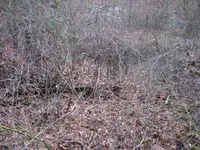
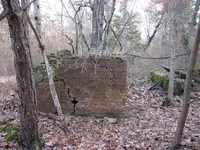
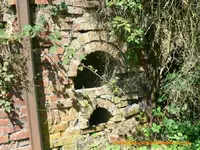
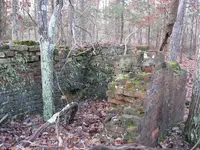
I went exploring today and came upon a old structure that at first I thought just a remains of a dwelling but now I am thinking it might be the remains of some special purpose building. My son suggested possible steam saw mill site from late 1800s or so, but I am clueless on this one.

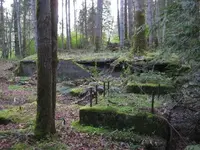
There is some rebar enforced foundations a few feet away and also a large cellarhole or depression adjacent to it.

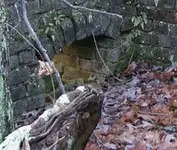
What gets me is the thickness of the walls, at least 4 bricks thick and the archway opening at ground level.

Do I think this is a normal homestead in the woods, nope, so looking for an answer as to what this brick structure was part of at one time.

Estimate age no later than 1900, and no idea how early but assuming mid to late 1800s.

Not near any town or current paved road, at least a mile to the nearest paved road.

Don
 

Attachments

  • IMG_0030.webp
    IMG_0030.webp
    263 KB · Views: 523
  • IMG_0031.webp
    IMG_0031.webp
    313 KB · Views: 525
  • IMG_0025.webp
    IMG_0025.webp
    254.5 KB · Views: 537
  • arched opening.webp
    arched opening.webp
    55.3 KB · Views: 532
I'm not sure. It doesn't look like any furnace or kiln that I've seen.
It does appear to have soot on the bricks.
Is it possible it may have been a smoker?
 
Upvote 0
Well for sure it is not iron furnace or forge related, they were long gone in this area in the 1840s, and they did not look anything like this. The smoke house idea is feasible but not something I have ever heard of or seen in this part of the country. The bricks do appear blackened, unless that is from a fire that demised the site.

Don

 
Upvote 0
Perhaps it is a base for a wooden(?) structure that was there. We have a park that was a huge coal mine complex in it's day and all that's left are some foundation remains for the most part.

The bolts in your third photo on the foundation look similar.

morden.webp

Jay
 
Upvote 0
Charcoal kiln to make charcoal for forging or gunpowder manufacturing ? Just my WAG .
 
Upvote 0
I'm going to go with a smokehouse since the firepit looks to be below the level of the "hanging" level. Would have been a good-sized one, and a good one with the sides so thick. There were really hardworking, ingenious people who had massive talents, who inhabited the backwoods areas of our country. My dad was one of them. No telling what you would have found if you'd inspected his living areas.

Let me know if you discover more. Nice site!! - Noodle
 
Upvote 0
I think just like not being a Iron Furnace, since it does not resemble the type used here from the late 1700s up to about 1840, I also would say not a charcoal kiln either, my house sits on the site of where charcoal was made for the nearby Iron Forge down the old road from my house and they were just logs piled in like a Teepee fashion and covered with the sugar sand in the area for slow burn. I think the Charcoal making Industry died out here at the same time frame.

Smoke house still is most plausible response I think, but still no logical reasoning to say it is for sure. Purpose of the Archway opening at the bottom and an example would be more telling for solving I believe.

One thing that bugs me is the nearby concrete and re-bar/bolt foundations and the large cellarhole. Most smoke houses I remember seeing while driving thru New England were not close to any other structure for obvious smelly reasons I suppose. :)

Don

 
Upvote 0
Don,

I can't say for sure, but the archway/hole low in the wall of the ruins is consistant with the typical meat smoking process. Smoke from a fire outside the arch would be drawn in to the smokehouse or fresh air would be drawn in to feed a fire inside the smokehouse. I believe that is the difference between "cold smoking" and "hot smoking" of meats.

I also read some info about where a smokehouse might be situated. Archaeologists have found evidence in Williamsburg that colonial farmyards were designed in zones. There was a clean zone nearer the house for doing laundry and preparing food. Another zone for dirtier work like slaughtering, butchering, and smoking would be a little farther away. They were able to determine that the door of the smokehouse faced away from the clean zone. One other interesting note was that the smokehouse was kept near enough to be defended from wild animals.

Here is a pic of a smokehouse in colonial Williamsburg.

smoke_42_2.jpg


DCMatt
 
Upvote 0
:read2:

Could it be a brick kiln :P Like this one, found near the Oxford canal, I know the walls on them have to be quite thick :dontknow:

SS
 

Attachments

  • Oxford-Canal-Brick-Kiln-3.webp
    Oxford-Canal-Brick-Kiln-3.webp
    112.2 KB · Views: 385
Upvote 0
Our town had brick factories in the late 1890's up till about WW2 era I believe and they look nothing like that and are more beehived shaped and usually are located close to the clay deposits.( no such quarries anywhere in the area) The area this was found is most gravel/sandy soil with nearby pure sugar type sand that is prevalent in our South Jersey areas. So, I would say most likely not related to bricks, but not totally ruling that out.

I am going to have to do a followup trip to this site next month, weather permitting and examine the structure more closely, like, looking for burnt items, of which I do not remember any junk like charcoal, coal or other items laying around. Maybe a the floor area might show some clue. I will take more photos next time. Like I said, I really did not notice the unusual features until I got home and downloaded the photos. :)

Good responses so far!

Don

 
Upvote 0
You might try some of the abandoned in New Jersey sites... there are a few out there. Looks kind of like the Harrisville ruins in Bass River Township. Abandoned paper mill. There are a ton of "forges" around here.

 
Upvote 0
I was thinking brick kiln also due to the thick walls. Monty

 
Upvote 0

Users who are viewing this thread

Back
Top Bottom