What's new

Bullet help.

Garabaldi

Bronze Member
Joined
Jun 28, 2009
Messages
2,382
Reaction score
100
Golden Thread
0
Detector(s) used
Whites M6, Whites Pulse Diver, ETRAC.
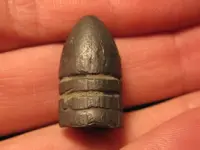
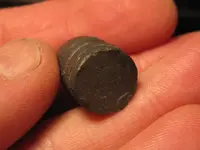
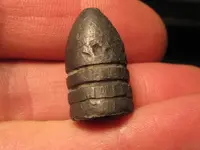
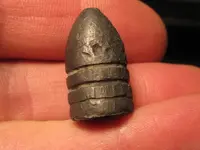
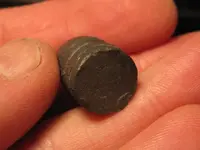
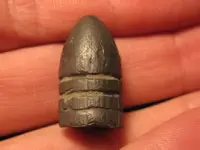
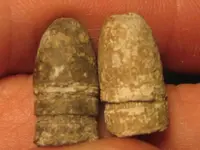
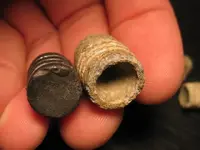
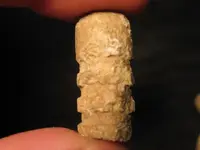
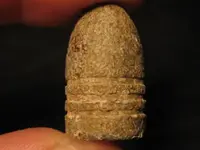
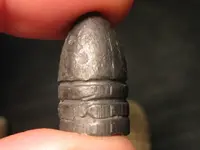
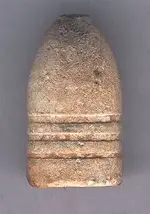
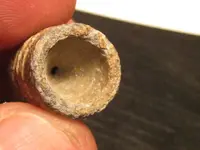
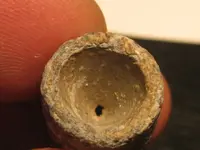
I thought this was a musket bullet, civil war era, but someone said it is a "modern black powder bullet". :icon_scratch:
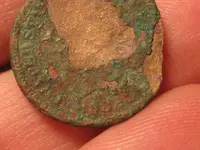
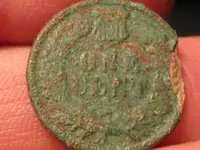
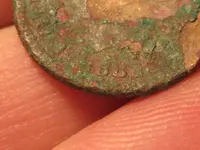
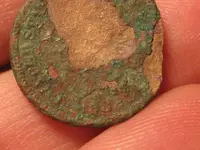
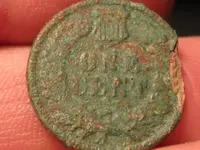
I dug it in thick grey mud. I have been finding alod coins here. I had found a shiled nickle and with this bullet today I found an 1882 IH Penny.
 

Attachments

  • IMG_2003.webp
    IMG_2003.webp
    20.4 KB · Views: 765
  • IMG_2004.webp
    IMG_2004.webp
    22.5 KB · Views: 749
  • IMG_2005.webp
    IMG_2005.webp
    27.1 KB · Views: 741
  • IMG_2000.webp
    IMG_2000.webp
    48 KB · Views: 746
  • IMG_2002.webp
    IMG_2002.webp
    45.2 KB · Views: 743
  • IMG_2001.webp
    IMG_2001.webp
    36.9 KB · Views: 694
  • IMG_2000.webp
    IMG_2000.webp
    48 KB · Views: 737
  • IMG_2005.webp
    IMG_2005.webp
    27.1 KB · Views: 728
  • IMG_2004.webp
    IMG_2004.webp
    22.5 KB · Views: 717
  • IMG_2003.webp
    IMG_2003.webp
    20.4 KB · Views: 717
  • IMG_2002.webp
    IMG_2002.webp
    45.2 KB · Views: 706
dick99344 said:
l.cutler said:
Yes, it needs to be looked at to be sure. I don't think it is a modern muzzle loading bullet. I have been shooting black powder and casting my own bullets for over 30 years and never saw one like this. A muzzleloading rifle bullet has to be able to be loaded down the bore but must engage the rifling. This is accomplished in one of three ways. An undersized bullet with something covering it to engage the rifling, patched round ball, paper patched bullet, or todays saboted bullets. The second is an undersized expanding bullet eg., the hollow based minie that expands upon firing. The third is a solid based bullet that is oversized, forced down the barrel engaging the rifling upon loading. The solid type bullet generally has raised rings to engage the rifling with grease grooves in between. The bullet here does not have raised rings, it would have to be oversized and forced down the bore. This would be virtually impossible to do with a ramrod. The rifling on the bullet is also very shallow, not like the grooves in a modern muzzleloading barrel. The grooves in a cartridge gun are much shallower, the bullet being oversized and forced through, they do not need to be deep to engage the rifling.

Good information. For those that don't cast bullets, I cast two types of solid based conicals for my Hawkin rifle. A maxi ball penetrator, and a maxi ball hollow point at 430 grains. They do not look anything like that pictured. My molds were made by Thompson Center Arms. These molds cast a bullet with a very slight taper from top to bottom. This taper allows for easy insertion into the muzzle just far enough so that a short starter can be used to get the bullet into the muzzle a distance of a few inches, a ram rod can be used from there once the bullet engraves the rifling. I can easily get a 1 to 1 1/2 inch 3 shot group at 75 yards off the bench. These bullets being tapered, they do not require raised rings but do require the use of a short starter. Perhaps if the bullet was measured for any taper from top to bottom, this might give a clue as to it being modern or not. However I have never seen a modern solid based bullet with a nose shaped like that pictured. If a short starter was used, there should be a small slight circle shaped indentation cut around the nose of the bullet different from what a ram rod would make. I do not think it is modern. MHO-HH

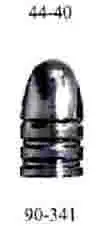
I have been thinking about this bullet and offer this opinion for further evaluation. Perhaps it is possible that this was a black powder cartridge bullet, photo included here is not an exact match for the one in question but I show it as an example. I use information from my black powder cartridge reloading manual written by Randolpf S. Wright.

The tools required to reload a cartridge in the field included a hand held priming and deprimer tool (Simmons manufacture) and a bullet seating tool (NO crimping tool as the bullets are a press fit). Basically, you remove the old primer and insert a new one. Pour a measured amount of powder into the cartridge, the amount depended on how far the bullet was to be seated in the cartridge. A card wad would then be loaded on top of the powder charge. If grease grooved bullets were to be use you would apply the lube to the grooves and seat the bullets into the cartridge. You wanted a combination of powder, card wad, and bullet seating depth to compress the powder charge about 1/8 of an inch. You did not want any head space in the cartridge. If you needed more of the the bullet bearing surface to be seated in the bore, then you would adjust the combination for the desired results.

The soft lead bullets of this era could be upset by the detonation of the powder charge allowing the the bullets to fill the grooves in the bore. I have recovered fired solid base bullets from my own black powder Sharps and the rifling grooves are clearly visible on the rounds. I have used loose bullet (properly seated in the bore with a special bullet starter) and powder in my sharps with similar results. Loose powder and bullet were used in the black powder Sharps before paper or brass cartridges. My sharps also has shallow rifling in the bore. Looking at the photo of the bullet in question, it appears that the bottom groove has been compressed more than the other grooves leading me wonder if this was a black powder cartridge bullet cast from a mold long out of production or perhaps it was fired as a loose bullet and powder combination. Of course the complete details of reloading the black powder cartridge are compressed here. The method of reloading in the field and at home at the bench are slightly different. A more accurate round can be made at the bench.

I submit this information only as an idea of what this bullet could be. I of course can be completely wrong in my opinion but this makes sense to me. HH
 

Attachments

  • 90-341.webp
    90-341.webp
    1.9 KB · Views: 374
Upvote 0
I don't think there is any question that it is a black powder cartridge bullet [my opinion], which one is the problem! Some have already been suggested above. Somewhat larger than .50 caliber narrows it down some. I suppose bullets made by different manufacturers may look somewhat different from others making exact ID more difficult.
 
Upvote 0
If this statement is true "I don't think there is any question that it is a black powder cartridge bullet"(i.cutler). Does this mean that the bullet is from the CW era? :-\
 
Upvote 0
Garabaldi said:
If this statement is true "I don't think there is any question that it is a black powder cartridge bullet"(i.cutler). Does this mean that the bullet is from the CW era? :-\

No. Just means that the poster was convinced on the basis of the physical attributes and characteristics of the bullet that it's for a black-powder firearm. I tend to agree.

I would further venture that it's modern, not a CW relic due to the appearance of the rings (sharp-edged, and no sign of the slope characteristic of most such 3-ringers from the CW period) and other features such as the complete lack of an expansion cavity.
 
Upvote 0
"not a CW relic due to the appearance of the rings (sharp-edged, and no sign of the slope characteristic of most such 3-ringers from the CW period)"(mirage83). With respect, I disagree with this statement. If you look closely you can see a slight slope in the goves. I think that because I found this encased in mud 10" down, it is not typical to see a bullet in this condition. I suspect if this bullet was dusty and exposed to the natural elements, you would be able to see the slope characteristics. This bullet is in the same condition as if it were made yesterday, so the rings seem to have sharp-edges. :dontknow: What do you guys think about that theory. :icon_scratch:
 
Upvote 0
Garabaldi said:
With respect, I disagree with this statement. If you look closely you can see a slight slope in the goves. I think that because I found this encased in mud 10" down, it is not typical to see a bullet in this condition. I suspect if this bullet was dusty and exposed to the natural elements, you would be able to see the slope characteristics. This bullet is in the same condition as if it were made yesterday, so the rings seem to have sharp-edges. :dontknow: What do you guys think about that theory. :icon_scratch:
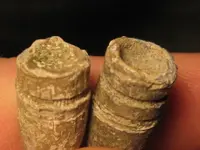
You've taken some very close, very sharp pictures of the bullet, and I haven't noticed any sign of the slope typical of most 3 ringer's. The slope in most 3-ringers I've personally seen and seen in my CWP2 are pretty distinct. Your bullet shows no sign at all of such a slope.

As for the rings, well, the molds used at the time of the CW imparted a far more rounded edge to them. Your bullet has very sharp, very "edged" rings.

In the end, I feel you're probably going to believe whatever you prefer to believe about the bullet. Could it actually be a CW relic? Yes it could. I wish everything I found was a CW period relic, it's hardly an uncommon sentiment among MD'ers who have an interest in that period. But the physical characteristics of your bullet argues against it.
 
Upvote 0
"In the end, I feel you're probably going to believe whatever you prefer to believe about the bullet."(mirage83). This is not true. I actually have a passion for Colonial artifacts rather than CW. I am just trying to, with the help of TNET members, figure out the correct ID to this bullet. I am probably the least qualified member on bullets, but am adding my two cents to try and help, seeing how I was the one who dug it and know details of the area where it was found.
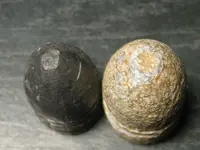
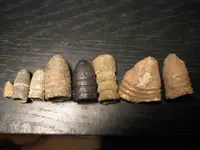
I have included images of my entire collection on musket bullets. I am still seing a slope if you follow the rings around and look at the sides. I see that the grooves on the sides are not square, but rather tapered. There is a slight radius. I have taked an image of three bullets holding them in the same position and they all seem to have the same slope in the gooves unless we are talking about two different parts. Your saying slope and I am saying radius. The bullet that is a bit larger, but in the same shape except the botton, I had also found in the same area, but not in the muddy area. It was under a bunch of small rocks in the ocean. I also found the two smaller bullets that are the same size, not sure what they are.
The second bullets grooves actually seem more square than the bullet in question. Do you think the second bullet is CW?
 

Attachments

  • IMG_2020.webp
    IMG_2020.webp
    37.1 KB · Views: 353
  • IMG_2022.webp
    IMG_2022.webp
    27.3 KB · Views: 338
  • IMG_2023.webp
    IMG_2023.webp
    24.3 KB · Views: 331
  • IMG_2028.webp
    IMG_2028.webp
    22.6 KB · Views: 341
  • IMG_2026.webp
    IMG_2026.webp
    33.2 KB · Views: 334
  • IMG_2027.webp
    IMG_2027.webp
    12.1 KB · Views: 346
  • IMG_2024.webp
    IMG_2024.webp
    22.1 KB · Views: 349
  • IMG_2025.webp
    IMG_2025.webp
    19.7 KB · Views: 330
Upvote 0
LOL. :laughing7: Which second bullet? Not really sure which one you're referring to.
 
Upvote 0
The third image #2024.
 
Upvote 0
For the record some civil war bullets were machine made and had fairly sharp edged rings . The Merril carbines are an example. there are several more as well.
 
Upvote 0
Does look a little larger than the one in question, maybe .57 or so? Rings are spaced a little wider than most bullets found in my area, but such spacing isn't unknown in many bullets from that era. Nice wide conical cavity in the base for good expansion against the rifling. Rather course-looking surface and patina without any really sharp, clean edges. Just based on appearance and a rough-guess at the caliber I'd say yes, it's probably from the CW-period if not CW itself.

And yes, I think we're were talking about two different things in regards to my mention of slope. I'm speaking of the angled decline from the O.D. of the body of the bullet inward into the grooves between the rings.
 
Upvote 0
vayank54 said:
For the record some civil war bullets were machine made and had fairly sharp edged rings . The Merril carbines are an example. there are several more as well.

Quite true, though from the pictures posted I feel the bullet in question was probably cast rather than machined.
 
Upvote 0
There are some cast bullets that have squared off rings too. The Allen-Whitlock revolver bullet and a Barthlow are two. As a matter of fact the rings and spacing on those look almost the same as on the bullet posted. The Allen-Whitlock only has 2 rings though.
 
Upvote 0
I've been reading and thinking and I am thinking I don't know! But it looks like Breezie has come the closest so far. I am pretty well up on cased bullets (late 1800s to present), and although I shoot muzzle loaders, I mostly use saboted bullets. So, I thought first it was modern mainly because I never saw a flat based civil war bullet in .51 caliber. But Breezie demonstrated that there was one. Then I thought the ogive on the bullet in question was sharper pointed than Breezie's example, but it could have been slightly flattened if it impacted anything soft. Also, different manufacturers vary slightly in bullet shapes. I haven't read the weight of the bullet and that could tell us something. Bullets weights are usually given in grains, but there are conversion charts online. Conclusion? I still don't know! But I will stick around and see what comes up. M :dontknow: nty
 
Upvote 0
I was wondering when you were going to jump in here and help Monty ;D
 
Upvote 0
I am hesitant to jump in on these early bullets because so many are homemeade with molds made by the local gunsmith. I didn't see any sign of it being crimped so I am fairly sure it is a muzzle loading bullet. Otherwise? Monty
 
Upvote 0
On the 3 ringer in the 3rd pic. Is the cavity real deep on that. Deep enough that it ends in the nose, past the rings. If so it is a Harpers Ferry Pistol Carbine bullet. I don't know why I didn't think of it before. I still have no idea what the solid base one is though.
 

Attachments

  • pistol carbine.webp
    pistol carbine.webp
    7.2 KB · Views: 252
Upvote 0
Yes the cavity is real deep as you say. Is a "Harpers Ferry Pistol Carbine bullet" CW era? Is the name refering to the place they are typically found? :dontknow:
 

Attachments

  • IMG_2072.webp
    IMG_2072.webp
    24.9 KB · Views: 268
  • IMG_2073.webp
    IMG_2073.webp
    26.3 KB · Views: 264
Upvote 0
you need to "mike" the bullet diameter.
Then count the groves left by the lands of the rifle.
This is a rifle bullet, three grease groves, the top grove would be at the case mouth.
This is a case bullet.
Generally flat nosed bullets are from repeaters. with tube magazines.
Could be a 50-70 government springfield.
A spencer cartridge.
Or a english .577 rifle contracted for the CSA.
Remeber you could by military arms from Bannertmans for around two dollars. A lot of people in the "hills" could afford to buy one for hunting.
Also you can buy old moulds from lyman that reproduce the older bullets for shooting the older guns.
 
Upvote 0
Monty, thank you for your vote of confidence. I'll put a NO SQUIRREL sign in my yard in your honor! :laughing7: Have you seen this website:
http://www.sugarbushsquirrel.com/

Breezie
 
Upvote 0

Users who are viewing this thread

Back
Top Bottom