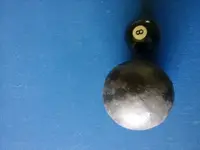
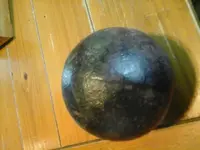
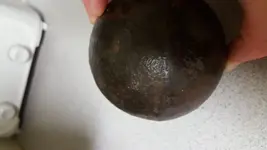
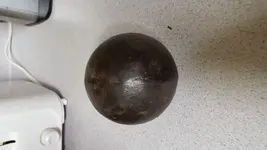
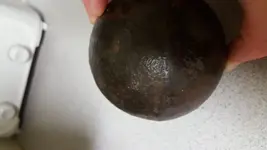
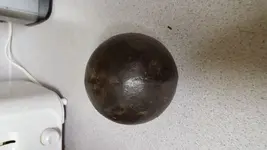
Allison asked me to examine the ball and give my opinion as to whether or not it is a cannonball.
Unless a ball has a recognizable artillery fuze in it, photos cannot tell me whether it's a cannonball or not.
In the photos, the seam on it "looks right" for a cannonball. BUT, the ball's precisely-measured weight and diameter are far more important. If the 1861 US (and CSA) Ordnance Manual's historical data records of cannonball sizes and weights (called the "Shot Tables") does not have an exact match-up for a ball, it's not a cannonball. I co-wrote an educational article with detailed instructions and photos, telling how to very-precisely measure the ball. You can view it online for free at:
SolidShotEssentialsMod
When you've done the very-precise measuring and weighing, see if there's a match-up in the Shot Tables charts, at:
www.civilwarartillery.com/shottables.htm
(I should mention, cw0909 already posted that link in this discussion-thead.)
Put simply... if a ball's diameter isn't with a couple of hundredths of an inch (.02-inch) of one of the cannonball sizes in the Shot Tables, it isn't a cannonball.
I should also mention, cannonballs have been found at places where a cannon was located but no combat ever happened there. Artillerymen have to do practice/training. Also, at more than just a few forts, cannonballs got thrown away when that kind of artillery became obsolete. In such cases, the ball's finder must do some research to provwe there once was a cannon at that location. And, the cannon's ammunition must be the same size ball that was found.