MikeyDigsIt
Tenderfoot
- Joined
- Feb 14, 2013
- Messages
- 6
- Reaction score
- 0
- Golden Thread
- 0
- Location
- Pennsylvania
- Detector(s) used
- Fisher F4
- Primary Interest:
- All Treasure Hunting


Hi everyone,
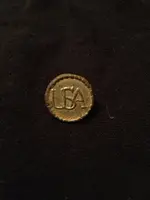
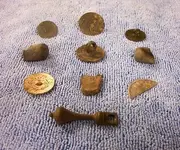
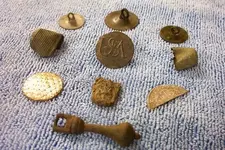
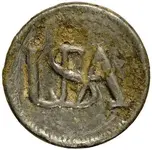
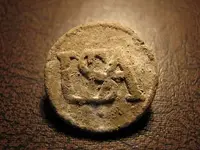
I was wondering if anyone could tell me if this button is authentic or a reproduction. Any help would be greatly appreciated!


The button is a modern reproduction. These are often sold for use on representative uniforms for historical reenactments, as well as souvenirs.
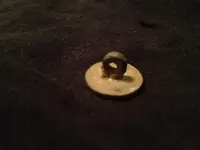
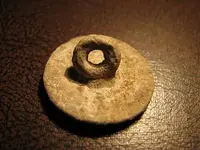
On original Continental Army USA buttons of the 18th century, the metal composition is different, the lettering and rim detail is slightly different, and the shank (loop) is different, as well as the mold seam. I've personally dug several original Rev War Continental buttons, in various styles, and can assure you this example here is modern.
CC Hunter

The face struck me as modern, and mold seam, or lack there of, pushed me more in that direction. Do all the USA buttons have the seam?
I'd never trust the look of the metal, just look at it as another factor because you could always get an oddball mix.... and then you add in some good ground conditions and you could have a pretty impressive looking button. As you know just digging a little deeper can make quite a difference in condition, and that was the case for me never seeing a Rev War pewter that wasn't completely oxidized white... until I dug one from about two feet and it was mostly grey. In fresh water you can get some brown color on pewter or lead, which is another reason I wouldn't try to judge something based only on the color or what looked like a certain metal composition.
PS: Most that look that good are too good to be true, but detecting miracles can and do happen!
oh, and I think CC calls it fake because it's nicer than his.


I've owned numerous Rev War buttons over the years. I would not write this off as a repro,but can't determine for sure if it's genuine. The shank is totally unlike the repro shank, but the face is a variant of most authentic rev war buttons. Hang onto it.
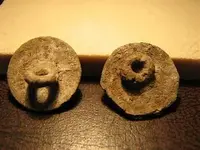
Is it my eyes or does the loop look like it was added at a later date, the colour looks different to the button back, the loop looks a lot thicker than would be expected
SS
Wanting to know more, I googled some of the pictures on the net, and noticed a difference on the letter U on the one posted, the bottom seems more flat, than on the original USA pewter buttons, also on the original letters, they seemed to be more pronounced(thicker) than this one.Silver Searcher, your eyes are seeing many of the same discrepancies in the loop/shank, that I was attempting to describe as being suspect. I've never seen an original 18th century cast pewter button with rough casting or extra sprue junk around the shank like we see here. MikeyDigsIt also describes the shank as having what appears to be a drilled hole, which is not seen on period pewter buttons. There are authentic cast brass buttons of the late 18th and early 19th century, with drilled shanks. However, I cannot recall ever seeing a drilled shank on a period pewter button.
CC Hunter

I am not disregarding any of CC Hunter's statements, which are well-reasoned, as usual. However, I am reluctant to consign any dug button to the Reproduction bucket without being fully 100% certain that it's a repro.
As I mentioned in my reply above, all of the pewter "intertwined-USA" reproduction buttons I've seen have a wedge/pillar shank with a drilled hole. However, as I've said many times in this forum, I do not believe I've seen everything there is to see. I haven't attended RevWar battle reenactments and examined the repro buttons for sale there by "sutlers" selling repro uniforms & equipment.
So, as research for this reply, I did a websearch for reproduction pewter intertwined-USA buttons. The only result I got was: View the United States of America "USA" Pewter Button, 5/8" [#GPB33] at http://www.gggodwin.com
That button looks very similar to MikeyDigsIt's button, but not quite completely exact. The seller says it has a cast shank, but there's no photo showing what its shank looks like. (As I said, a repro interwined USA pewter button I own has a cast wedge/pillar shank.) The seller also says it is 5/8-inch in diiameter. MikeyDigsIt, please measure your button super-precisely, to see if it is exactly 5/8-inch. Also, you could email photos of your button to the owner of that website and ask him if its loop/shank is the kind he sells.
Thee is another reason I am hesitant to consign MikeyDigsIt's button the the Repro bucket. In Alphaeus Albert's button book, he says (in a remark under a GI-2Av intertwined-USA pewter 19-millimeter button), "There are a number of variants in this pattern, with slight differences in the monogram." That means he knew of variants which are not shown in his book. So, before tossing your button into the Repro bucket, I suggest you make several additional well-focused closeup photo of its front and back, and email them to Willaim Leigh at civilwarbuttons.com and to Don Troiani, via the Contact form at his website Troiani Collector
Mr. Troiani wrote the book "Military Buttons of the American Revolution." I know both William and Don personally, and I'll testify they are both "helpful-minded" guys about military-button ID requests.
Meanwhile... I usually ask posters for precise measurements of objects they want identified, but I failed to do so in my previous post about your button. Please tell us the precise measurement of your button, in millimeters or 16ths-of-an-inch.