What's new

Debunking AMRT

geowizard

Supporting Vendor
🛒 Supporting Vendor
Joined
Apr 9, 2007
Messages
660
Reaction score
560
Golden Thread
0
Primary Interest:
All Treasure Hunting
Can it be true?

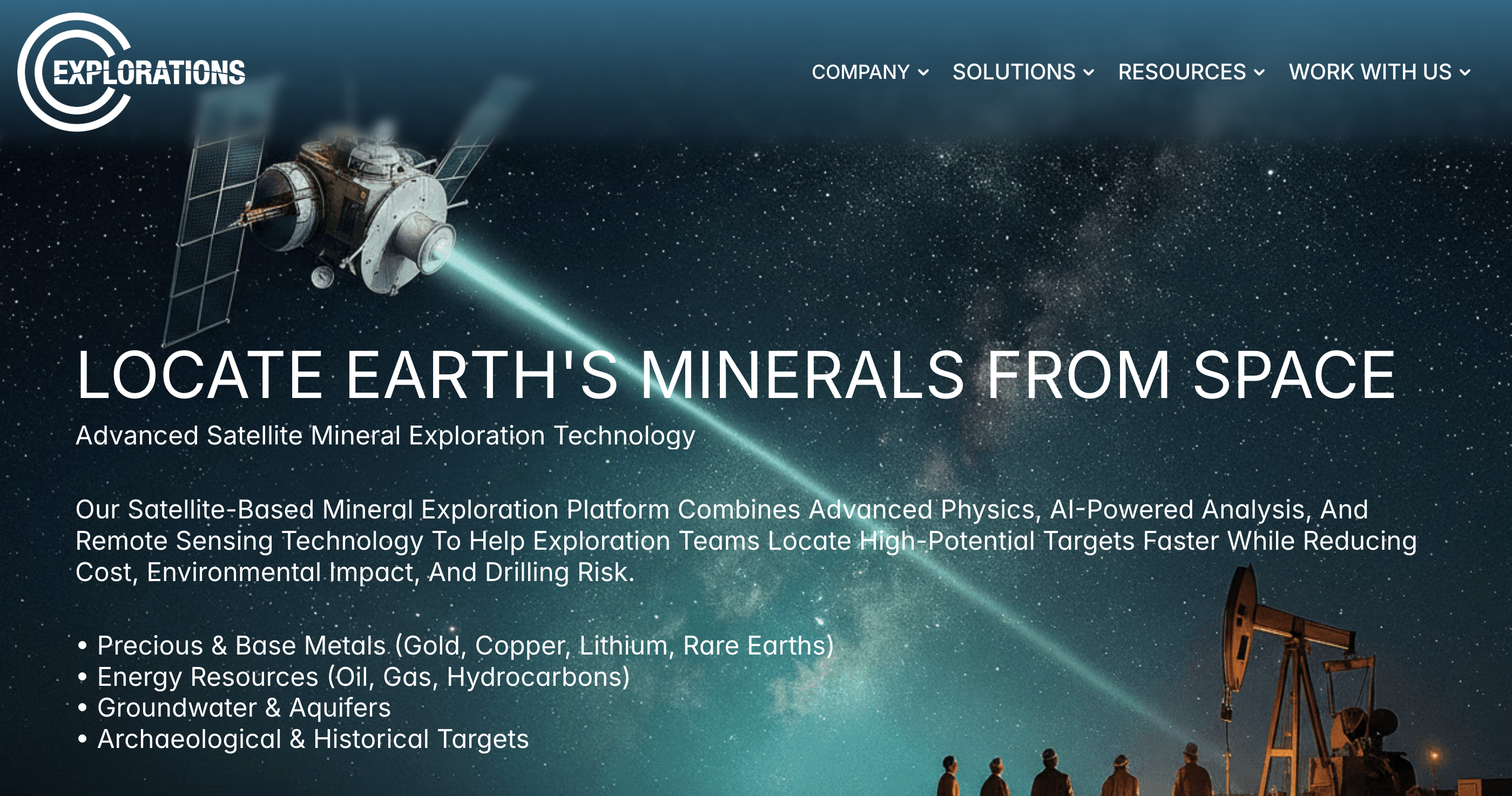
www.ccexplorations.com/

Every claim made today must pass the test of basic physics. Is it possible?

Does it pass the test? You be the judge! Let's check it out!

- Geowizard
 
Is this "New proprietary technology" feasible?

AMRT feasibility

Atomic Mineral Resonance Tomography (AMRT) is a proprietary, satellite-based remote sensing method marketed for subsurface mineral targeting. However, independent, rigorous peer-reviewed scientific validation or empirical testing published in mainstream academic geophysics or academic journals remains absent.

Lack of Independent Literature: Standard geophysical journals feature peer-reviewed work on established techniques like nuclear magnetic resonance (NMR) or atom probe tomography, but proprietary concepts like AMRT lack independent validation.

Scientific Status and Context

Lack of Independent Literature: Standard geophysical journals feature peer-reviewed work on established techniques like nuclear magnetic resonance (NMR) or atom probe tomography, but proprietary concepts like AMRT lack independent validation.

Commercial Promotion: Descriptions of AMRT performance derive primarily from corporate white papers, promotional newsletters, or industry marketing materials rather than double-blind academic scrutiny.

Mainstream Skepticism:

Mainstream geophysicists generally view space-based resonance methods that claim direct subsurface elemental identification with caution due to the severe attenuation and complexity of electromagnetic signals passing through crustal layers.

Related Validated Technologies

Atom Probe Tomography (APT): A destructive, high-resolution laboratory technique used in materials and planetary science to map small mineral samples atom by atom.

Surface Nuclear Magnetic Resonance (SNMR): A ground-based geophysical tool backed by extensive academic research, though it is primarily sensitive to liquid water rather than deep mineral lattices.

Electromagnetic induction imaging with atomic magnetometers... application is severely restricted by the poor sensitivity of the sensing coil at low frequency.

- Geowizard
 
Debunking of a concept in terms of technology and science has to be objective and without bias;

There is no bias intended in the determination of feasibility of technology or science. The technology and science speak for themselves. Either the science and technology exist or it does not.

The premise of measurement of NMR signals at distance has never been demonstrated.

NMR spectrometers operate in a laboratory environment. The sample under investigation is confined in a sample chamber with sensor(s) mounted in fixed position within less than 1 centimeter.

All of the imaging satellites in orbit around earth are accounted for. They are well documented. Imaging satellites are reflective imaging only. The exception is the International Space station. It only has imaging capabilities to within centimeters of the surface.

- Geowizard
 
Satellites having NMR sensors;

Traditional Nuclear Magnetic Resonance (NMR) spectrometers cannot operate as remote sensors on orbiting satellites because NMR requires placing a sample inside a powerful, highly uniform magnetic field and applying localized radio-frequency pulses. Spacecraft instead use magnetometers or passive multispectral/hyperspectral radiometers to map magnetic fields or surface minerals.

Why NMR Fails in Space Remote Sensing

Weak Signal Strength: NMR signals generated by natural atomic nuclei are extremely weak and require close-range inductive coils surrounding a physical sample.

Lack of Local Control: Spacecraft cannot remotely project a stable, high-strength magnetic gradient down to Earth's surface to stimulate specific atomic nuclei on demand.

Distance and Noise: Ambient electromagnetic noise and vast orbital distances make detecting induced radio-frequency nuclear precession from space impossible.

What Satellites Use Instead

Magnetometers: Instruments like fluxgate and vector field magnetometers measure ambient planetary magnetic fields rather than atomic resonance.

Hyperspectral Imaging: Orbiters analyze reflected and emitted light spectra to identify surface minerals and chemical compositions.

Alternative Quantum Sensors: Emerging airborne or ground-based mobile NMR systems exist for localized prospecting, but they operate in direct contact or low altitude rather than from orbital space.


- Geowizard
 
What satellites do nmr imaging?

I Googled "what satellites do NMR imaging?"

"No operational satellites perform Nuclear Magnetic Resonance (NMR) imaging or spectroscopy from space.

Why NMR From Space Is Not Feasible

Magnetic Field Requirements: Standard NMR and MRI require extremely strong, highly homogeneous magnetic fields (typically 1 to 14+ Tesla) generated by massive superconducting cryomagnets.

Weak Earth Field: Earth’s natural magnetic field is far too weak (~0.00005 Tesla) and variable to induce the atomic spin transitions required for controlled, high-resolution remote NMR from an orbiting spacecraft.

Signal-to-Noise Ratio: Radio frequency signals emitted by subsurface nuclei would dissipate completely over low-Earth or geostationary orbital distances, making detection impossible.

Claims and Alternative Contexts

Commercial Marketing Claims: Certain private ventures (such as CC Explorations with their promoted "Atomic Mineral Resonance Tomography" or Geo Resonance) claim to use satellite data combined with ground-based NMR principles or proprietary multi-spectral analysis to detect minerals or water from space. Mainstream geophysics and the broader scientific community classify these specific space-based NMR claims as pseudoscience or unproven remote sensing.


Spectroscopy Terminology: In laboratory NMR spectroscopy, the term satellite peaks refers to small flanking doublet peaks caused by low-abundance active isotopes (like ¹³C or ²⁹Si) coupling with main atomic signals, which has nothing to do with outer space."

- Geowizard
 

Users who are viewing this thread

Back
Top Bottom