What's new

DIGHEM

Do you own a shovel?
The shovel may not do the job if one needs to go down over a hundred feet. Some have got there with the good old shovel for sure.
 
The shovel may not do the job if one needs to go down over a hundred feet.
Hyperbole. GW has been singing the praises of Dighem and all the gold he's found with aerial scans, yet not a flake of gold to be seen. The forums for dowsing, LRLs, and treasure marks/auras are full of guys who have located all sorts of massive buried treasures, but none of them seem to own a shovel. Ergo my question.
 
Hyperbole. GW has been singing the praises of Dighem and all the gold he's found with aerial scans, yet not a flake of gold to be seen. The forums for dowsing, LRLs, and treasure marks/auras are full of guys who have located all sorts of massive buried treasures, but none of them seem to own a shovel. Ergo my question.
I hear what you are saying and you make an excellent point.
 
Again, am no expert. But if you ( from the drilling perspective on your side ) want to kind of neglect some deposits like Molybdenum and Vanadium because of their hardness, as well as Titanium because of its abundance and Zirconium too, I would seek gold deposits where Manganese or Bismuth deposits are. But I would first find way to register the Manganese Signals despite its low electroconductivity but make it appear as equal strenght to Gold.or almost, and will then Select areas where MN signal is medium strenght ( as juxtaposed to whatever well conductive elements are in same landmases ). Like 60 % strenght of Au signal.
Same for More Narrowerly positioned deposits of Silver. I would look for Au 30 or 40 % or more stronger than the Silver signal that corresponds to visible Ag deposits. But Ag not As Gathered from a broad area. Rather maybe from deeper area.
I reread what I had written in February after Mr Sprailroad left me thumbs up and other remarks.
Actually I never worked mining in the field at such depths.
But I know for shallow like 2- 3 feet setting, Yes Silver can show where gold is but tightly packed Silver deposits that stretch over broad area can also Unfortunately Mask gold that we want : in Compact but concentrated Spots. That kind of gold..
 
We have the technology that makes our dreams come true right here, right now!
Interestingly, it's just like metal detecting. I can show everyone where the shovel needs to hit the dirt. The big question we all face at that moment is, "Do we dig it?" :dontknow:

There is that "Come to Jesus" moment. With bigger and deeper detectors the question amounts to some real soul searching! :occasion14:

The next step involves knowing how deep and how are we going to dig it! DIGHEM gives "Depth to top of target" based in a mathematical process called "inversion". It's included along with the data and using multiple frequencies having different depths of investigation, depth to top can be provided!

We all naturally want to find a big Nugget!

Surprisingly, many Big Nuggets are shallow and found near the surface! My Big Nugget discovery has a negative depth! That means it is actually above the surface and probably exposed in an outcrop! I have not been at the outcrop yet. It takes a "remote prospector" with a modest amount of venture capitol to "get there from here" It takes a plan. The deposit is remote. I flew in on an R44 helicopter with a helper for staking and due to being handicapped had my helper stake five claims. We found a few gold nuggets but not what we were after. With too little daylight left, we flew out.

Big Nuggets are out there for those with resources to get into places where no one has previously explored.

I find the gold. I document the discoveries with data and exact GPS coordinates. My exploration clients do the diggin'! :hello:

- Geowizard
 
Last edited:
Do you own a shovel?
Carl,
I own $250,000 worth of shovels and other assets most all new in their boxes. Thanks but no thanks for the personal affront.

It's a short story;

I sold one gold mine and leveraged the proceeds including claim staking ($20,000) beginning in 2021 to stage tools and related hardware, vehicles, etc within 20 miles of the project site. I paid $500 per month for 48 months ($24,000) for secure storage. In 2023, I was interrupted with the amputation of my right leg. I made a round-trip in late fall of 2024 after buying an 8x8 Argo ($15,000) and shipping it 250 miles down the Yukon River. My objective was to test airline and remote handicapped access. Access by ground is through 8 miles of wild Alaskan Bush and Tundra with no trail. It was snowing in October 2024. Myself and a helper forged ahead through uncharted bush in an almost blinding snow storm and alien world. Any failure in the machine and we were dead men. We had a Starlink mini dish system for outside comm but with no camp and dense snow showers (no sat comm), help would come too late.

We retreated to a safe haven and flew home.

In 2025, I hired a project manager and helper. They broke the Argo, I air freighted over-night $1000's in Argo parts from all over the US. I burned through the remainder of my cash and credit. I closed shop.

Fun stuff!

- Geowizard
 
Last edited:
Perhaps drilling is called for to sample at the target locations?
Is one hundred feet deep enough for a sample at such locations?
The system is flying along at 120 feet per second "drilling a hole" hundreds of feet deep with a footprint 60 feet across every 12 feet on three frequencies of 900, 7200 and 56,000 cycles per second (Hertz). It has horizontal and vertical coil pairs to image flat and vertical conductors. It includes a precision magnetometer with diurnal correction to measure "structure" of the earth with Differential GPS sub-meter position.

The best part is the data is free to the public!

- Geowizard
 
It's easy to detect Gold in Alaska 3000 miles away from Arizona. I do it every day! :hello:
Phase angle to one degree is sufficient. I go to two digits past the decimal point. This allows determination of the highest grade gold in a deposit which is in the vein.

- Geowizard
 
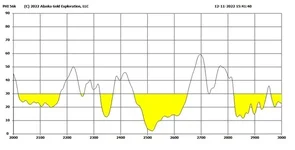
I wrote software to provide a graphic image of the cross section of a deposit.

The cross section shows phase. Thirty (30) is copper, the cutoff for gold and silver. Ten (10) or less is gold/silver.

nome1.webp

1001 samples are shown. This example is from Nome.

- Geowizard
 
I own $250,000 worth of shovels and other assets most all new in their boxes. Thanks but no thanks for the personal affront.
Not meant to be an affront, and certainly nothing personal. A provocation, for sure. I've been on these forums for 28 years and cannot count the number of folks who've shown up here bragging about all the treasure they've found, without a gram of anything to show. Probably most never even dug a hole in the ground, ergo my recurring question to them: "Do you own a shovel?" Most of these braggarts are dowsers, LRL users, aura photographers, and monument seekers, and/or often looking for fake treasures like Beale, LUE, KGC, etc. In other words, pretenders looking for pretend treasures using pretend methods. They never find anything, but they sure can make things up.

You fit the pattern of bragging about finding a lot of treasure, except that you describe looking for real treasure (native gold deposits) using real methods (aerial induction sensing). But the end result is the same: nothing to show. Now that you describe your situation, it sounds to me like a bit of bad luck, combined with some bad choices, and maybe founded on bad assumptions. I suspect you have a boat load of capital sunk in equipment and no where to go with it. And I suspect that what led you to where you are at is a fundamental misunderstanding of the DIGHEM data you are analyzing.

The cross section shows phase. Thirty (30) is copper, the cutoff for gold and silver. Ten (10) or less is gold/silver.
This is where I think you've taken a wrong turn. I am no expert on DIGHEM per se, but I do understand its basic operation and I am an expert on induction metal detection technology. I believe your assumptions about the meaning of the phase shift data is excessively optimistic; I see no way that anyone can say a phase of "10 or less is gold/silver." Even in basic metal detectors, we all know that gold phases can be all over the place depending on alloy, shape, size, and thickness. Silver and copper, same thing. And it's the same with natural gold. In fact, I strongly suspect that it's an extremely rare case that DIGHEM can even detect natural gold at all, given that it's rarely concentrated enough in large enough sizes for an aerial probe. Heck, even a coil scrubbing the ground struggles to pick up anything more than a few inches deep. I wonder if DIGHEM could even detect the Hand of Faith, laying on top of the ground. I'd wager not, else the Aussies would be using it aggressively to find more Hands of Faith.

Probably the DIGHEM data is more useful in looking for tell-tale signs of gold deposits; magnetic black sand concentrations or conductive sulfides. I'd expect that they use the data to map "more" conductive bodies, then they have to go ground-truth each spot, probably using core samples (at least, this is what they are doing in my neighborhood) to determine if it's a useful gold-bearing sulfide or a worthless iron sulfide. I doubt DIGHEM can inherently tell them apart.

I could be wrong about all this, and I welcome the opportunity to learn something new. But knowing what I know about induction phase responses, I think you've overstated both what DIGHEM can do and the value of what you think you have done. The only way to know is to visit one of the sure-fire sites and bring back some gold.
 
Back on topic,

I have been on a Treasure Hunt. I would like to introduce new precious and base metals discoveries to readers right here on TreasureNet. I will share a NEW discovery every day. Readers can see how the process works! You can see REAL Discoveries! I provide the detector. I provide the data. I provide the map. I provide a graphic. You decide. Would you dig it?

-Geowizard
 
Would you dig it?

Remote prospectors have only ONE ambition. To find a nugget! :occasion14:

The inevitable question for every remote prospector comes down to... "Would you dig it?"
Being an above average remote prospector, You found TEN nuggets!
Nugget 1 is a 10 gram nugget buried 6 feet. score 1.7 #1
Nugget 2 is a 5 gram nugget buried 4 feet. score 1.25 #6
Nugget 3 is a 13 gram nugget buried 8 feet. score 1.625 #3
Nugget 4 is a 6 gram nugget buried 10 feet. score 0.60 #9
Nugget 5 is a 20 gram nugget buried 30 feet. score 0.67 #7
Nugget 6 is a 2 gram nugget buried 3 feet. score 0.67 #8
Nugget 7 is a 7 gram nugget buried 5 feet. score 1.4 #4
Nugget 8 is a 17 gram nugget buried 13 feet. score 1.31 #5
Nugget 9 is a 8 gram nugget buried 20 feet. score 0.4 #10
Nugget 10 is a 100 gram nugget buried 60 feet. score 1.67 #2

Would you dig ANY of these nuggets? and if so, what would be the order of the digs? :dontknow:

Think about it!

Solution:
Develop an algorithm: :icon_study:
What is "good"?

Grams are proportional to goodness.
Depth is inversely proportional to goodness

goodness score = grams/depth

The highest score wins! :thumbsup:

- Geowizard
 
Last edited:
DIGHEM provides a depth estimate to the top of mineralization in Meters. It does this because the system uses multiple frequencies and calculates approximate depth based on mathematical "inversion". The process of how inversion is done is beyond our "need to know" and security clearance!

- Geowizard
 
With an inferred target, drilling is an option. If the target is shallow, there is probably disseminated Gold at the surface. Geo-chemical sampling or panning will help get a picture of the deposit. With enough "overwhelming and convincing" evidence, the shovel hits the ground. :occasion14:

- Geowizard
 
Hyperbole. GW has been singing the praises of Dighem and all the gold he's found with aerial scans, yet not a flake of gold to be seen. The forums for dowsing, LRLs, and treasure marks/auras are full of guys who have located all sorts of massive buried treasures, but none of them seem to own a shovel. Ergo my question.
Dighem is a recognized geophysical system used world-wide by major exploration and mining companies. Readers can search DIGHEM. It's based on the same technology as as FDEM aka VLF metal detectors! It has been peer reviewed and published in Society of Exploration Geophysics and numerous other professional publications. It's a very foolish and misleading statement to group it with Dowsing and LRLs. I would submit it diminishes the credibility of Carl to make such misguided and incredulous statements.

It's another example of Carl-NC bologna and why I have placed Carl-NC on my ignore list! I check his replies on occasion only to see what kind of non-sense he's up to. He never fails to deliver.

DIGHEM has been used by the State of Alaska for decades to identify mineral deposits. Millions of dollars have been expended on Geophysical surveys. The surveys are planned and executed by esteemed Geophysical Scientists with lifetimes of experience and degrees to match. Very untruthful and misleading to make a statement like Carl has made in such a reputable venue as TreasureNet!

- Geowizard
 
Not meant to be an affront, and certainly nothing personal. A provocation, for sure. I've been on these forums for 28 years and cannot count the number of folks who've shown up here bragging about all the treasure they've found, without a gram of anything to show. Probably most never even dug a hole in the ground, ergo my recurring question to them: "Do you own a shovel?" Most of these braggarts are dowsers, LRL users, aura photographers, and monument seekers, and/or often looking for fake treasures like Beale, LUE, KGC, etc. In other words, pretenders looking for pretend treasures using pretend methods. They never find anything, but they sure can make things up.

You fit the pattern of bragging about finding a lot of treasure, except that you describe looking for real treasure (native gold deposits) using real methods (aerial induction sensing). But the end result is the same: nothing to show. Now that you describe your situation, it sounds to me like a bit of bad luck, combined with some bad choices, and maybe founded on bad assumptions. I suspect you have a boat load of capital sunk in equipment and no where to go with it. And I suspect that what led you to where you are at is a fundamental misunderstanding of the DIGHEM data you are analyzing.


This is where I think you've taken a wrong turn. I am no expert on DIGHEM per se, but I do understand its basic operation and I am an expert on induction metal detection technology. I believe your assumptions about the meaning of the phase shift data is excessively optimistic;

Even in basic metal detectors, we all know that gold phases can be all over the place depending on alloy, shape, size, and thickness. Silver and copper, same thing. And it's the same with natural gold. In fact, I strongly suspect that it's an extremely rare case that DIGHEM can even detect natural gold at all, given that it's rarely concentrated enough in large enough sizes for an aerial probe. Heck, even a coil scrubbing the ground struggles to pick up anything more than a few inches deep. I wonder if DIGHEM could even detect the Hand of Faith, laying on top of the ground. I'd wager not, else the Aussies would be using it aggressively to find more Hands of Faith.

Probably the DIGHEM data is more useful in looking for tell-tale signs of gold deposits; magnetic black sand concentrations or conductive sulfides. I'd expect that they use the data to map "more" conductive bodies, then they have to go ground-truth each spot, probably using core samples (at least, this is what they are doing in my neighborhood) to determine if it's a useful gold-bearing sulfide or a worthless iron sulfide. I doubt DIGHEM can inherently tell them apart.

I could be wrong about all this, and I welcome the opportunity to learn something new. But knowing what I know about induction phase responses, I think you've overstated both what DIGHEM can do and the value of what you think you have done. The only way to know is to visit one of the sure-fire sites and bring back some gold.
I really don't care what Carl thinks.

All concerned, read the White's Electronics Patent!

Carl said, "I see no way that anyone can say a phase of "10 or less is gold/silver."

The "phase response" algorithm comes from Discrimination in FDEM detectors as published in Papers Patent awarded to Whites Electronics. Carl, you should know this. Phase angle is well understood by those "skilled in the art". I would seriously recommend an evaluation.

It's all transparent and written in an easy to understand but rather technical form of English. I suggest anyone purporting to be or even a wannabe expert "read a book" and grow a brain before expressing unfounded, outrageous, misleading comments.

Really? 28 years on these forums?

- Geowizard
 
Last edited:
Anyone else that wants to chime in?

Please be considerate and if you have a question or comment, bring a reference or citation to support a challenge of my statements. I am an adult and expect a fair exchange in discussion.

Thanks, Geowizard
 
Got Gold?

I am a second generation Gold Miner.
I prospected and mined Gold with my father in Eastern Oregon.
I prospected in six different mining districts in Alaska.
I mined on East Beach in Nome and moved to the interior.
I mined Gold for 12 years on Ophir Creek in Alaska.

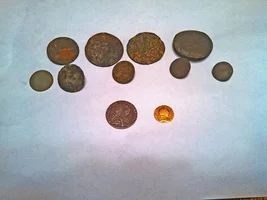
Gold nuggets from Ophir Creek

nuggets.webp
 
I have a twenty year plan. :hello:

Welcome to my plan! The plan involves exploration and development of the many discoveries I have made in Alaska using the same tools the "Big Boys" use. I make new discoveries every day! As an exploration company, I market discoveries to private individuals and junior mining companies.

When I am not mining, I am writing about mining! I share knowledge and information on mining and geophysics with members of this forum and other forums. People are a big part of the plan. There is much confusion and misunderstanding by earnest and well deserved people involved in the subjects of mining and geophysics! There's a lot to learn! :icon_study:

- Geowizard
 

Users who are viewing this thread

Back
Top Bottom