What's new

DIGHEM

In reply to an earlier remark, "Phase angles all over the place".

Phase angle is used to discriminate between metals in FDEM (VLF) metal detectors. Phase angles are both stable and conformal. Conformal in this context means you can see the orderly definition of mineralization as a DIGHEM survey flightline crosses a deposit.
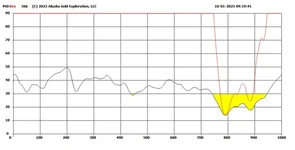
When a flightline is shown in graphic form, gold bearing zones are well defined.

Here's an example:
moore creek INF.webp

This example shows gold mineralization (in yellow) extending down from the 30 degree line. Thirty degrees is considered as copper. Less than 30 is a mixture of copper and gold. The red line is Resistivity. As resistivity decreases, conductivity increases. So it is understood that a mineral deposit is conductive and therefore is a low resistivity. Low resistivity combined with low phase angle has the greatest probability of being a gold deposit. This deposit is about 2400 feet across. Gold is supported by the fact this survey line is on a gold mine. This district has been mined over the past 200 years using placer methods. The lode deposit has not been discovered until now. This is the first time I have published this.

Please understand also, raw gold is a mixture of different metals and minerals. The purity of gold increases below the 10 degree phase line as per US Patent info that is in the public domain.
Notice, the grade of the gold diminishes toward the edges of the deposit. This is in keeping with the naturally expected degradation of purity from the center of the deposit into surrounding copper as expected in a normal copper-silver-gold deposit. There are exceptions. This deposit is in a fissure vein. The vein degrades out to wall rock having little or no mineralization.

- Geowizard
 
In the prior illustration;

Phase angle is "qualitative". It shows quality, copper-silver-gold-iron of metals and minerals. Resistivity is "quantitative" in a general sense. Lower resistivity means more conductive paths for electric current flow in the ore body and corresponding greater signal response.

- Geowizard

 
Thanks for all the info and sorry it came your turn at the whipping post of life. I hope you live long enough to see your discoveries realized.
My discoveries are realized every time a frequency domain metal detector responds to metal or mineralization. Induction is real. The response is real. Once we realize that, we realize a metal detector is another form of "seeing". We can see what we cannot see with our limited sense of vision in the visible portion of the spectrum. With metal detectors, we can "see" outside of the visible spectrum! Metal detectors are another form of sight!

- Geowizard
 
Think about this;

Our retina converts light into an image that our brain interprets as a gold nugget.
A metal Detector converts an electromagnetic response that our brain interprets as a gold nugget.
What's the difference?

- Geowizard
 
Think about this;

Our retina converts light into an image that our brain interprets as a gold nugget.
A metal Detector converts an electromagnetic response that our brain interprets as a gold nugget.
What's the difference?

- Geowizard
Just as your eyes see iron pyrite and think it is gold, your metal detector sees the responses of other alloys and think they are gold. Nothing is infallible. Not your eyes, not a metal detector. The difference is your eyes and brain can draw on other inputs that the metal detector cannot.
 
But we can infer, and do. And so can detectors, it's either in the beep or display. They infer a target's composition.
I can decide to dig a beep based on past experiences or not. But I'm still going off the design parameters the manufacturer decided on
Detectors are limited currently to working within the parameters they were designed with but it's still an inference. It's based on the designers choices. Even when AI detectors become a thing,it will be the same.
Even the the old adage " To find gold go where gold has been found before " is an inference.
My dad was a military cryptographer, mom a mainframe operator. So I grew up in a family that wrote code and understood GIGO.
Any machine is only as good as it's adherence in manufacturing to the concept it was based on. Even assuming the concept is flawless.
I gave up on my BSEE a semester before graduating when I discovered I hate nerds in cubicles at the R and D department at TI and made more than anyone but the plant manager on my side job.
I feel for manufacturing people trying to make consumers happy only to be second guessed at every turn and for 🥜.
 
Just as your eyes see iron pyrite and think it is gold, your metal detector sees the responses of other alloys and think they are gold. Nothing is infallible. Not your eyes, not a metal detector. The difference is your eyes and brain can draw on other inputs that the metal detector cannot.
robertk,

Please do not make statements without a reference. This Forum is saturated with extensive discussion about discriminating metal detectors that reliably discriminate between iron and gold. Too many examples that support the technology. That debate is off topic and should go on another thread.


- Geowizard
 
Last edited:
There are 119 pages (38 to the page) of discussion on discriminating metal detectors. Over 4500 posts on the subject. With reference to a "comparison" of metal detectors and human vision, that was not the point. The point is that instrumentation in the form of metal detectors supplement human vision.

Everything is fallible. Fallibility was not the point either. The topic is DIGHEM. It uses the same technology.

- Geowizard
 
Last edited:
Please do not make statements without a reference. This Forum is saturated with extensive discussion about discriminating metal detectors that reliably discriminate between iron and gold. Too many examples that support the technology. That debate is off topic and should go on another thread.
@robertk is correct; metal detector discrimination is, at best, a barely-educated guess. Lots of metals overlap all the way across the phase range. Any serious jewelry hunter knows you have to dig all the aluminum. Even iron is tricky and often lands in the non-ferrous phase range. Ask any Aussie gold hunter who's dug a 3-foot hole chasing a gold nugget only to pull out a big rusty bolt.

If you don't understand the fallacies of phase discrimination in handheld detectors, you can't hope to understand the limitations of phase data in DIGHEM scans. I read through a number of AEM/HEM papers, and I see no one claiming these things can actually tell you "there's gold there." As I suspected, they are mapping general ground conductivity and looking for signs that might possibly correlate with those of known gold deposits, usually conductive sulfide deposits. Not the gold itself, and certainly nothing like "anything less than 10° is gold." And even when the scans show a "maybe," they still have to core-sample to see what's really there. The scans can't do that. If you have references that show this is incorrect, please share.

Meanwhile, let me know the White's patent you were referencing before. I was Director of Engineering for White's and wrote a number of their patents, but probably not the one you mentioned. Also, if you want a good understanding of how target phases behave -- for example, why a silver dime and a silver dollar, both with the exact same alloy, have completely different phases; or why a steel bottle cap often mimics a non-ferrous coin -- I suggest looking at the 3rd edition of Inside the Metal Detector. It explains all of that.

It's a very foolish and misleading statement to group [DIGHEM] with Dowsing and LRLs.
I think you missed the intended correlation; it had nothing to do with the hardware.
 
Papers Patent;

I have found in my search for documents over the years, certain resources are most relevant and informational. The US Patent Office (www.uspto.gov) and the Canadian Patent office.

I would like to take a moment to share a Canadian Patent on the subject of DIGHEM.

- Geowizard
 

Attachments

My discoveries are realized every time a frequency domain metal detector responds to metal or mineralization. Induction is real. The response is real. Once we realize that, we realize a metal detector is another form of "seeing". We can see what we cannot see with our limited sense of vision in the visible portion of the spectrum. With metal detectors, we can "see" outside of the visible spectrum! Metal detectors are another form of sight!

- Geowizard
There is no "whipping post of life". Life is a continuum of challenges. When we chose to speak, there are those that may challenge the words we speak. Challenges represent opportunity! An opportunity to speak further on a topic! It is regretful and often annoying that topics are distracted by inappropriate and misguided behavior.

- Geowizard
 
It is regretful and often annoying that topics are distracted by inappropriate and misguided behavior.
It is an open public forum. Just because you dislike someone's point of view does not make their comments inappropriate or misguided.
 
It is an open public forum. Just because you dislike someone's point of view does not make their comments inappropriate or misguided.
Inappropriate and misguided behavior is annoying in the context of learning. It's like a child having a tantrum when their parent says, "get ready for school." This discussion is annoying because it is off topic. It distracts from the intended content. Moderators?

DIGHEM is not a topic about "anyone's point of view." Please take it to the "Random Chat" thread.

- Geowizard
 
The Alaska Division of Geological & Geophysical Surveys (DGGS) uses DIGHEM (a helicopter-borne frequency-domain electromagnetic and magnetic survey system) to map geology, magnetics, and conductivity across Alaska's historic mining districts.

[1] (https://dggs.alaska.gov/pubs/project/73),

[2] (https://dggs.alaska.gov/pubs/project/59)

There are project Report references as seen above that demonstrate the continued use over decades of DIGHEM in mapping mineral resources in Alaska. Reading the project reports shows the amount of preparation needed to accomplish a survey. The project report gives the end user an inside and amplified view of every detail of the survey setup and results. In addition, many maps are available giving contour lines much like a topographic map. We can look at a few examples next. :occasion14:

- Geowizard
 
The links above take you into a new realm. The realm of geophysical data. The data comes from places in the earth where no geologist has never been. in coming posts, I invite readers to join me in exploring Alaska as an application of DIGHEM in a Real setting.

Also view other applications in the thread "Buried Gold in Alaska".

- Geowizard
 
It's like a child having a tantrum when their parent says, "get ready for school."
I'm not the one having a tantrum.

It distracts from the intended content. Moderators?
There's a "report" button on every post. If you think my posts are out of line, feel free to use it. I have not violated any actual rules.
 
Geo, only mods and admins can tell members not to post in a thread, RK is not breaking any of our rules, he expressed his opinion on the topic which is
allowed.

Please do not insult members by calling or implying their opinion is childish.
 
Moving forward;

For reasons as can be seen in the above dialogue, I have chosen to ignore robertk.

-Geowizard
 
Project Reports accompany each of the surveyed mining districts in Alaska.

I would like to identify and give recognition to the source:

Fugro Airborne Surveys, 2505 Meadowvale Boulevard, Mississauga, Ontario, Canada, L5N 5S2
Phone: 1 905 812 0212, Fax: 1 905 812 1504

- Geowizard
 

Attachments

Project Reports offer an "Introduction";

There is limited information online with reference to the DIGHEM survey system. Readers and viewers can gain knowledge and understanding of the system, the surveys and the organization and presentation of the data. All of this adds confidence in the process.

Please see attached.

Geowizard
 

Attachments

Users who are viewing this thread

Back
Top Bottom