Muddyhandz
Bronze Member
- Joined
- Jul 1, 2012
- Messages
- 1,236
- Reaction score
- 1,960
- Golden Thread
- 0
- Location
- In da bush
- Detector(s) used
- Fisher's 1266X, 1270X & 1280X
- Primary Interest:
- All Treasure Hunting
Don't axe me to swing that coil all day!
Hey there,
Went out with Hardy the other day to one of our fields that just got plowed. This place had a lot of activity and was in an area that Natives had lived up until 1900 for millennia. We had hammered this place pretty good but with all the iron, there’s always something still coming out. Also Hardy is now armed with a nautilus and had been pulling out stuff really deep. The 1266x is no slouch either.
Anyway, we’ve hit this field hard during the spring when things were flat and I wasn’t feeling like reworking a lumpy field again, so I had a plan.
There’s an area where I had pulled out dozens of flat buttons, gun parts, George III coppers, etc. that I remember having ash and debris down past the plow zone and my plan was to listen for larger, deep iron signals and see if I could fluke a nice midden.
The reason being is that there’s more underground than we think, when detecting in the typical fashion. I used to think that little hot spots in a plowed field were from the previous inhabitants loosing a bunch of buttons, coins, and relics but this isn’t the case every time. How do we know that these areas that produce aren’t from a refuse mound that gets moved around over the last hundred years from the plow?
To make a long story short, (too late lol) I wanted to investigate that area and hope to open up a small pit instead of swinging the detector all day.
I’d rather hunt the field real good in the spring time.
We headed out to that end of the field and very shortly I got my first deep iron signal. Took my little army shovel and started to open a larger hole than I normally have to and got down 2 feet deep. I could see a different colour soil and blue pottery shards started to surface. I spent a few minutes to break clumps of soil up with my hand, finding a bone button and a flat button.
Hit the target that gave the signal and removed this large piece of tin sheeting. I also found a toasted knife blade. Left the hole open and continued searching. The non-ferrous targets were scarce as we have hammered this area hard. I opened two more large holes before going over to see how Hardy made out.
I also wanted to go back to car and grab my trusty screwdriver so that I could “fluff” up the soil in the holes without fear of breaking something like a clay pipe with my shovel.
Hardy showed me a hand fashioned hinge that I explained was made from a certain copper banding that shows up often in these types of sites. The Natives would always utilize metal from kettles, barrel banding, butt plates, (from guns) and what ever else was available. At some period in the mid 19th century, certain kegs shipped out here had a thick copper banding instead of the typical iron/steel and I have found many cool things made from this material over the years. That’s what Hardy’s find was made from.
Took a short break and I headed to hole #1 and slowly expanded the sides. I would spread the soil out handfuls at a time on the south side of the hole. I planned this out early so that when I was done, I would fill in the hole with clean soil and leave the midden soil on the surface so that after a rain, we may find a bead or two. Every so often I would fire up the detector and try the spread out soil. Found a few more flat buttons, pipe stems, and of course pottery.
On one handful, I noticed root matting with green dust and I knew that some non-ferrous would be coming out soon.
Sure enough, I felt a long twisted piece of green metal and pulled out a knife!
Walked over to show Hardy as we just finished talking about that copper banding and that was what this knife was made out of.
He loved it and was excited to see what else would come out of this hole.
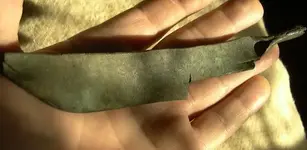
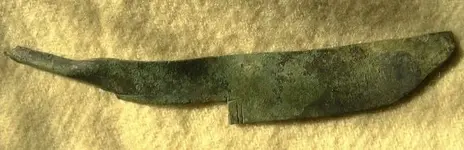
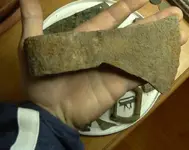
Not 5 minutes after finding the knife and almost right beside it, an axe blade was now revealed resting on top of a deer bone. It was on the side wall at that 2 foot level that everything else was coming from. All I could see was the blade and called over to Hardy “There’s a trade axe starting to show” and left it alone until he was standing beside me. He agreed that it looked like the blade from an axe. I loosened it out and when we saw the shape, we both yelled and next thing I know, my back almost broke from Hardy slapping me in excitement! TOMAHAWK!
Well, I don’t know if that’s what you’d classify it as but it sure looks like it and much more profound than the usual trade axes.
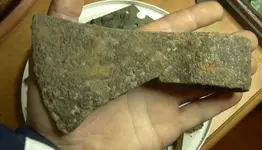
Continued on and eventually the hole fizzled out. I managed to get a few more buttons, a trap spring, a figural clay pipe bowl fragment, and other odds and ends. One cool thing I found with the detector in the spread out soil was a black stone pipe stem (mouth piece) that had lead wrapped around it. (Below the trap spring in picture #5)
Went on to hole #2 (6 feet away) and the same type of soil was found just beyond two feet but mostly only contained bone, a few pottery pieces, and some tin. I worked on it for at least an hour and after several fish bones stabbing into my hands, I only found a large green piece of that same banding. It has some unusual holes through it.
Poked around in hole #3 which was quite further from the other two, and noticed a lot of heavy ash with a few pottery pieces but not much else.
My back was getting sore from being hunched over and stretched out by finishing my day swinging the coil. Found a few more things like the Jew’s harp.
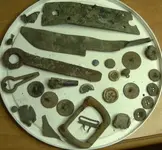
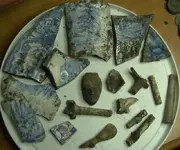
I only took a few choice pottery pieces as I see these shards all the time. The only glass really was from window panes.
Hardy found a few keepers as well and dazzled me with the depth that naughty could achieve using only a 5 inch coil.
What a beast!
This day was the final straw. After a few previous sifting projects and poking around over the years, I am now officially morphing into a different class of treasure hunting.
There’s been too many good finds coming out of old refuse concentrations that lay below the plow zone, which no detector in the world could properly identify. I can think of tons of fields where the possibilities could be endless for small pit digging.
Of course I’ve always dug pits at bottle sites since childhood but this is a little different.
Anyway, when winter comes I’ll make a few posts on the fur trade forum showing some of my past sifting projects where I came into several beads and metal artifacts. I posted those projects on another forum (not T-net) but they lost all the pictures after forum upgrades.
The archaeological method takes you to a whole other level of artifact hunting.
Yes, I know. I said the big bad archie word. Don’t worry; I’m still one of you.
There is a method to their madness!
Thanks for looking.
Cheers,
Dave.
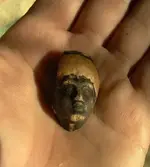
P.S. All finds were found on private property with permission from the owner.
I know this means nothing in Canada, as all artifacts technically belong to the Crown but if it’s any consolation, I document my finds and I am a good caretaker of them, spending countless hours of which no one pays me for.
Hey there,
Went out with Hardy the other day to one of our fields that just got plowed. This place had a lot of activity and was in an area that Natives had lived up until 1900 for millennia. We had hammered this place pretty good but with all the iron, there’s always something still coming out. Also Hardy is now armed with a nautilus and had been pulling out stuff really deep. The 1266x is no slouch either.
Anyway, we’ve hit this field hard during the spring when things were flat and I wasn’t feeling like reworking a lumpy field again, so I had a plan.
There’s an area where I had pulled out dozens of flat buttons, gun parts, George III coppers, etc. that I remember having ash and debris down past the plow zone and my plan was to listen for larger, deep iron signals and see if I could fluke a nice midden.
The reason being is that there’s more underground than we think, when detecting in the typical fashion. I used to think that little hot spots in a plowed field were from the previous inhabitants loosing a bunch of buttons, coins, and relics but this isn’t the case every time. How do we know that these areas that produce aren’t from a refuse mound that gets moved around over the last hundred years from the plow?
To make a long story short, (too late lol) I wanted to investigate that area and hope to open up a small pit instead of swinging the detector all day.
I’d rather hunt the field real good in the spring time.
We headed out to that end of the field and very shortly I got my first deep iron signal. Took my little army shovel and started to open a larger hole than I normally have to and got down 2 feet deep. I could see a different colour soil and blue pottery shards started to surface. I spent a few minutes to break clumps of soil up with my hand, finding a bone button and a flat button.
Hit the target that gave the signal and removed this large piece of tin sheeting. I also found a toasted knife blade. Left the hole open and continued searching. The non-ferrous targets were scarce as we have hammered this area hard. I opened two more large holes before going over to see how Hardy made out.
I also wanted to go back to car and grab my trusty screwdriver so that I could “fluff” up the soil in the holes without fear of breaking something like a clay pipe with my shovel.
Hardy showed me a hand fashioned hinge that I explained was made from a certain copper banding that shows up often in these types of sites. The Natives would always utilize metal from kettles, barrel banding, butt plates, (from guns) and what ever else was available. At some period in the mid 19th century, certain kegs shipped out here had a thick copper banding instead of the typical iron/steel and I have found many cool things made from this material over the years. That’s what Hardy’s find was made from.
Took a short break and I headed to hole #1 and slowly expanded the sides. I would spread the soil out handfuls at a time on the south side of the hole. I planned this out early so that when I was done, I would fill in the hole with clean soil and leave the midden soil on the surface so that after a rain, we may find a bead or two. Every so often I would fire up the detector and try the spread out soil. Found a few more flat buttons, pipe stems, and of course pottery.
On one handful, I noticed root matting with green dust and I knew that some non-ferrous would be coming out soon.
Sure enough, I felt a long twisted piece of green metal and pulled out a knife!
Walked over to show Hardy as we just finished talking about that copper banding and that was what this knife was made out of.
He loved it and was excited to see what else would come out of this hole.
Not 5 minutes after finding the knife and almost right beside it, an axe blade was now revealed resting on top of a deer bone. It was on the side wall at that 2 foot level that everything else was coming from. All I could see was the blade and called over to Hardy “There’s a trade axe starting to show” and left it alone until he was standing beside me. He agreed that it looked like the blade from an axe. I loosened it out and when we saw the shape, we both yelled and next thing I know, my back almost broke from Hardy slapping me in excitement! TOMAHAWK!
Well, I don’t know if that’s what you’d classify it as but it sure looks like it and much more profound than the usual trade axes.
Continued on and eventually the hole fizzled out. I managed to get a few more buttons, a trap spring, a figural clay pipe bowl fragment, and other odds and ends. One cool thing I found with the detector in the spread out soil was a black stone pipe stem (mouth piece) that had lead wrapped around it. (Below the trap spring in picture #5)
Went on to hole #2 (6 feet away) and the same type of soil was found just beyond two feet but mostly only contained bone, a few pottery pieces, and some tin. I worked on it for at least an hour and after several fish bones stabbing into my hands, I only found a large green piece of that same banding. It has some unusual holes through it.
Poked around in hole #3 which was quite further from the other two, and noticed a lot of heavy ash with a few pottery pieces but not much else.
My back was getting sore from being hunched over and stretched out by finishing my day swinging the coil. Found a few more things like the Jew’s harp.
I only took a few choice pottery pieces as I see these shards all the time. The only glass really was from window panes.
Hardy found a few keepers as well and dazzled me with the depth that naughty could achieve using only a 5 inch coil.
What a beast!
This day was the final straw. After a few previous sifting projects and poking around over the years, I am now officially morphing into a different class of treasure hunting.
There’s been too many good finds coming out of old refuse concentrations that lay below the plow zone, which no detector in the world could properly identify. I can think of tons of fields where the possibilities could be endless for small pit digging.
Of course I’ve always dug pits at bottle sites since childhood but this is a little different.
Anyway, when winter comes I’ll make a few posts on the fur trade forum showing some of my past sifting projects where I came into several beads and metal artifacts. I posted those projects on another forum (not T-net) but they lost all the pictures after forum upgrades.
The archaeological method takes you to a whole other level of artifact hunting.
Yes, I know. I said the big bad archie word. Don’t worry; I’m still one of you.
There is a method to their madness!
Thanks for looking.
Cheers,
Dave.
P.S. All finds were found on private property with permission from the owner.
I know this means nothing in Canada, as all artifacts technically belong to the Crown but if it’s any consolation, I document my finds and I am a good caretaker of them, spending countless hours of which no one pays me for.
Upvote
18