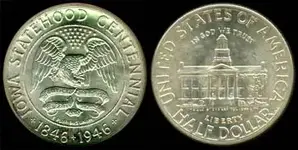
That is an amazing find! Very low mintage ~100k makes that a hard to find coin. If I had the time and money I would start myself a classic commerative collection. There are some very hard to get and expensive ones in that collection.
Here is a little info on your coin.
Iowa Centennial Half Dollar
More so than any other commemorative coin issue, the Iowa half dollar stands as a monument to effective and equitable production and distribution. There was not the slightest taint of corruption associated with it, nor was there any acrimony in the course of its preparation. The coins that resulted from this program were quite attractive, while the greater bulk of them went not into the hands of dealers or speculators, but directly to their intended owners—the proud residents of Iowa.
The Territory of Iowa was established in 1838, carved out from a portion of the vast Louisiana Purchase. Eight years later, on December 28, 1846, the State of Iowa superseded it, with Iowa City designated as the first state capital. Although the capital would ultimately shift to Des Moines in 1857, it was the Old Stone Capitol Building in Iowa City which appeared on the commemorative halves of 1946.
Iowa is primarily an agricultural state, famed for its tall corn and razorback hogs. The various populist movements designed to provide relief for embattled farmers have always held strong sway there. Among the prominent natives of Iowa to achieve national recognition were Herbert Hoover, President of the United States 1929-33, and Mamie Dodd Eisenhower, First Lady from 1953 to 1961. Both were recipients of the Iowa Award, the state’s highest honor and one which is available exclusively to natives. Included with this award is a handsome plaque and a specimen of the Iowa Statehood half dollar, reserved for just such presentations.
The Iowa half carries the distinction of being the first commemorative issue approved since 1937, though many others were proposed during the intervening years. The abuses perpetrated by past commemorative sponsors soured Congress and President Roosevelt on any further issues. It was Roosevelt’s recent successor, Harry S Truman, who approved the Iowa bill on August 7, 1946, authorizing the Booker T. Washington commemorative half dollar at the same time.
A maximum of 100,000 coins was permitted under the Iowa legislation, and it was strongly believed by the sponsors that this issue would be a sell-out. Chairman of the State Centennial Sub-Committee on Coin was Ralph Evans. He worked tirelessly to have this bill signed into law, and he followed up its passage with an equal effort in securing the best models and seeing to a fair distribution of the finished coins.
His committee already had some idea of what it wanted to see on the Iowa half dollar, but it deferred to U. S. Mint Director Nellie Tayloe Ross to select a capable sculptor. She solicited the talents of Adam Pietz. An assistant engraver at the Mint from 1927 to 1946, Pietz had only recently retired to undertake private commissions. He agreed to the customary fee of $1000 for this assignment, and he was immediately put into contact with Ralph Evans.
In a rare example of co-operation and mutual trust, the designing and sculpting of the Iowa models went off without a hitch, and they were quickly endorsed by Ralph Evans’ Sub-Committee on September 7, 1946. Six days later, the designs were forwarded to the federal Commission of Fine Arts. They were accompanied by instructions that the finished coins were desired by November 15, 1946 to be available for the centennial festivities. The Commission was not informed of the artist’s identity then, nor was that revealed on the 16th when Iowa Governor Robert D. Blue contacted the Commission with the news that the State Centennial Committee had also approved Pietz’s models.
Under such pressure, the Commission of Fine Arts tentatively passed the design, subject to its examination of the actual models. These were received on October 1, at which time the Commission was informed of Pietz’s role in creating them. Pressed for a speedy answer, the usual criticisms of first models were waived. Chairman Gilmore Clark replied to Acting Mint Director Leland Howard on October 7, noting that “in view of the fact that the models were submitted at such a late date, the Commission of Fine Arts imposes no objection to the minting of the coin.” While officially an approval, much more can be read into this remark.
As completed, Adam Pietz’s obverse design depicts a heraldic eagle. It grasps in its beak a banner inscribed in several lines OUR LIBERTIES WE PRIZE AND OUR RIGHTS WE WILL MAINTAIN. This motif is a simplification of the Iowa State Seal. A constellation of 29 stars is above the eagle, indicating Iowa’s role as the 29th state admitted to the Union. E PLURIBUS UNUM appears in arc form, placed in small letters beneath the banner. A beaded inner border surrounds these elements. Outside, arranged peripherally, are IOWA STATEHOOD CENTENNIAL and the dates 1846 and 1946. These inscriptions are separated by quatrefoils. The reverse of the Iowa half depicts an elevation view of the Old Stone Capitol at Iowa City, so identified below it. Billowing clouds appear above and behind the structure along with the motto IN GOD WE TRUST, arranged in an arc. Also in arc form is the motto LIBERTY, placed below the building. Around the periphery are UNITED STATES OF AMERICA and HALF DOLLAR. The designer’s initials AP appear in tiny letters between the R of DOLLAR and the second A of AMERICA.
Pietz’s models were reduced to hubs at the Philadelphia Mint, and the full authorized mintage of 100,057 was coined late in November (the odd 57 pieces were reserved for assay and later destroyed). Priced at $2.50 to Iowa residents and at $3 for those out of state, the coins sold very quickly. All supplies were exhausted by March of 1947, with the exception of some 1,000 pieces set aside for future distributions in 1996 and 2046, along with several dozen additional coins for presentation purposes (such as the Iowa Award). To assure that all residents of Iowa had ample opportunity to secure at least one coin, the State Centennial Committee devised a novel distribution plan which allocated all but 5,000 of the coins for Iowa residents exclusively, each county receiving a quantity selected on the basis of its population. The counties could then distribute the coins to the various banks within their borders. The coins were disbursed in a lottery system, in which each resident of a particular town theoretically had an equal shot at being able to purchase a coin. As it was, not all of the coins set aside for Iowans were purchased, and out-of-state collectors were given plenty of opportunity to acquire one or a few pieces. Unlike other commemorative programs, however, no one was able to obtain large numbers, and none of the coins were ever discounted by the state. Though this type had a large mintage as compared to most commemorative issues, the Iowa halves remain widely distributed to this day.
The typical Iowa half dollar displays satiny luster ranging from dull to quite brilliant. Some will appear weakly struck on the eagle’s head and neck, but enough well struck pieces are around that this shouldn’t present an obstacle. Many of these coins were mishandled and will show signs of light wear and/or harsh cleaning. Again, choice and gem examples are so plentiful that one can pass on lower quality coins. Check for signs of wear on the eagle’s neck and head and on the building’s central pillars.
A total of 500 coins were retained by the state for presentations and sales in 1996, while another are being withheld for the state’s bicentennial in 2046. Offered at $500 apiece in custom holders beginning in 1992, sales of the 150th anniversary allotment have been slow, since the market value of even an MS-65 coin was far below that figure at the time. Their eventual disposition remains to be seen.
SPECIFICATIONS:
Diameter: 30.6 millimeters
Weight: 12.5 grams
Composition: .900 silver, .100 copper
Edge: Reeded
Net Weight: .36169 ounce pure silver