
You are using an out of date browser. It may not display this or other websites correctly.
You should upgrade or use an alternative browser.
You should upgrade or use an alternative browser.
H3 element detector
- Thread starter papcin
- Start date

Assembler
Silver Member
- Joined
- May 10, 2017
- Messages
- 4,857
- Reaction score
- 2,754
- Golden Thread
- 0
- Detector(s) used
- Fisher AQ Pulse, Fisher water old detectors, Older Whites TRs.
- Primary Interest:
- All Treasure Hunting
Can you share some background information?I am interested in purchasing an H3 element detector.

- Joined
- Mar 19, 2003
- Messages
- 2,799
- Reaction score
- 3,511
- Golden Thread
- 0
- Location
- Washington
- Detector(s) used
- Custom Designs and Prototypes
- Primary Interest:
- All Treasure Hunting
H3Tec was a company that made a dowsing-based LRL back around 2009-2010. It sold for $10,000 and the hustler was Chuck Christensen. I got ahold of one and dissected it, here is the full report:
(Link Deleted for rule violation)
Bottom line, it's just another LRL scam. Do a TNet search for "H3Tec" to see past discussions about it. Chuckie himself used to post here, but I think he deleted all his posts and fled the scene.
(Link Deleted for rule violation)
Bottom line, it's just another LRL scam. Do a TNet search for "H3Tec" to see past discussions about it. Chuckie himself used to post here, but I think he deleted all his posts and fled the scene.
Assembler
Silver Member
- Joined
- May 10, 2017
- Messages
- 4,857
- Reaction score
- 2,754
- Golden Thread
- 0
- Detector(s) used
- Fisher AQ Pulse, Fisher water old detectors, Older Whites TRs.
- Primary Interest:
- All Treasure Hunting
Thank you for the quick reply of information.H3Tec was a company that made a dowsing-based LRL back around 2009-2010. It sold for $10,000 and the hustler was Chuck Christensen. I got ahold of one and dissected it, here is the full report:
(Link Deleted for rule violation)
Bottom line, it's just another LRL scam. Do a TNet search for "H3Tec" to see past discussions about it. Chuckie himself used to post here, but I think he deleted all his posts and fled the scene.


dowser
Silver Member
I never heard about the H3. I bought one LRL in the past.
I didn't need to disect it to know it contained a frequency generator.
It displayed the frequency dialed, it generated the frequency displayed, and came with 2 pages of frequencies assigned to Elements, along with a set of L-rods.
It worked as advertised..
I didn't need to disect it to know it contained a frequency generator.
It displayed the frequency dialed, it generated the frequency displayed, and came with 2 pages of frequencies assigned to Elements, along with a set of L-rods.
It worked as advertised..
- Joined
- Apr 9, 2007
- Messages
- 755
- Reaction score
- 664
- Golden Thread
- 0
- Primary Interest:
- All Treasure Hunting
The rods have to be diffusion rods;
Two good references on helium-3 detection are:

 www.interlune.space

 www.kronosfusionenergy.com
- Geowizard
Two good references on helium-3 detection are:
What Would the World Look Like with an Abundance of Helium-3? - Interlune
www.interlune.space
Kronos Fusion Energy — Technical Library
1005 open pages: physics, validation, engineering, materials, methodology, open science.
www.kronosfusionenergy.com
- Geowizard
- Joined
- Apr 9, 2007
- Messages
- 755
- Reaction score
- 664
- Golden Thread
- 0
- Primary Interest:
- All Treasure Hunting
Based on this AI summary;
"Helium-3 is a rare, non-radioactive isotope of helium that has accumulated on the lunar surface over billions of years from solar wind bombardment. Because Earth's atmosphere and magnetic field deflect the solar wind, the gas is virtually non-existent on Earth, where current supplies cost roughly $20 million per kilogram."
View of the European Space Agency:

This links back to the wiki page:

 en.wikipedia.org
"Neutron detection
Helium-3 is an important isotope in instrumentation for neutron detection. It has a high absorption cross section for thermal neutron beams and is used as a converter gas in neutron detectors. The neutron is converted through the nuclear reaction
n + 3He → 3H + 1H + 0.764 MeV
into charged hydrogen isotopes, tritium ions (T, 3H) and hydrogen ions, or protons (p, 1H) which then are detected by creating a charge cloud in the stopping gas of a proportional counter or a Geiger–Müller tube.[55]"
Also:
"Nuclear magnetic resonance
Helium-3 nuclei have an intrinsic nuclear spin of 1/2 ħ, and a relatively high gyromagnetic ratio. Because of this, it is possible to use Nuclear magnetic resonance (NMR) to observe helium-3. This analytical technique, usually called 3He-NMR, can be used to identify helium-containing compounds. It is however limited by the low abundance of helium-3 in comparison to helium-4, which is itself not NMR-active."
Hope this helps!
- Geowizard
"Helium-3 is a rare, non-radioactive isotope of helium that has accumulated on the lunar surface over billions of years from solar wind bombardment. Because Earth's atmosphere and magnetic field deflect the solar wind, the gas is virtually non-existent on Earth, where current supplies cost roughly $20 million per kilogram."
View of the European Space Agency:
Helium-3 mining on the lunar surface
The idea of harvesting a clean and efficient form of energy from the Moon has stimulated science fiction and fact in recent decades. Unlike Earth, which is protected by its magnetic field, the Moon has been bombarded with large quantities of Helium-3 by the solar wind. It is thought that this...
www.esa.int
This links back to the wiki page:
Helium-3 - Wikipedia
"Neutron detection
Helium-3 is an important isotope in instrumentation for neutron detection. It has a high absorption cross section for thermal neutron beams and is used as a converter gas in neutron detectors. The neutron is converted through the nuclear reaction
n + 3He → 3H + 1H + 0.764 MeV
into charged hydrogen isotopes, tritium ions (T, 3H) and hydrogen ions, or protons (p, 1H) which then are detected by creating a charge cloud in the stopping gas of a proportional counter or a Geiger–Müller tube.[55]"
Also:
"Nuclear magnetic resonance
Helium-3 nuclei have an intrinsic nuclear spin of 1/2 ħ, and a relatively high gyromagnetic ratio. Because of this, it is possible to use Nuclear magnetic resonance (NMR) to observe helium-3. This analytical technique, usually called 3He-NMR, can be used to identify helium-containing compounds. It is however limited by the low abundance of helium-3 in comparison to helium-4, which is itself not NMR-active."
Hope this helps!
- Geowizard

3RDLIFE
Full Member
- Joined
- Apr 20, 2025
- Messages
- 109
- Reaction score
- 288
- Golden Thread
- 0
- Detector(s) used
- beat up radio shack 63-3013, newer GM1000
- Primary Interest:
- All Treasure Hunting
If they worked, you'd see the videos on social media. Discovery would do a show or three. And the owners wouldn't live in ramshackle mobile homes driving a rusty truck with 4 unmatched rims.
- Joined
- Mar 19, 2003
- Messages
- 2,799
- Reaction score
- 3,511
- Golden Thread
- 0
- Location
- Washington
- Detector(s) used
- Custom Designs and Prototypes
- Primary Interest:
- All Treasure Hunting
Here is the report; the formatting ain't great but passable. I assume the link was removed because it pointed to another web site, not because of the report itself.
PART I
The H3Tec LRL (Fig. 1) is claimed to be an "element detector." The fundamental claim (by CEO Charles L. Christensen) is that it can be tuned to detect any element (including precious metals) based on that element's NMR frequency. This report is based on testing and dissection of an H3Tec unit that was sent to me for investigation. The H3Tec web site address is http://www.h3tec.com.

Fig. 1: H3Tec Device
Background
According to the manual, this device is part of the "Treasure Tracker" line of devices, but is simply referred to as an "H3 detector" throughout the manual, as opposed to a particular model name, although the name "Tricorder" is mentioned. I will call it the "H3 device" in this report, as it turns out "detector" is an inappropriate term.
The H3 device has a swiveling pointer which [supposedly] swings to point toward a selected element. From a video provided by the company, the pointer appears to swing freely. However, several comments from the manufacturer and users of the device seemed to suggest that the H3Tec pointer would move and lock on its own, or that it behaved differently whether powered or unpowered. Mr. Christensen stated:
"yes it has a rod, however it is not free moving when the device is turned on." [2]
My first exposure to an H3 device was at the 2009 Texas Treasure Show in Longview, TX. In my own casual inspection of the unit at the Treasure Show, I found that the pointer loosely flopped around, and there was no difference in its movement whether powered or unpowered. My preliminary opinion was that it was just another dowsing rod, the same as countless other LRLs.
At the Treasure Show, Mr. Christensen gave a seminar on the H3Tec that consisted almost entirely of a video presentation. That (or similar) video can be viewed here. At one point, I ran across two potential customers who were using the H3Tec's in a field next to the Show, looking for a couple of silver dollars that had been planted. They were having no luck, and one was clearly getting frustrated with his unit. I intentionally walked in front of both men as they were scanning, and both failed to pick up the 10-ounce silver bar I was carrying. In a later response, Mr. Christensen claimed:
"It could be a ton of U.S. silver, if the isotope was silver 107, and they were looking for silver 109, they would miss it, because it wasn't looking for silver 109. We set the target to a specific atomic signature, and weight from the specific element mass, type, and isotopes." [3]
"For example, the Tricorder Pro-one can scan up to one mile, while the Tricorder Pro-five can scan up to five miles. This is basically the only difference between the different H3 models." [H3 manual]
I have heard from various sources that pricing for the H3 detector has ranged from about $5,000 to well over $15,000. Besides the device itself, it is also necessary to purchase "elements" for it, which are settings that are programmed into the device to [supposedly] search for particular elements, such as gold or platinum. I've consistently heard that elements cost $100 each, so the wide reported price range could be attributed to the different models or the inclusion of multiple elements in the pricing. H3Tec absolutely requires that anyone buying an H3 device attend a training seminar hosted by them.
First Look
When the unit is turned on, the only apparent thing that happens is that the LED lights up. The swivel pointer continues to move freely, exactly as it did with the power off. According to the manual, the knob sets the "scanning range":
"You set the scanning range on your H3 Treasure Tracking [sic] using the dial on top of the device. The distance you can scan is limited by the chip built into your device; for example, if you have a device with a range of five miles, you can scan up to and including five miles away from you." [H3 manual]
The small push button next to the rotary knob is never really explained in the manual, other than calling it the "start" button:
Step 1: Set the range to "0."
Step 2: Turn on the power to your detector.
Step 3: Depress and release the start button.
Step 4: Set the range and begin scanning per instructions.
[H3 manual]
A more detailed examination of the H3 device reveals what this button actually does, as we'll see later.
The notebook computer is used to program, via a USB cable, the H3 device for a desired element. As mentioned before, elements are purchased for $100 each. Up to six elements can be programmed simultaneously, supposedly for searching for compounds.
Also included with the H3 device is what appears to be an auxiliary dowsing rod which plugs into the front of the H3 via a BNC cable. Again, according to the manual, this "secondary sensor" is used to [supposedly] pinpoint the location of the target:
"Approach the target using the detector with the secondary sensor in a horizontal position. When you are directly over a target, the primary sensor and the secondary sensor rod will be drawn towards each other. If your hands are close enough together, the sensors will cross." [H3 manual]
Theory of Operation
Closer Look - Inside the H3

Fig. 2: Internal View

Fig. 3: Circuit boards

Fig. 4: Dowsing Rod Revealed

Fig. 5: Dowsing Rod Disassembled
Fig. 6 is the backside of the main dowsing rod assembly, which shows an electrical contact on which the dowsing rod pivots. The single wire soldered to the contact is connected the signal output of the DDS generator; there is no provision for a signal ground path.

Fig. 6: Dowsing Rod Electrical Contact
In addition to the main unit dowsing rod, there is a secondary dowsing rod (which is referred to in the manual as the secondary sensor) which connects to the main unit via a BNC cable (see Fig. 1). The BNC connector is then wired to the output of the DDS signal generator. Interestingly, even though both the signal output and the signal ground from the DDS generator are routed through the BNC connector and BNC cable, the BNC connector mounted in the handle of the secondary dowsing rod is only electrically connected to the signal ground; the signal output does nothing. So to clarify, only the signal output is connected to the main unit dowsing rod, and only the signal ground is connected to the secondary dowsing rod.
The final piece to the H3 device is the notebook computer. It contains the software which is used to program the [supposed] element settings. It connects via a USB cable as shown in Fig. 7.

Fig. 7: Notebook computer
Let's tie all this together in a block diagram, Fig. 8, of the circuitry, the main dowsing rod, the sidekick dowsing rod, and the computer:

Fig. 8: Circuitry Block Diagram
There is an interesting final note to the disassembly regarding the construction of the case. It is made of plastic, but it was produced on a 3D printer using either stereolithography (SLA) or Selective Laser Sintering (SLS), a method which is commonly used for rapid prototyping. It is generally never intended for production because of lack of durability. Indeed, this particular H3 device came from H3Tec with plastic broken in several places.
Next we'll examine the software.
PART I
The H3Tec LRL (Fig. 1) is claimed to be an "element detector." The fundamental claim (by CEO Charles L. Christensen) is that it can be tuned to detect any element (including precious metals) based on that element's NMR frequency. This report is based on testing and dissection of an H3Tec unit that was sent to me for investigation. The H3Tec web site address is http://www.h3tec.com.
Fig. 1: H3Tec Device
According to the manual, this device is part of the "Treasure Tracker" line of devices, but is simply referred to as an "H3 detector" throughout the manual, as opposed to a particular model name, although the name "Tricorder" is mentioned. I will call it the "H3 device" in this report, as it turns out "detector" is an inappropriate term.
The H3 device has a swiveling pointer which [supposedly] swings to point toward a selected element. From a video provided by the company, the pointer appears to swing freely. However, several comments from the manufacturer and users of the device seemed to suggest that the H3Tec pointer would move and lock on its own, or that it behaved differently whether powered or unpowered. Mr. Christensen stated:
"yes it has a rod, however it is not free moving when the device is turned on." [2]
My first exposure to an H3 device was at the 2009 Texas Treasure Show in Longview, TX. In my own casual inspection of the unit at the Treasure Show, I found that the pointer loosely flopped around, and there was no difference in its movement whether powered or unpowered. My preliminary opinion was that it was just another dowsing rod, the same as countless other LRLs.
At the Treasure Show, Mr. Christensen gave a seminar on the H3Tec that consisted almost entirely of a video presentation. That (or similar) video can be viewed here. At one point, I ran across two potential customers who were using the H3Tec's in a field next to the Show, looking for a couple of silver dollars that had been planted. They were having no luck, and one was clearly getting frustrated with his unit. I intentionally walked in front of both men as they were scanning, and both failed to pick up the 10-ounce silver bar I was carrying. In a later response, Mr. Christensen claimed:
"It could be a ton of U.S. silver, if the isotope was silver 107, and they were looking for silver 109, they would miss it, because it wasn't looking for silver 109. We set the target to a specific atomic signature, and weight from the specific element mass, type, and isotopes." [3]
It appears that the H3 device is sold as three different models of [supposedly] different detection ranges:
"For example, the Tricorder Pro-one can scan up to one mile, while the Tricorder Pro-five can scan up to five miles. This is basically the only difference between the different H3 models." [H3 manual]
I have heard from various sources that pricing for the H3 detector has ranged from about $5,000 to well over $15,000. Besides the device itself, it is also necessary to purchase "elements" for it, which are settings that are programmed into the device to [supposedly] search for particular elements, such as gold or platinum. I've consistently heard that elements cost $100 each, so the wide reported price range could be attributed to the different models or the inclusion of multiple elements in the pricing. H3Tec absolutely requires that anyone buying an H3 device attend a training seminar hosted by them.
First Look
An H3 owner contacted me and asked if I wanted to inspect and test their device. The owner purchased the unit from H3Tec and attended their training, but soon realized that it seemed to be just a dowsing device. The H3 device is sold as a system consisting of the main unit, a secondary rod, a notebook computer, various cables and chargers, and a user manual. There is also a hard case for the main unit, which I did not get with the package.
The main unit has a power switch, an LED power indicator, a rotary knob, and a small push button next to the knob. There is also a BNC connector on the front, plus a USB port and a battery charging port. A large clear plastic window on top encloses what appears to be a brass pointer, which freely rotates with no apparent friction from full left to full right, about 180 degrees.
The main unit has a power switch, an LED power indicator, a rotary knob, and a small push button next to the knob. There is also a BNC connector on the front, plus a USB port and a battery charging port. A large clear plastic window on top encloses what appears to be a brass pointer, which freely rotates with no apparent friction from full left to full right, about 180 degrees.
When the unit is turned on, the only apparent thing that happens is that the LED lights up. The swivel pointer continues to move freely, exactly as it did with the power off. According to the manual, the knob sets the "scanning range":
"You set the scanning range on your H3 Treasure Tracking [sic] using the dial on top of the device. The distance you can scan is limited by the chip built into your device; for example, if you have a device with a range of five miles, you can scan up to and including five miles away from you." [H3 manual]
The small push button next to the rotary knob is never really explained in the manual, other than calling it the "start" button:
Step 1: Set the range to "0."
Step 2: Turn on the power to your detector.
Step 3: Depress and release the start button.
Step 4: Set the range and begin scanning per instructions.
[H3 manual]
A more detailed examination of the H3 device reveals what this button actually does, as we'll see later.
The notebook computer is used to program, via a USB cable, the H3 device for a desired element. As mentioned before, elements are purchased for $100 each. Up to six elements can be programmed simultaneously, supposedly for searching for compounds.
Also included with the H3 device is what appears to be an auxiliary dowsing rod which plugs into the front of the H3 via a BNC cable. Again, according to the manual, this "secondary sensor" is used to [supposedly] pinpoint the location of the target:
"Approach the target using the detector with the secondary sensor in a horizontal position. When you are directly over a target, the primary sensor and the secondary sensor rod will be drawn towards each other. If your hands are close enough together, the sensors will cross." [H3 manual]
In my experience, this sounds exactly like dowsing.
Theory of Operation
In order for the rest of this report to make sense, it is useful to cover the [supposed] theory of operation of the H3 device. A common claim with electronic LRLs is that "all elements have a natural frequency" and will either resonate with other like elements, or can be made to resonate with a properly tuned signal generator. LRL manufacturers and proponents often point to the fact that all elements have a property called "nuclear magnetic resonance" (NMR) and therefore, they claim, the concept of resonance is entirely scientific.
NMR is a well-known effect in physics whereby proton spin creates a precession effect when the nuclei is subjected to an outside force, such as a strong polarizing magnetic field. The atomic precession has a frequency that can be measured, and is used in the design of proton precession magnetometers (useful for treasure hunting) and in medical MRI. Since NMR produces a characteristic precession frequency, every atomic element has an associated NMR frequency. You can go to WebElements and click on the "NMR" tab, then click any element to see its NMR frequency.
For gold, you will find that the NMR frequency is 1.754000MHz, and that this entry includes the statement "relative to 1H = 100 (MHz)". What this means is that whatever conditions produce an NMR frequency of 100MHz for hydrogen will produce an NMR frequency of 1.754MHz for gold. It turns out the NMR frequency for any given element is dependent on the applied (or ambient) magnetic field the element is exposed to. To make hydrogen precess at 100MHz requires a field strength of roughly 2.35 Teslas (T), so this becomes the reference field strength for all other elements. The NMR frequency is proportional to the magnetic field, so a field strength of 4.7T will result in an NMR frequency of 200MHz for hydrogen.
In treasure hunting, we are looking for e.g. buried gold that is subjected to the Earth's natural magnetic field. This varies from place-to-place, but 50 microTeslas (uT) is a fair average strength. So the reference field strength of 2.35T is a whopping 47,000 times stronger than the Earth's field. Working the other way, we can find that the NMR frequency of hydrogen exposed to the Earth's field is a mere 2.13kHz. Gold, with an NMR frequency of 1.754MHz at 2.35T, will have an NMR frequency of only 37Hz or so at 50uT.
So if any LRL were being true to the NMR property, it should use roughly 37Hz for gold. And since the Earth's field varies from place-to-place (about 25uT - 60uT), and even varies over time, it is important to measure the local field and adjust the frequency accordingly. An investigation of these kinds of LRLs reveal that none of them use the same frequencies, and even different models from the same manufacturer often use wildly different frequencies. Beyond that, practically none of them use frequencies that are remotely close to real NMR frequencies.
The H3 device attempts to move the selected frequencies closer to NMR reality. As we will see later, the programmed frequencies are close to actual NMR frequencies, and the H3 device includes a small magnetometer circuit to measure the ambient magnetic field and adjust the selected frequency. But, as we will also see later, this closer adherence to science does not produce a scientific outcome.
Closer Look - Inside the H3
Fig. 2: Internal View
The H3 device has two circuit boards inside. The main board (Fig 4, left) contains an Atmel microcontroller, an Analog Device AD9850 DDS (Direct Digital Synthesis) chip, a USB interface, plus some ancillary devices. The DDS chip is used as a sinusoidal signal generator, and its frequency is programmed by the notebook computer via the USB interface and the Atmel micro. The second board (Fig 4, right) is a magnetometer, used to measure the ambient magnetic field in order to fine-tune the DDS frequency. The reason for this was mentioned in the Theory of Operation.
Fig. 3: Circuit boards
The circuitry is powered by a 12.8V 1200mAh Lithium (LiFePO4) rechargeable battery. A charging port is built in to the case for plugging in a provided battery charger.
Besides the circuitry and battery, the other item of interest inside the H3 device is the pointer contained in the enclosed half-moon section. A disassembly of this section reveals that the pointer is nothing but a brass dowsing rod mounted in bearings. Fig. 4 shows a close-up of this section with the top removed, and Fig. 5 shows the individual pieces of the dowsing rod.
Besides the circuitry and battery, the other item of interest inside the H3 device is the pointer contained in the enclosed half-moon section. A disassembly of this section reveals that the pointer is nothing but a brass dowsing rod mounted in bearings. Fig. 4 shows a close-up of this section with the top removed, and Fig. 5 shows the individual pieces of the dowsing rod.
Fig. 4: Dowsing Rod Revealed
Fig. 5: Dowsing Rod Disassembled
Fig. 6 is the backside of the main dowsing rod assembly, which shows an electrical contact on which the dowsing rod pivots. The single wire soldered to the contact is connected the signal output of the DDS generator; there is no provision for a signal ground path.
Fig. 6: Dowsing Rod Electrical Contact
In addition to the main unit dowsing rod, there is a secondary dowsing rod (which is referred to in the manual as the secondary sensor) which connects to the main unit via a BNC cable (see Fig. 1). The BNC connector is then wired to the output of the DDS signal generator. Interestingly, even though both the signal output and the signal ground from the DDS generator are routed through the BNC connector and BNC cable, the BNC connector mounted in the handle of the secondary dowsing rod is only electrically connected to the signal ground; the signal output does nothing. So to clarify, only the signal output is connected to the main unit dowsing rod, and only the signal ground is connected to the secondary dowsing rod.
The final piece to the H3 device is the notebook computer. It contains the software which is used to program the [supposed] element settings. It connects via a USB cable as shown in Fig. 7.
Fig. 7: Notebook computer
Let's tie all this together in a block diagram, Fig. 8, of the circuitry, the main dowsing rod, the sidekick dowsing rod, and the computer:
Fig. 8: Circuitry Block Diagram
There is an interesting final note to the disassembly regarding the construction of the case. It is made of plastic, but it was produced on a 3D printer using either stereolithography (SLA) or Selective Laser Sintering (SLS), a method which is commonly used for rapid prototyping. It is generally never intended for production because of lack of durability. Indeed, this particular H3 device came from H3Tec with plastic broken in several places.
Next we'll examine the software.
Last edited:
- Joined
- Mar 19, 2003
- Messages
- 2,799
- Reaction score
- 3,511
- Golden Thread
- 0
- Location
- Washington
- Detector(s) used
- Custom Designs and Prototypes
- Primary Interest:
- All Treasure Hunting
PART II
Software & Programming

Fig. 9: Program - Single Element
or, via the "Compound" button, up to 6 elements can be selected:

Fig. 10: Program - Compound
It is fortunate that the H3 device has a BNC connector for the secondary sensor and that the connector has both the signal output and signal ground from the DDS generator board applied to it. This allows us to connect the signal to an oscilloscope and directly inspect the waveform, and measure the frequency and amplitude of the signal, even when the case is closed. Regardless of the element selections the waveform is always a sinusoid, which is expected given that it is generated from a DDS chip.
For this report, I will focus on gold, silver, and platinum settings. For this particular unit the software has two selections for silver: Silver 107 and Silver 109. This is, according to H3Tec, because common silver can be composed of two equally likely isotopes with slightly different NMR frequencies. As such, if you want to [supposedly] locate silver you would need to try both settings.
The resulting measured frequencies (using a frequency counter) for these four settings are:
Great care was taken to make these measurements away from anything that could influence the magnetic sensor inside the H3 device. From (real) NMR theory, the results imply that the magnetic field strength of Oregon is upwards of 75uT, which is quite high. According to recent data, the actual strength is around 54uT.
From the previous section we saw that multiple elements can be selected, supposedly for searching for compounds. The H3 unit I tested only included only metals so it was not possible to make a proper compound, but the results of selecting multiple elements was still interesting.
For example, if both gold and platinum are selected, the resulting frequency is 370.0 Hz, which appears to simply be the average of the individual element frequencies. Indeed, trying several combinations of multiple elements proved this to be the case. Even if we pretend the method of NMR location used by the H3 device could possibly work, this averaging of element frequencies is obviously bogus. For example, the 370 Hz for Gold+Platinum is right on top of the [supposed] frequency for argon.
Furthermore, despite the claim in the manual, the order of the selected elements made absolutely no difference in the resulting frequency. Gold+Platinum was the same as Platinum+Gold, so the need to "select the elements in the order of the significance to the compound" is nonsense.
Besides frequency, we can also measure the waveform amplitude which is controlled by the rotary encoder on top of the H3 device. Turning the knob clockwise increases the amplitude, counter-clockwise decreases the amplitude until it bottoms out at a minimum amplitude of about 0.545vpp (volts peak-to-peak). Individual clockwise clicks of the rotary knob result in the following amplitudes (vpp):
Beyond 10 clicks there is no more increase in amplitude.
There is a fault in the implementation of the rotary encoder, however. When starting from the minimum amplitude it is very difficult to turn 1 click and get the amplitude to stay at 2.59v. It repeatedly drops back down to the minimum setting, so after a series of slow 1-turn clicks the amplitude will most likely still be at the minimum level. It takes a quick 2-click turn to get the amplitude to jump to the third voltage level (4.79v). From there on up the amplitude generally increases with each click, although it will occasionally fail to increase on any level.
The faulty operation gets severe again at the maximum setting; when increasing from 20.48v to 22.68v, the amplitude repeatedly drops back down to 20.48v. It is very difficult to get it to stay at the maximum setting. Since the H3 device has no readout of the actual amplitude setting, the result of this faulty design is that you will never know what the amplitude is actually set to.
From the manual the user is instructed to set the rotary to the 12:00 position and hit the "start" button. Measurements show that pressing the button simply resets the amplitude to the minimum level. The rotary has 20 detents and the H3 case has eight positional markings, so when the manual states:
"For example, when the knob is set at the 12:00 position (shown above), the range is at zero. When the knob is set at 11:30, the range is at maximum size for your H3." [H3 manual]
there are two problems. First, since the rotary has 20 detents the stops don't correspond to the numbers of a clock face. Second, the amplitude is theoretically maximum at just past 6:00, unless the faulty operation of the rotary resulted in the amplitude staying stuck at the minimum.
Before we leave this section let's go back to the function of the two checkboxes in the software. With the "Enable Magnetometer" option unchecked the element frequencies were dramatically lower. For example, gold fell from 54.55 Hz to about 1.7 Hz. The "Correction Off" had the opposite effect. Checking this option (with magnetometer enabled) caused the frequencies to increase; gold rose to 128 Hz and was strongly affected by magnetic fields. With the magnetometer "disabled" the Correction Off option had no effect. So these two options are either horribly mis-named, or are faulty.
Claims vs. Reality
There are few explicit claims made as to what the H3 device can actually do. For example, the user manual is largely devoid of any statements that the H3 device is a "detector" or "locator" of any sort. Most claims of any usefulness come from various forum discussions in which a user named "H3Tec" (presumably Mr. Christensen) has posted specific information.
Here are a few excerpts from the manual:
"...you'll learn to use H3 technology to detect elements and compounds."
Placing targets in plain view is a red flag in testing dowsing-based devices. Anyone can recognize this as an easy path to self-deception.
"A basic rule of thumb is that the higher the number pertaining to isotopes, the more refined the element is
This is completely false. The "refinement" of an element has nothing to do with the isotope number. For example, most natural uranium is U-238 and has to be refined "down" to U-235 for reactors and weapons.
"You will learn that your H3 will only find the specific element you have loaded into it."
Again, false. Besides the fact that the device does not work, there have been reports by H3 believers who found items other than what they were looking for. If the H3 "only finds the specific element you have loaded into it" then why do H3 users keeping finding iron junk?
From the H3Tec web site:"H3’s claims were validated early on by Chemir an international products and testing laboratory to work as advertised before we started selling our products."
This claim has also been liberally posted around various forums. H3Tec has also posted a video which includes footage of full-view (non-double-blind) "tests" being conducted at Chemir.
I contacted Chemir and asked about the so-called testing, but they replied that the methods and results were confidential and that H3Tec did not want them released. Furthermore, Chemir specifically stated that they do not perform double-blind product testing. Finally, when I mentioned that H3Tec was using them as a "testimonial," they responded: "I appreciate your effort to notify us of a potential situation where a person or company is falsely representing our business or relationship." Details of the Chemir exchange can be found on the Geotech forums.
"We do not sell LRL’s..."
Since the H3 device is not a "locator" of any kind, the statement is literally true. However, anyone who believes in the H3 device will call it an LRL, and the term "LRL" is generally applied by both believers and skeptics to devices that are supposed to function as an LRL, even if they don't. So, practically, the statement would be considered false by either an H3 advocate or skeptic.
From forums:"The U.S. Army is convinced that this device work as we have trained advanced scout teams and H3's are in the Middle East protecting our troops." Discovery channel forum
As far as can be determined, the Army has purchased no H3 devices nor have they received any training. In an interview for the newspaper Davis Clipper Christensen said, "a friend of mine had a Son going into the Military. He took a couple of units with him, but we have nothing formal yet."
Yet prior to the Clipper article the H3Tec web site included the claim:"The U.S. Army ordered new and improved H3 for the Army in the war theater".
"yes it has a rod, however it is not free moving when the device is turned on." Geotech
"The H3 claims have been tested at Chemir Labs." Discovery channel forum
"It had to pass a double blind test for clams [sic] certifications." Geotech
This first claim was covered above, and is false. There were no "claims certifications" and no double-blind testing performed.
The ultimate question is, can the H3 detect the presence of gold? A simple test was performed whereby a 10-ounce 0.9999-fine gold bar was placed next to the H3. Prior to placing the gold bar, the H3 was programmed for gold and carefully leveled with the pointer pointing at the case screw just to the left of center. After 24 hours the pointer had not moved at all.

Fig. 11: Simple Gold TestTrademarks and Patents
Normally my reports on LRLs have little detail about the people behind them. My preference is to focus on the product — for which it's easy to provide objective evidence — and to avoid personal subjective speculation. In the case of Charles Christensen, there is some objective evidence worth presenting.
As it turns out, Mr. Christensen has registered with the Cambridge Who's Who database, which is a pay-for service for people to promote themselves by listing their accomplishments. Here is a screen capture of Mr. Christensen's entry:

Fig. 12: Charles L. Christensen's "Who's Who" Entry
Summary
The H3 device is, like so many other LRLs, a glorified and expensive dowsing rod. Although the electronics inside the H3 include a DDS signal generator and a magnetometer that alters the DDS frequency as the ambient magnetic field changes, those elements of the design serve no useful purpose except to appear technically impressive to the non-technical observer. Applying a signal to a dowsing rod does absolutely nothing, regardless that many people wish it did.
The claims, explicit or implicit, that the H3 device can locate gold or any other elements or compounds are completely false. The H3 has no ability to locate anything other than gravity. It simply does not work.
I have repeatedly offered Mr. Christensen my $25,000 prize if he can successfully demonstrate the H3 device in a scientific test. He has repeatedly ignored the offer publicly, and refused it in emails. I made the same offer to three H3Tec distributors: Ike Tiner, Dexter Hulse, and Jeff Haslett. All three have declined. Finally, Christensen was offered James Randi's $1 million prize for the same kind of test.
Mr. Christensen has sent me numerous emails containing legal threats if I refused to remove my findings about his device. All the email exchanges can be found on the Geotech forums. Near the end of this thread Christensen's sister joins the discussion, and has nothing good to say about his integrity. It's all pretty interesting reading.
Software & Programming
As mentioned, the H3 device includes a notebook computer for programming the [supposed] element frequencies. The software can either program a single element frequency, such as this:
Fig. 9: Program - Single Element
or, via the "Compound" button, up to 6 elements can be selected:
Fig. 10: Program - Compound
In both modes, there is a checkbox to enable or disable the magnetometer operation; the manual only states "This field must always be checked." There is also a checkbox called "Correction Off;" the manual makes no mention of this setting. We'll check them out in the next section. Finally, there is a Time Delay setting. The manual states this is to set the "response time." It turns out that it is the rate at which the magnetometer adjusts the DDS frequency. A (recommended) setting of 10 updates the DDS roughly every 10 seconds.
As mentioned, the H3 software allows the simultaneous selection of up to 6 elements at a time. The manual explains that compounds can be selected this way:
"When you select multiple elements to scan for a compound, you select the elements in the order of the significance to the compound. For example, if you were scanning for water (H2O), you would select hydrogen as element one, and oxygen as element two." [H3 manual]As mentioned, the H3 software allows the simultaneous selection of up to 6 elements at a time. The manual explains that compounds can be selected this way:
This is curious wording because, in water, the more significant element is oxygen, not hydrogen. In any case, if you want to [supposedly] search for cocaine (C17H21NO4) you would enter hydrogen first, followed by carbon, oxygen, and nitrogen. This avoids confusion with caffeine (C8H10N4O2), which would be entered as hydrogen, carbon, nitrogen, then oxygen. We will quite obviously revisit this in the next section.
Closer Look - Signals
It is fortunate that the H3 device has a BNC connector for the secondary sensor and that the connector has both the signal output and signal ground from the DDS generator board applied to it. This allows us to connect the signal to an oscilloscope and directly inspect the waveform, and measure the frequency and amplitude of the signal, even when the case is closed. Regardless of the element selections the waveform is always a sinusoid, which is expected given that it is generated from a DDS chip.
For this report, I will focus on gold, silver, and platinum settings. For this particular unit the software has two selections for silver: Silver 107 and Silver 109. This is, according to H3Tec, because common silver can be composed of two equally likely isotopes with slightly different NMR frequencies. As such, if you want to [supposedly] locate silver you would need to try both settings.
The resulting measured frequencies (using a frequency counter) for these four settings are:
| Gold | 54.55 Hz |
| Silver 107 | 128.86 Hz |
| Silver 109 | 148.30 Hz |
| Platinum | 684.60 Hz |
Great care was taken to make these measurements away from anything that could influence the magnetic sensor inside the H3 device. From (real) NMR theory, the results imply that the magnetic field strength of Oregon is upwards of 75uT, which is quite high. According to recent data, the actual strength is around 54uT.
From the previous section we saw that multiple elements can be selected, supposedly for searching for compounds. The H3 unit I tested only included only metals so it was not possible to make a proper compound, but the results of selecting multiple elements was still interesting.
For example, if both gold and platinum are selected, the resulting frequency is 370.0 Hz, which appears to simply be the average of the individual element frequencies. Indeed, trying several combinations of multiple elements proved this to be the case. Even if we pretend the method of NMR location used by the H3 device could possibly work, this averaging of element frequencies is obviously bogus. For example, the 370 Hz for Gold+Platinum is right on top of the [supposed] frequency for argon.
Furthermore, despite the claim in the manual, the order of the selected elements made absolutely no difference in the resulting frequency. Gold+Platinum was the same as Platinum+Gold, so the need to "select the elements in the order of the significance to the compound" is nonsense.
Besides frequency, we can also measure the waveform amplitude which is controlled by the rotary encoder on top of the H3 device. Turning the knob clockwise increases the amplitude, counter-clockwise decreases the amplitude until it bottoms out at a minimum amplitude of about 0.545vpp (volts peak-to-peak). Individual clockwise clicks of the rotary knob result in the following amplitudes (vpp):
| Minimum | 0.55 |
| 1 click | 2.59 |
| 2 clicks | 4.79 |
| 3 clicks | 7.11 |
| 4 clicks | 9.32 |
| 5 clicks | 11.60 |
| 6 clicks | 13.74 |
| 7 clicks | 15.98 |
| 8 clicks | 18.28 |
| 9 clicks | 20.48 |
| 10 clicks | 22.68 |
Beyond 10 clicks there is no more increase in amplitude.
There is a fault in the implementation of the rotary encoder, however. When starting from the minimum amplitude it is very difficult to turn 1 click and get the amplitude to stay at 2.59v. It repeatedly drops back down to the minimum setting, so after a series of slow 1-turn clicks the amplitude will most likely still be at the minimum level. It takes a quick 2-click turn to get the amplitude to jump to the third voltage level (4.79v). From there on up the amplitude generally increases with each click, although it will occasionally fail to increase on any level.
The faulty operation gets severe again at the maximum setting; when increasing from 20.48v to 22.68v, the amplitude repeatedly drops back down to 20.48v. It is very difficult to get it to stay at the maximum setting. Since the H3 device has no readout of the actual amplitude setting, the result of this faulty design is that you will never know what the amplitude is actually set to.
From the manual the user is instructed to set the rotary to the 12:00 position and hit the "start" button. Measurements show that pressing the button simply resets the amplitude to the minimum level. The rotary has 20 detents and the H3 case has eight positional markings, so when the manual states:
there are two problems. First, since the rotary has 20 detents the stops don't correspond to the numbers of a clock face. Second, the amplitude is theoretically maximum at just past 6:00, unless the faulty operation of the rotary resulted in the amplitude staying stuck at the minimum.
Before we leave this section let's go back to the function of the two checkboxes in the software. With the "Enable Magnetometer" option unchecked the element frequencies were dramatically lower. For example, gold fell from 54.55 Hz to about 1.7 Hz. The "Correction Off" had the opposite effect. Checking this option (with magnetometer enabled) caused the frequencies to increase; gold rose to 128 Hz and was strongly affected by magnetic fields. With the magnetometer "disabled" the Correction Off option had no effect. So these two options are either horribly mis-named, or are faulty.
There are few explicit claims made as to what the H3 device can actually do. For example, the user manual is largely devoid of any statements that the H3 device is a "detector" or "locator" of any sort. Most claims of any usefulness come from various forum discussions in which a user named "H3Tec" (presumably Mr. Christensen) has posted specific information.
Here are a few excerpts from the manual:
False. The so-called "H3 technology" has no ability to detect elements or compounds.
"At the conclusion of this exercise, everyone in the class will be able to scan and locate Silver 107 in the indoor training grid. The target will be in plain sight in the classroom."
Placing targets in plain view is a red flag in testing dowsing-based devices. Anyone can recognize this as an easy path to self-deception.
"A basic rule of thumb is that the higher the number pertaining to isotopes, the more refined the element is
This is completely false. The "refinement" of an element has nothing to do with the isotope number. For example, most natural uranium is U-238 and has to be refined "down" to U-235 for reactors and weapons.
"You will learn that your H3 will only find the specific element you have loaded into it."
Again, false. Besides the fact that the device does not work, there have been reports by H3 believers who found items other than what they were looking for. If the H3 "only finds the specific element you have loaded into it" then why do H3 users keeping finding iron junk?
From the H3Tec web site:
This claim has also been liberally posted around various forums. H3Tec has also posted a video which includes footage of full-view (non-double-blind) "tests" being conducted at Chemir.
I contacted Chemir and asked about the so-called testing, but they replied that the methods and results were confidential and that H3Tec did not want them released. Furthermore, Chemir specifically stated that they do not perform double-blind product testing. Finally, when I mentioned that H3Tec was using them as a "testimonial," they responded: "I appreciate your effort to notify us of a potential situation where a person or company is falsely representing our business or relationship." Details of the Chemir exchange can be found on the Geotech forums.
"We do not sell LRL’s..."
Since the H3 device is not a "locator" of any kind, the statement is literally true. However, anyone who believes in the H3 device will call it an LRL, and the term "LRL" is generally applied by both believers and skeptics to devices that are supposed to function as an LRL, even if they don't. So, practically, the statement would be considered false by either an H3 advocate or skeptic.
From forums:
As far as can be determined, the Army has purchased no H3 devices nor have they received any training. In an interview for the newspaper Davis Clipper Christensen said, "a friend of mine had a Son going into the Military. He took a couple of units with him, but we have nothing formal yet."
Yet prior to the Clipper article the H3Tec web site included the claim:
Most likely, the US military has never bought an H3 device, has never had any training, and no H3 devices are deployed by any military unit anywhere.
"yes it has a rod, however it is not free moving when the device is turned on." Geotech
This is totally false; the pointer device (small L-rod) is completely free-moving whether the device is turned on or off.
"The H3 claims have been tested at Chemir Labs." Discovery channel forum
"It had to pass a double blind test for clams [sic] certifications." Geotech
This first claim was covered above, and is false. There were no "claims certifications" and no double-blind testing performed.
The ultimate question is, can the H3 detect the presence of gold? A simple test was performed whereby a 10-ounce 0.9999-fine gold bar was placed next to the H3. Prior to placing the gold bar, the H3 was programmed for gold and carefully leveled with the pointer pointing at the case screw just to the left of center. After 24 hours the pointer had not moved at all.
Fig. 11: Simple Gold Test
The "Basic Training Manual" for the H3Tec has on the second page the following statement:
©2000-2009 by H3TecTM, LLC. All rights reserved. Treasure TrackerTM, Treasure TrekkerTM, Treasure TricorderTM, Tricorder Pro-oneTM, Tricorder Pro-twoTM, and Tricorder Pro-fiveTM are registered trademarks of H3TecTM, LLC.A "TM" symbol is used as a public trademark statement but does not confer "registered trademark" status. "Registered" trademarks are registered through the US Patent & Trademark Office (USPTO) and are noted with a ® symbol. But H3Tec does not have any of these names registered with the USPTO, so claiming them as "registered trademarks of H3Tec" is a false claim. In fact, "Treasure Tracker" is actually a registered trademark of First Texas and is the name of one of their "Bounty Hunter" metal detectors. Because the title of the H3 manual is "Basic Training Manual for the Treasure TrackerTM Line of Devices," Mr. Christensen is not only falsely claiming registered trademarks, but he is illegally using someone else's registered trademark.
Mr. Christensen was awarded a patent July 2010 for what is essentially the H3 device described in this report. This has become a favored strategy with those who market bogus products; most people assume that if the US Patent Office awards a patent, that the technology must be valid. Nothing could be further from the truth. The quality of patent examination has nose-dived in the last 20 years, and the USPTO is awarding patents for just about anything, valid or not.
The patent itself is rather bizarre, and has hallmarks of extremely amateur preparation. Out of 24 pages, 13 pages are dedicated to images of PCB board layouts, plus another 1-1/2 pages for a parts list, which are completely irrelevant to the patent. Also included is a list of file names that constitute the source code for the control software; again, this totally irrelevant and superfluous. This seems to have been added to "fluff up" the patent and impress non-technical readers.
Charles L. ChristensenMr. Christensen was awarded a patent July 2010 for what is essentially the H3 device described in this report. This has become a favored strategy with those who market bogus products; most people assume that if the US Patent Office awards a patent, that the technology must be valid. Nothing could be further from the truth. The quality of patent examination has nose-dived in the last 20 years, and the USPTO is awarding patents for just about anything, valid or not.
The patent itself is rather bizarre, and has hallmarks of extremely amateur preparation. Out of 24 pages, 13 pages are dedicated to images of PCB board layouts, plus another 1-1/2 pages for a parts list, which are completely irrelevant to the patent. Also included is a list of file names that constitute the source code for the control software; again, this totally irrelevant and superfluous. This seems to have been added to "fluff up" the patent and impress non-technical readers.
Normally my reports on LRLs have little detail about the people behind them. My preference is to focus on the product — for which it's easy to provide objective evidence — and to avoid personal subjective speculation. In the case of Charles Christensen, there is some objective evidence worth presenting.
As it turns out, Mr. Christensen has registered with the Cambridge Who's Who database, which is a pay-for service for people to promote themselves by listing their accomplishments. Here is a screen capture of Mr. Christensen's entry:
Fig. 12: Charles L. Christensen's "Who's Who" Entry
All of the information listed was provided to Cambridge Who's Who by the applicant, Mr. Christensen. Among the claims made by Mr. Christensen are two degrees from Cal Tech, a premier engineering school. Such claims are easily and routinely checked (by employers, for example), and doing so for Mr. Christensen resulted in the following response:
The school was unable to locate either a degree or enrollment record for the subject of your verification request.That is to say, Mr. Christensen's claim of having two degrees from Cal Tech is false.
Another claim Mr. Christensen makes in the Cambridge entry is the receipt of the 1984 R.D. Franklyn Award for Aerospace Engineering. However, it turns out this award was given to Charles C. Christensen, who was Charles L. Christensen's father. So, again, this claim is false. It's also interesting to note that Mr. Christensen claims to have been "part of the development team for the PAM II D Apogee Kick Motor" which, I'm told, was actually developed by his father as well.
Several people who have contacted me regarding Mr. Christensen say he truly believes that the H3 device works, and that he is only delusional. However, there is no way he could "truly believe" that he received two degrees from Cal Tech, and it becomes difficult to believe anything Mr. Christensen claims, whether about himself or his product.
Summary
The H3 device is, like so many other LRLs, a glorified and expensive dowsing rod. Although the electronics inside the H3 include a DDS signal generator and a magnetometer that alters the DDS frequency as the ambient magnetic field changes, those elements of the design serve no useful purpose except to appear technically impressive to the non-technical observer. Applying a signal to a dowsing rod does absolutely nothing, regardless that many people wish it did.
The claims, explicit or implicit, that the H3 device can locate gold or any other elements or compounds are completely false. The H3 has no ability to locate anything other than gravity. It simply does not work.
I have repeatedly offered Mr. Christensen my $25,000 prize if he can successfully demonstrate the H3 device in a scientific test. He has repeatedly ignored the offer publicly, and refused it in emails. I made the same offer to three H3Tec distributors: Ike Tiner, Dexter Hulse, and Jeff Haslett. All three have declined. Finally, Christensen was offered James Randi's $1 million prize for the same kind of test.
Mr. Christensen has sent me numerous emails containing legal threats if I refused to remove my findings about his device. All the email exchanges can be found on the Geotech forums. Near the end of this thread Christensen's sister joins the discussion, and has nothing good to say about his integrity. It's all pretty interesting reading.
Last edited:
dowser
Silver Member
dowser
Silver Member
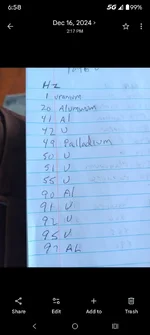
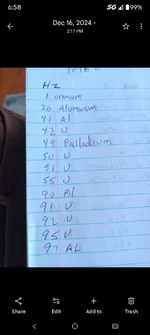
The way I see it, the frequency Lrl inventor's didn't have the full picture, of what was going on.
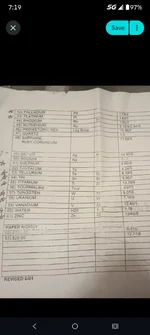
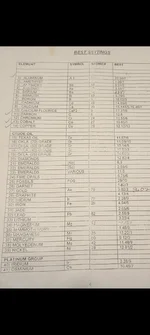
Here is the 2 pages of Khz frequencies and the Elements assigned to them.
The creator of this list only knew of Element frequencies, he wasn't aware of others.
Most of those frequency listed are not a specific frequency to the Element listed.
Here is the 2 pages of Khz frequencies and the Elements assigned to them.
The creator of this list only knew of Element frequencies, he wasn't aware of others.
Most of those frequency listed are not a specific frequency to the Element listed.
Attachments
Last edited:
- Joined
- Apr 9, 2007
- Messages
- 755
- Reaction score
- 664
- Golden Thread
- 0
- Primary Interest:
- All Treasure Hunting
The difference between a gas and solid;
Without describing a solid, I will cut to the chase - a gas called Helium-3.
Helium-3 is a gas. It's everywhere! It's found in lower parts per million and parts per billion.
Helium-3 is an atom. Nothing can point at an atom. Concentrations are in parts per million.
Ed: "It's an atom"
- Geowizard
Without describing a solid, I will cut to the chase - a gas called Helium-3.
Helium-3 is a gas. It's everywhere! It's found in lower parts per million and parts per billion.
Helium-3 is an atom. Nothing can point at an atom. Concentrations are in parts per million.
Ed: "It's an atom"
- Geowizard
Last edited:
- Joined
- Apr 9, 2007
- Messages
- 755
- Reaction score
- 664
- Golden Thread
- 0
- Primary Interest:
- All Treasure Hunting
Capturing Helium-3 after you detect it;
Capturing Helium-3 on Earth:
AI says;
"On Earth, Helium-3 is not mined directly from the atmosphere because concentrations are too low to be economically viable. Instead, it is captured through industrial and nuclear processes:
• Tritium Decay: Helium-3 is a natural decay product of tritium (a radioactive isotope of hydrogen). Facilities like the U.S. Department of Energy’s Savannah River Site recover Helium-3 left behind as tritium decays over time.
• Terrestrial Cryogenic Capture: Companies are developing Cold Capture technology that plugs directly into existing commercial helium liquefaction plants. By running industrial helium streams through cryogenic distillation systems, trace amounts of Helium-3 can be filtered and extracted from everyday Grade A helium production."
Do a search on this topic.
- Geowizard
- Joined
- Apr 9, 2007
- Messages
- 755
- Reaction score
- 664
- Golden Thread
- 0
- Primary Interest:
- All Treasure Hunting
Detection is not possible.
Production is possible only in a known process that provides "feed".
1. Tritium Decay at the U.S. Department of Energy’s Savannah River Site.
2. Cryogenic distillation in a Helium liquefaction process approaching absolute zero.
- Geowizard
Production is possible only in a known process that provides "feed".
1. Tritium Decay at the U.S. Department of Energy’s Savannah River Site.
2. Cryogenic distillation in a Helium liquefaction process approaching absolute zero.
- Geowizard
- Joined
- Apr 9, 2007
- Messages
- 755
- Reaction score
- 664
- Golden Thread
- 0
- Primary Interest:
- All Treasure Hunting
U.S. Department of Energy’s Savannah River Site;

We collectively, even if we try, are not going to replicate the US DOE's Savannah River Site on a workbench.
Cryogenic distillation;
The other impossibility is cryogenic distillation in a Helium liquefaction process approaching absolute zero.
Distillation is reasonably complicated in a laboratory at ambient temperatures. Brewers use distillation to separate ethanol from water to make whiskey! It requires strict temperature control. Distillation of H3 takes the environment surrounding a flask the other way. It requires extreme refrigeration to remove all heat approaching absolute zero is not trivial. The moon is a good laboratory!
The final note is that H3 does not exist in sufficient abundance on earth to be economically feasible for capture, refining and concentration.
A detector is of no value on earth.
- Geowizard

- Joined
- May 16, 2023
- Messages
- 7,313
- Reaction score
- 35,363
- Golden Thread
- 0
- Detector(s) used
- XP Deus II
White's Spectra v3i
Garrett Ultra GTA 1000
Whites Coinmaster
- Primary Interest:
- All Treasure Hunting
What on Earth are you going on about?The final note is that H3 does not exist in sufficient abundance on earth to be economically feasible for capture, refining and concentration.
- Joined
- Apr 9, 2007
- Messages
- 755
- Reaction score
- 664
- Golden Thread
- 0
- Primary Interest:
- All Treasure Hunting
Hit and run?
"papcin" posted one message. No follow-up comments... no thank you, kiss my a$$ or go to he**.
This device and the notion of Helium-3 detection has been given full debunking.
Thanks to all!
- Geowizard
"papcin" posted one message. No follow-up comments... no thank you, kiss my a$$ or go to he**.
This device and the notion of Helium-3 detection has been given full debunking.
Thanks to all!
- Geowizard

signal_line
Silver Member
- Joined
- Nov 14, 2011
- Messages
- 4,000
- Reaction score
- 2,278
- Golden Thread
- 0
- Detector(s) used
- XP Deus
- Primary Interest:
- All Treasure Hunting
A lot of crap being spewed here aka people talking out their rear.
Carl is probably right about the compound frequencies but even that is controversial—Dell Winders said gold is gold.
It’s sure sign of ignorance spewing “My detector is better that yours. Yours can’t possibly work.” I say B.S. big time!
You might have something if you could figure out how to detect only gold or silver. Thousand hits in a field is no better than a simple metal detector. You don’t want to see that, do you?


Featured Treasure Finds
Featured Treasure Finds
Similar threads


Users who are viewing this thread
Total: 2 (members: 0, guests: 2)














