West Jersey Detecting
Gold Member
- Joined
- Oct 23, 2006
- Messages
- 5,249
- Reaction score
- 1,102
- Golden Thread
- 1
- Location
- Philadelphia Area
- 🥇 Banner finds
- 1
- Detector(s) used
- Nokta Legend, Excalibur 1000/II (hybrid) , Teknetics T2 SE
- Primary Interest:
- Other
I have not posted anything anything lately, mainly because I haven't found anything worth posting, but also because I have just been to darn busy.
I have been finding plenty of relics, some great buttons and a few Indian Heads and Wheaties, but I have not found a decent old coin since March!
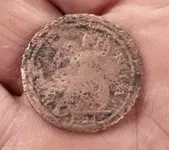
Well the slump finally ended today. I had an appointment with a client about an hour away from home, and I remembered some old woods I had detected a few years back in the area that gave up a few nice tombac buttons and an awesome "coin silver" (Sterling) spoon by Philadelphia silversmith James Watts. So after my appointment and a quick change of clothes in the car (I am getting good at that), I was off to the woods. I left the path for a patch of low vegetation and got a questionable signal right away that turned out to be a deep square nail. A few feet away were many iron signals, but as I slowly worked between the iron, I got my second diggable signal. This one also had a questionable signal reading, masked by the abundant iron. after a few quick narrow sweeps over the target, I got a positive signal about 7 inches deep. It had a VDI in the 50's which is somewhere between an Indian Head and a Wheat Cent, hardly what one would expect when digging a large copper. This one had nice weight and at first I thought it may be a Large Cent. I put the coin down and swept the coil across and got a 60 VDI. That told me this was no large cent. I put it in a coin packet and worked the area for about another hour with no good finds to speak of.
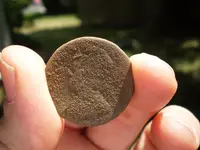
After a little while, I moved into some direct sunlight and was able to see the profile of King George II.
I am soaking the coin overnight in peroxide, but you can already see that there is a lot of detail remaining on the coin. Unfortunately I cannot read any date, but it is the later variety (1740-1754) with the aging George on it.
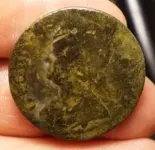
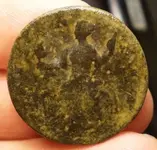
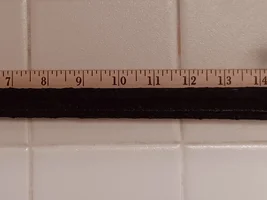
If it was not for the low VDI, I may have thought that this was a Regal copper. The weight is fairly close to the acceptable range for a new Halfpenny, weighing in at 128 gns. It is a bit small in diameter, measuring 27.75 mm, which is a bit short of the 28.5 mm of the Regal. My guess is that the counterfeiter may have used lead in the coin which would explain the relatively low VDI and its heavy weight.
The area is nearly impossible to detect this time of year, but it is one of my top sites to hit in the late Fall for sure!
I have been finding plenty of relics, some great buttons and a few Indian Heads and Wheaties, but I have not found a decent old coin since March!
Well the slump finally ended today. I had an appointment with a client about an hour away from home, and I remembered some old woods I had detected a few years back in the area that gave up a few nice tombac buttons and an awesome "coin silver" (Sterling) spoon by Philadelphia silversmith James Watts. So after my appointment and a quick change of clothes in the car (I am getting good at that), I was off to the woods. I left the path for a patch of low vegetation and got a questionable signal right away that turned out to be a deep square nail. A few feet away were many iron signals, but as I slowly worked between the iron, I got my second diggable signal. This one also had a questionable signal reading, masked by the abundant iron. after a few quick narrow sweeps over the target, I got a positive signal about 7 inches deep. It had a VDI in the 50's which is somewhere between an Indian Head and a Wheat Cent, hardly what one would expect when digging a large copper. This one had nice weight and at first I thought it may be a Large Cent. I put the coin down and swept the coil across and got a 60 VDI. That told me this was no large cent. I put it in a coin packet and worked the area for about another hour with no good finds to speak of.
After a little while, I moved into some direct sunlight and was able to see the profile of King George II.
I am soaking the coin overnight in peroxide, but you can already see that there is a lot of detail remaining on the coin. Unfortunately I cannot read any date, but it is the later variety (1740-1754) with the aging George on it.
If it was not for the low VDI, I may have thought that this was a Regal copper. The weight is fairly close to the acceptable range for a new Halfpenny, weighing in at 128 gns. It is a bit small in diameter, measuring 27.75 mm, which is a bit short of the 28.5 mm of the Regal. My guess is that the counterfeiter may have used lead in the coin which would explain the relatively low VDI and its heavy weight.
The area is nearly impossible to detect this time of year, but it is one of my top sites to hit in the late Fall for sure!
Upvote
0


 Slumpy no more! I know how crappy it feels to have a cold streak. I imagine you are feeling better now!