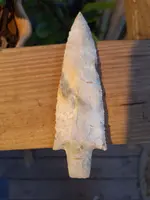
Should these remarks pertain to me, I would humbly suggest that a less combative stance would be more appropriate for a moderator. Disseminating information in a provocative manner, particularly when one's role is to facilitate rather than inflame discussion, raises questions about judgment. Cultivating greater impartiality and fairness would better support the moderating function. This understanding is not mine alone. This represents a coordinated effort by numerous diggers- collectors based in Central Florida and extending into South Georgia. I would reasonably conclude that such a comprehensive group of contributors cannot be wholly mistaken. Nevertheless, I would respectfully propose that the current methodology is
I will humbly disagree with your analysis of the Kirk serrated morphing into a Newnan. Newnan points did extend out to various styles still within the cluster of its type, such as Hillsborough, Orange, Lochloossa. Newnan stayed inside of Florida for the most part with a few being found in Georgia and Alabama. Kirks are much older and much more widespread across the Eastern seaboard & mid western states and seem to have been associated with notched type points of similar style & age. You can petition state archeologists with your findings and see if they agree and may be willing to acknowledge the "Newkirk" in a professional paper signed by several people who are qualified to accept your findings as legitimate.View attachment 2267157
View attachment 2267155
View attachment 2267156Is it perhaps worth considering that this specimen may not align precisely with the established Kirk Serrated classification? Given its flower pot stem configuration and drooping barbs—characteristics that diverge from the expected straight shoulders and square stem—it similarly does not conform to the Newnan category below. As this point exhibits serration, it represents a transitional form. During the 600 to 800 year overlap period, it transitions from Kirk Serrated above to Newnan below. Upon careful examination of the point's description, it becomes evident that it fits neither category cleanly. This represents a subtype of Newnan designated as Newkirk. This observation resonates with others who have examined comparable specimens from Central Florida to South Georgia. Given that it clearly demonstrates characteristics of both point types—Kirk Serrated as well as Newnan—it does not fit neatly into either classification. This makes it a transitional point during the overlapping time period. Personally, I find myself less concerned with strict typological classifications. My focus tends toward workmanship quality and authenticity.