What's new

Private School gives up an old copper!

incajoe

Sr. Member
Joined
May 17, 2007
Messages
387
Reaction score
3
Golden Thread
0
Location
New England
Detector(s) used
Minelab Explorer XS
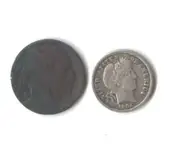
I went back last night to the private school that I recently got permission to hunt. I spent about a half hour at a new spot I never searched before and was getting nothing but a few shredded pieces of aluminum cans when I spotted a small depression that I thought may have been an old building site. As I got to it I found a very old axe/hatchet head that was crumbling from being in the ground so long. Then the next signal I got was kind of erratic but I decided to dig it anyway. About 9 or 10 inches down I pull out an old coin that was very green and the size of a large cent. I was very excited because I've never found a large cent yet. I put it in the pouch and continued on. I didn't find anything else in that location so I headed to my favorite area which is next to an old abandoned section of sidewalk. Here I found the Buffalo nickel and the Barber dime.
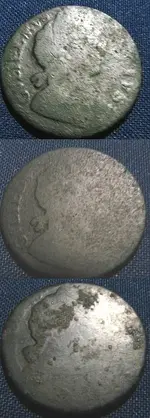
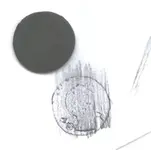
I got home and started to wash the large cent and realized that itis nearly worn smooth on both sides but I could just make out the bust profile on the obverse. The figure doesn't really match any US large cent so I'm figuring that it is some sort of colonial copper. After a quick dip in the olive oil I could also see the letters "G" and maybe a "V" next to it. The back has no detail except a letter "A". Other than that I can't see anything. I'm hoping maybe someone could ID this for me. I made a rubbing and highlighted some of the detail I could see. Got any ideas?
I think the key to identifying this will be from the bottom of the bust being arched with the edge of the coin and the letters "GV" starting at the back of the bust.
 

Attachments
  • coins2.webp
    coins2.webp
    7.2 KB · Views: 521
  • coins1.webp
    coins1.webp
    2.8 KB · Views: 495
Upvote 0

nice......cool coin
 
CRUSADER said:
The only British copper starting GV is William III 1690s although the head looks abit wrong.

http://www.romanbritain.freeserve.co.uk/britannia_files/image019.jpg

I concur that only William and Mary and William III coppers began with GV and I also concur the bust is not right! Strange, now there were known cast counterfeits, but I believe they would have been like the originals. I looked at my ground founds, of which none of the busts are as small and far away from the edge as the drawing depicts.

The key indicator for me in IDing William III's, beside GV, and I am not 100% sure that is a V, could be a funky E, but anyway, the Ribbons on the bust usually are about the last thing to wear off on a William III copper and I do not see them in your tracing. They are very distinctive for identifying the coin, when they can be seen.

We have quite a few of the William and William&Mary coppers and almost all wear about the same, look at the bust size, I attached three different coins, one a 1694, 1695 and 1699. Compare, look closely at the lettering and the bust size and the ribbons.
IF you could weigh it in GRAINS, that would help also, my coins vary from 126 grains to 155 grains with most being in the 130 grain range.

Most but not all King George III coppers will weigh less than 125 grains, since 95% of them or more were counterfeits and underweight.....(In America)

Don

Regardless it is either a William III copper or a King George III copper, so congrats on a Colonial era find.
 

Attachments

  • William examples.webp
    William examples.webp
    84.4 KB · Views: 349
Thanks for all the help guys. I think you've nailed it down for me as a William III copper. There are a few distinct spots that match up very nicely to the pictures that Crusader posted. The area where the ribbon should be has some light corrosion over it which would hide that feature from me seeing it. Maybe I can further clean it to reveal the ribbon? Also my drawing shouldn't be taken as concrete evidence for proving or disproving the identity of this coin. I drawn in some spots where I "thought" the lines should be not necessarily where they actually could be seen. I was just trying to make it easier to decipher which way the bust was facing and to generally orient you as to how the coin might have looked. The least worn spot is at the back of the neck on the bust and pics Crusader posted show this to be the least worn spot on his coins too. I think am now fairly certain it is indeed a William III copper and I couldn't be happier! Up until now the earliest coin I've found is an 1880 Indian head (I've only been detecting for 4 months). I would never have imagined I would break that personal record by nearly 200 years!

The town I found this in was founded in 1707 and this coin is older (of course it looks like it was carried for 100 years before it was dropped). I'll be going back to look for more very soon. I'll let you know what I find. Thanks for all the help!
 
Man, you learn something new here everyday. This was an informative post.
Congrats on your coin Incajoe.
-MM-
 
Wow, looks like you found yourself a Great spot to hunt. I'd hit that site again and again. Especially next spring when the ground is wet. The Wetter The Better!

HH, Ringfinder
 

Users who are viewing this thread

Back
Top Bottom