
You are using an out of date browser. It may not display this or other websites correctly.
You should upgrade or use an alternative browser.
You should upgrade or use an alternative browser.
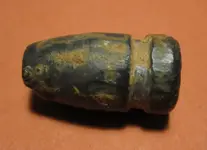
Unknown bullet
- Thread starter buddyb
- Start date

BttleDiggerDrew
Full Member
buddyb said:This bullet is a .36 caliber or 9mm and .67" long. The blunt nose appears to have been made that way. I suspect it is more modern than CW, but want some elses thoughts. Thanks for looking.
It looks like a modern round, a wadcutter of sorts. It also appears that it has rifling on the base and also appears not to be jacketed. This may help:
http://firearmsid.com/Bullets/bullet1.htm
Upvote
0

Monty
Gold Member
- Joined
- Jan 26, 2005
- Messages
- 10,752
- Reaction score
- 170
- Golden Thread
- 0
- Location
- Sand Springs, OK
- Detector(s) used
- ACE 250, Garrett
- Primary Interest:
- All Treasure Hunting
If it's truly a .36 caliber it would be a Civil War era bullet for a percussion revolver. But if it is a true 9mm it is a bit smaller in diameter, and should measure at its widest point abut .355. Now I said CW era, not a CW bullet. That would depend on where it was found as much as what it looks like. But you also have to take into consideration that nearly all CW era revolver bullets were round nosed rather than the semi-wadcutter like yours. And you also have to consider that nearly all true 9mm handgun bullets were jacketed. The only lead ones I have ever seen were for reloaders as lead bullets are very contrary to feed through a 9mm handgun unless it is a revolver of which there are few. Consensus? I don't know and need more information. Monty
Upvote
0

buddyb
Jr. Member
- Joined
- Mar 31, 2010
- Messages
- 85
- Reaction score
- 43
- Golden Thread
- 0
- Detector(s) used
- White's DFX
Garrett AT Pro
- #4
Thread Owner
The caliber measurement varies from about .352 to .36. It is not jacketed. It was found at the site of a large Union encampment. As you can tell, there is no white or gray patina which leads me to believe that is has not been in the ground for 150 years. However, I have been told that in some soil conditions that lead does not always develop the white patina.
Upvote
0
Monty
Gold Member
- Joined
- Jan 26, 2005
- Messages
- 10,752
- Reaction score
- 170
- Golden Thread
- 0
- Location
- Sand Springs, OK
- Detector(s) used
- ACE 250, Garrett
- Primary Interest:
- All Treasure Hunting
With the additional information I would guess a 36 caliber revolver bullet from a gun like a .36 caliber US Navy model. Monty
Upvote
0
buddyb
Jr. Member
- Joined
- Mar 31, 2010
- Messages
- 85
- Reaction score
- 43
- Golden Thread
- 0
- Detector(s) used
- White's DFX
Garrett AT Pro
- #6
Thread Owner
Monty said:With the additional information I would guess a 36 caliber revolver bullet from a gun like a .36 caliber US Navy model. Monty
Any thoughts as to why it would be a flat nosed bullet?
Upvote
0
Monty
Gold Member
- Joined
- Jan 26, 2005
- Messages
- 10,752
- Reaction score
- 170
- Golden Thread
- 0
- Location
- Sand Springs, OK
- Detector(s) used
- ACE 250, Garrett
- Primary Interest:
- All Treasure Hunting
When a cap and ball revolver was loaded the bullet was a press fit into the cylinder. The revolver had a built in seating tool that applied pressure to the nose of the bullet to seat it on top of the powder. A round nose or pointy bullet would be mashed out of shape easily when being loaded in this manner. Also, each loaded cylinder had to have a grease coating over the bullet to prevent one fired cylinder from igniting another. This was known as a chain fire and would really ruin your day. It ws much faster to apply the grease to a flat surface than it would be with a round nose or pointed bullet. Also, later they found out that a flat point bullet had a tendency to deliver more shocking power to a wound than the other type bullets. That's my best guess. Monty
Upvote
0
Sorry to be a naysayer, but this is a fired, modern, cast 9mm bevel base lead flat point bullet from a modern 9mm handgun. The groove around the midsection is for a wax/alox lubricating compound applied in a lubricating press. The bevelled base aids in seating the bullet properly during the reloading process. The truncated cone (flat point) is a common modern cast bullet configuration. Cast lead bullets are used routinely in modern 9mm semi automatic handguns..as well as almost all other calibers. I cast about a thousand of them myself last week...and fired the same amount. Sorry....but this is in no way associated with the CW site on which it was found. Still cool though!
ELee
ELee
Upvote
0

Bigcypresshunter
Sapphire Member
- Joined
- Dec 15, 2004
- Messages
- 27,124
- Reaction score
- 3,351
- Golden Thread
- 0
- Location
- South Florida
- Detector(s) used
- 70's Whites TM Amphibian, HH Pulse, Ace 250
- Primary Interest:
- Beach & Shallow Water Hunting
Monty please explain.elee said:Sorry to be a naysayer, but this is a fired, modern, cast 9mm bevel base lead flat point bullet from a modern 9mm handgun. The groove around the midsection is for a wax/alox lubricating compound applied in a lubricating press. The bevelled base aids in seating the bullet properly during the reloading process. The truncated cone (flat point) is a common modern cast bullet configuration. Cast lead bullets are used routinely in modern 9mm semi automatic handguns..as well as almost all other calibers. I cast about a thousand of them myself last week...and fired the same amount. Sorry....but this is in no way associated with the CW site on which it was found. Still cool though!
ELee
Upvote
0
Monty
Gold Member
- Joined
- Jan 26, 2005
- Messages
- 10,752
- Reaction score
- 170
- Golden Thread
- 0
- Location
- Sand Springs, OK
- Detector(s) used
- ACE 250, Garrett
- Primary Interest:
- All Treasure Hunting
Esplain what? I just answered your question about why a flat point bullet might be better for a cap and ball revolver. And I told you I was just guessing about the other. I further qualified my answer by saying,"if it was a CW era bullet that's what it would be". I have never owned a 9mm weapon or reloaded for it, but I do know that the nominal cast bullet bullet size is .355". None of my friends load cast lead bullets for their 9mm either, so I am only acquainted with jacketed bullets in that caliber. The ones I have seen were either hard round nose or hollowpoint. I have no doubt that elee is probably casting his lead bullets that way. I cast bullets for the .44 mag and .44 special as well as the .38 special and the .357 magnum, and the .40 S&W. but just never took a liking to the 9mm. I had to change barrels in my .40 S&W because a Glock has a polygonal rifling and leads up too fast with lead bullets. If I had your bullet in my hand and could handle it and measure it with my calipers and weigh it I probably would change my mind. So, that's part of why bullets are often so hard to exactly identify. Monty
Upvote
0
Bigcypresshunter
Sapphire Member
- Joined
- Dec 15, 2004
- Messages
- 27,124
- Reaction score
- 3,351
- Golden Thread
- 0
- Location
- South Florida
- Detector(s) used
- 70's Whites TM Amphibian, HH Pulse, Ace 250
- Primary Interest:
- Beach & Shallow Water Hunting
Sorry Monty Im not a bullet person like yourself and this was my first question on this thread. Elee seems to disagree with you. I was just asking for clarification.Monty said:Esplain what? I just answered your question about why a flat point bullet might be better for a cap and ball revolver. And I told you I was just guessing about the other. I further qualified my answer by saying,"if it was a CW era bullet that's what it would be". I have never owned a 9mm weapon or reloaded for it, but I do know that the nominal cast bullet bullet size is .355". None of my friends load cast lead bullets for their 9mm either, so I am only acquainted with jacketed bullets in that caliber. The ones I have seen were either hard round nose or hollowpoint. I have no doubt that elee is probably casting his lead bullets that way. I cast bullets for the .44 mag and .44 special as well as the .38 special and the .357 magnum, and the .40 S&W. but just never took a liking to the 9mm. I had to change barrels in my .40 S&W because a Glock has a polygonal rifling and leads up too fast with lead bullets. If I had your bullet in my hand and could handle it and measure it with my calipers and weigh it I probably would change my mind. So, that's part of why bullets are often so hard to exactly identify. Monty
Upvote
0
It was not my intention to disagree with anybody. The original post asked for clarification of age, so I am providing that. Please go to the Lee Precision website at this link:
http://www.leeprecision.com/cgi/catalog/browse.cgi?1294259986.3602=/html/catalog/bullmol2.html
Scroll down to 9mm Luger, and look at mold code 356-120-TC. (TC= Truncated Cone) There is your bullet!
http://www.leeprecision.com/cgi/catalog/browse.cgi?1294259986.3602=/html/catalog/bullmol2.html
Scroll down to 9mm Luger, and look at mold code 356-120-TC. (TC= Truncated Cone) There is your bullet!
Attachments

Upvote
0
Bigcypresshunter
Sapphire Member
- Joined
- Dec 15, 2004
- Messages
- 27,124
- Reaction score
- 3,351
- Golden Thread
- 0
- Location
- South Florida
- Detector(s) used
- 70's Whites TM Amphibian, HH Pulse, Ace 250
- Primary Interest:
- Beach & Shallow Water Hunting
Excuse me Elee but I thought Monty was saying it may be CW era and you were disagreeing (naysayer). I stand corrected. I think Ill stay away from bullets. It not my specialty.elee said:It was not my intention to disagree with anybody. The original post asked for clarification of age, so I am providing that. Please go to the Lee Precision website at this link:
http://www.leeprecision.com/cgi/catalog/browse.cgi?1294259986.3602=/html/catalog/bullmol2.html
Scroll down to 9mm Luger, and look at mold code 356-120-TC. (TC= Truncated Cone) There is your bullet!
 Pretend I never posted.
 If I were to guess, my guess would also be modern but I usually stay away from bullets, unless Im trying to learn.
Upvote
0
Monty
Gold Member
- Joined
- Jan 26, 2005
- Messages
- 10,752
- Reaction score
- 170
- Golden Thread
- 0
- Location
- Sand Springs, OK
- Detector(s) used
- ACE 250, Garrett
- Primary Interest:
- All Treasure Hunting
And I am not arguing with anyone. I was going on the pretext that you thought it was a CW bullet. If it was a CW bullet then it would be as I described it. But if it is a contemporary bullet elee is probably correct. One of the mistakes many people make is that they so want an item to be of a certain age or use that they are binded by what it may actually be. All of us are guilty of that to some degree. Although the bullet was found in a CW area does not mean it is of the CW vintage. A lot of things could have and probably did go on in that areas since the civil war. You will nearly always find modern things mixed with old tresures. That is no reason to shy away from bullets as such. Many of them are very easily identified, especially the modern cupro plated ones. Over the last 150 years literally millions of different types have been manufactured and sometimes identifying one is like searching a haystack for a needle. You got some very good answers on this particular bullet. But I don't think anyone could have been 100% dead sure positive under the circumstances. And that's what the "What Is It" forum is all about. Monty
Upvote
0
"One of the mistakes many people make is that they so want an item to be of a certain age or use that they are binded by what it may actually be. All of us are guilty of that to some degree."
Very true Monty! I have dug ALOT of modern metal from colonial sites here in New Hampshire, and have been fooled by more than a few pieces. The detective work is part of the fun of the hobby, and I am pleased to be part of a forum where the expertise of all members can come together to the benefit of all. I have learned a huge amount by reading the posts on this forum. Thank you for your exrensive contributions.
ELee
Very true Monty! I have dug ALOT of modern metal from colonial sites here in New Hampshire, and have been fooled by more than a few pieces. The detective work is part of the fun of the hobby, and I am pleased to be part of a forum where the expertise of all members can come together to the benefit of all. I have learned a huge amount by reading the posts on this forum. Thank you for your exrensive contributions.
ELee
Upvote
0
Bigcypresshunter
Sapphire Member
- Joined
- Dec 15, 2004
- Messages
- 27,124
- Reaction score
- 3,351
- Golden Thread
- 0
- Location
- South Florida
- Detector(s) used
- 70's Whites TM Amphibian, HH Pulse, Ace 250
- Primary Interest:
- Beach & Shallow Water Hunting
The green check that went up before Elee posted was what confused me, with such opposing views. I thought buddy posted the green check as CW.Monty said:You got some very good answers on this particular bullet. But I don't think anyone could have been 100% dead sure positive under the circumstances. And that's what the "What Is It" forum is all about. Monty
Monty said:With the additional information I would guess a 36 caliber revolver bullet from a gun like a .36 caliber US Navy model. Monty
Elee its OK to disagree. Getting the correct ID is of most importance.
In this case the poster thought it was modern but wanted to make sure since it was found in a CW encampment area.
I thought it was modern all the way but I guess like Monty said we cannot be 100% sure. Thanks for the explanations.

Upvote
0
Bigcypresshunter
Sapphire Member
- Joined
- Dec 15, 2004
- Messages
- 27,124
- Reaction score
- 3,351
- Golden Thread
- 0
- Location
- South Florida
- Detector(s) used
- 70's Whites TM Amphibian, HH Pulse, Ace 250
- Primary Interest:
- Beach & Shallow Water Hunting
One more thing, will a bottom view help us any?
Upvote
0
Monty
Gold Member
- Joined
- Jan 26, 2005
- Messages
- 10,752
- Reaction score
- 170
- Golden Thread
- 0
- Location
- Sand Springs, OK
- Detector(s) used
- ACE 250, Garrett
- Primary Interest:
- All Treasure Hunting
No, we can see it's a flat bottom. All modern lead bullets have flat bottoms except for a hollow base wad cutter and I haven't seen any of them in a long time. If the base of that bullet had been hollow, themnit would have been a whole new ball game. I think a green check is appropriate. Monty
Upvote
0
Bigcypresshunter
Sapphire Member
- Joined
- Dec 15, 2004
- Messages
- 27,124
- Reaction score
- 3,351
- Golden Thread
- 0
- Location
- South Florida
- Detector(s) used
- 70's Whites TM Amphibian, HH Pulse, Ace 250
- Primary Interest:
- Beach & Shallow Water Hunting
How do we see without a bottom view?Monty said:No, we can see it's a flat bottom. All modern lead bullets have flat bottoms except for a hollow base wad cutter and I haven't seen any of them in a long time. If the base of that bullet had been hollow, themnit would have been a whole new ball game. I think a green check is appropriate. Monty
Upvote
0



Featured Treasure Finds
Featured Treasure Finds
Similar threads

- Replies
- 3
- Views
- 397


Users who are viewing this thread
Total: 1 (members: 0, guests: 1)















