Re: here are some thoughts...
Dunc, howdy and hope you are doing well.
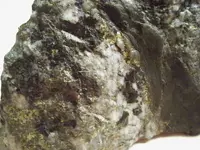
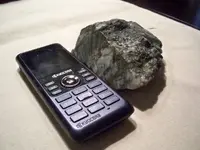
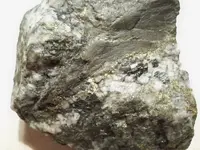
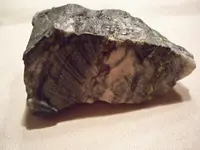
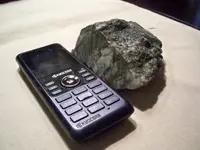
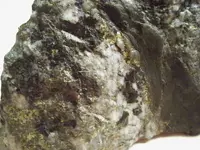
Its by merest chance I happened to see your thread title. So I had a look at your samples and have a few thoughts about it. Perhaps armed with the following, maybe you could get a buddy (or yourself) to heat a small sample above 2000F or so and see what results, prior to making any decisions about further testing.
There are only so many sulfides that will produce the brassy, metallic lustre of the vein material in that rock. Many of those sulfides are related to iron, for example iron pyrite, even some marcasite (same molecular structure (FeS2) as iron pyrite with a slight variance in the sulfur content), and pyrrhotite…another pale brassy yellow substance with a different molecular configuration from regular iron pyrite. Pyrrhotite is also magnetic unlike the other iron sulfides, and usually massive in structure without exhibiting the massive cubic crystal structure we see in iron pyrite for example.
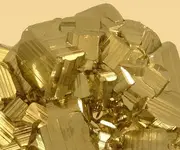
There are a number of other simple tests to distinguish various sulfides, for example…hardness, crystal structure, streak, malleability/brittleness, color, specific gravity… to name a few common tests. There is a good photo above that shows iron pyrite ideally as a specimen, but keep in mind that pyrite doesn’t necessarily display the wonderful cubic crystalline structure either, it can be otherwise and frequently does not show such fine crystals. Enough said here, as I don’t believe what you have here is related to iron sulfides. Thought you might want the background.
Next, with all due respect to a post above, this is not arsenic pyrite (FeAsS) either. That is not a guess, that is definite. Arsenopyrite is widespread in my prospecting area, and I am far too familiar with it first-hand. It is usually massive, heavy, silvery-white (fresh surface) with a low to medium level metallic lustre, brittle and quite hard as sulfides go. Another thing, if you whack it with a hammer, it will give an immediate garlic smell…there can be no mistake. OK, so now we’re making progress. So, what else could it be??
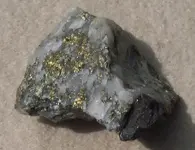
The next possibility that came to mind was a substance I’m very familiar with named “chalcopyrite” a basic yellow-gold colored copper sulfide that represents the first stage of copper in its evolution to native copper…with three intermediate steps of oxidation to occur before reaching the native state. Often a massive crystalline structure (indefinable) rather than the ideal individual crystals of specimen photos, brittle, non-magnetic, modest specific gravity around 4ish, and hardness just under 4ish (calcite to fluorite range). And while its possible, I don’t think so…just call it experience combined with what I see in that photo. Here are two photos to help you out with what I’ve written…
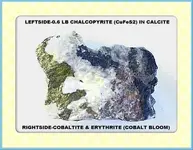
And again...
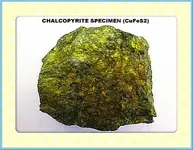
The 2nd last idea that came to mind was a nickel sulfide (millebrite), more often called “ cap (or capillary) pyrites”… because you mention all the tiny veinlets running through the rock. Yes, millebrite has that sort of structure, often described as “cobwebby” and might fit. It’s brassy yellow, and can occur in more massive “crusts”, it’s brittle but fairly soft like the chalcopyrite above. I don’t have a photo handy, and merely point out the possibility. But it’s normally associated with the sedimentary rocks like calcite or dolomite, and therefore may not resonate with your area geology.
But Dunc, it’s also associated with fluorite, and I believe I saw some fluorite on your rock sample… if the first and third photos are fairly accurate in coloration.
Finally then, I noted where the sample was found… Calaveras County, Califormia. Well, gold telluride formations are internationally known from that specific area, and gold telluride…namely “Calaverite” is also very much associated with fluorite and quartz. If it is Calaverite, the gold content will be in the neighborhood of 44% with the remainder as a telluride that can be blown off with sufficient heat to leave a gold “button”. In fact, such samples are often “roasted” in order to convert over to native gold in the rock and sold as “blister gold” specimens.
Calaverite is very soft…around 2.5 or so (gypsum area), brittle, brassy yellow, and fairly heavy SG = 9.3. Yes, with an effort it could be crumbled in your fingers.
I suggest you proceed with an appropriate heat test on a very small sample you might chip off, or take it into the local college lab or wherever and get it tested. An assay will do too. Use only a tiny amount for any testing and keep that rock intact.
Finally, gold telluride normally does not react to a metal detector. It is possible that an F-75 (despite its lower relative operating frequency it is highly sensitive and well suited to this task) set to a ground balance of 45 (to eliminate all non-conductive iron minerals including the oxides such as the relatively low ground phase “maghemite”) and using the all-metal stat mode plus high sensitivity… will signal in a bench test to this material on the electrical center of the coil. The only other unit I’m aware can do a similar sensitive test would be the GMT in manual ground balance, again set to eliminate maghemite such that maghemite gives a negative response. The GB2 is not really suitable, since its non-ferrite (lower GB range) range is limited and might very well respond to non-conductive iron minerals. Mind you, such tests are only field indicators of very low conductivity, and certainly not in any manner meant to take the place of an assay.
That’s it for now, good luck with it, please let us know what you learn if you can.
Jim.

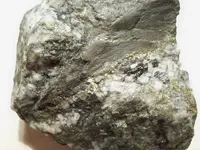
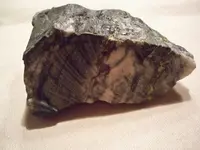






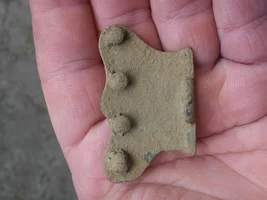

















 Naturallly Occuring Formation OR Manmade Treasure Marker/Sign?
