What's new

A GUIDE TO VAULT TREASURE HUNTING (Condensed)

Convincing people of auras and treasures is not my goal (I have shown enough proof), I put the info out there for people to try and test out for themselves, this is no longer in the testing phase for me. I have found more than enough evidence the auras are coming from treasures.
 
Convincing people of auras and treasures is not my goal (I have shown enough proof), I put the info out there for people to try and test out for themselves, this is no longer in the testing phase for me. I have found more than enough evidence the auras are coming from treasures.
Thanks sandy1!
Exactly The Truth. To see is to know. I believe what I see. Auras are a phenomenal, verifiable confirmation of precious metals present, a clue like no other on earth.
It seems unbelievable if you ever try and actually get one on your memory card, I also use the cameras, speed, lense, sandy1 told me he's used for years, it works!.
But if you never go out to your site and try for one, then sadly, you will never see one, that you have just surprisingly, amazingly captured. Period...
 
Last edited:
  1. Back in the heyday of SX-70 auras, a guy named Don Danylyk posted a Polaroid of an old house where the photo has the classic "Polaroid flare." They then metal detected the house and discovered a small cache of coins behind a brick in the fireplace. He also showed other Polaroid flare examples where nothing was found.
  2. Despite the utter bogosity of LRLs, I know of a case where an LRL user actually located a cache of silver coins. How could that happen if LRLs are bogus? Well, he used the LRL a whole lot and followed up every LRL-detected spot with a metal detector until he eventually found something.
These are cases of the classic "Blind Squirrel" scenario. Do it enough and you might eventually get a hit, regardless of the validity of the process. Unfortunately, an otherwise random discovery can grossly skew one's perception of what is going on, leading them down a long road of wasted time. A better approach is to devise tests to see what actually works and what doesn't. Ferinstance, if auras are real, can you bury a test target and get repeatable results?


I take it you are only attempting aura photography at these particular sites, so it makes sense that when you manage to capture an anomaly it is always at one of these sites. It's a self-fulfilling prophesy. OTOH, if the anomalies are caused by the camera itself, you could get these anomalies anywhere. That might be a worthy experiment.
That's well written, but as far as coincidences go , the amount of consistency and frequency in where the auras occur would rule out coincidence. We have already been thru this several years back though.
I'm not just attempting the photography. I don't really have the free time to experiment with burying my own targets for the benefit of convincing others, it would likely take weeks to get results, and I have spent years on this already. I'm only interested in your input on finding deep targets ( in the 6 foot range) and what to use, maybe it's something I haven't tried or thought of.
 
If iron is likely included, I would try a mag first. If not, I would use a high-powered PI with a 1-2m coil.
 
If iron is likely included, I would try a mag first. If not, I would use a high-powered PI with a 1-2m coil.
I have the large coil pi's. They wander on balance a lot., and very hard to use on uneven or sloped ground, let alone places with basalt. Have you used any gprs? Perhaps looking for previously disturbed ground. That's my next purchase, Friend has one but the software is bogus and it's quite an investment figuring which ones work.
 
I've seen that many want to bring in heavy artillery for prospecting, but in reality, following the investigation sequences and reaching what we consider the final point based on what we've learned, we still want to be 100% sure. So we bring in equipment that often doesn't reach the depth we're looking for, and if we make it too sensitive, any concentration of mineralization will trigger it. We really need to complement this equipment. For my part, I acquired a gradiometer, a geophysical instrument, and it has really gone hand in hand with the PI (Prospecting Instrument). Like everything, it's just a matter of knowing how to operate it to get the maximum capacity from both the instrument and the operator.

 
I have the large coil pi's. They wander on balance a lot., and very hard to use on uneven or sloped ground, let alone places with basalt. Have you used any gprs? Perhaps looking for previously disturbed ground. That's my next purchase, Friend has one but the software is bogus and it's quite an investment figuring which ones work.
Something you may want to look into is the Ground resistivity meters (not the cheap ones that look like an ohmmeter) but the high powered type big mining companies use with software that maps subsurface anomalies this could be good for finding a tunnel, or simply put, it measures change in the resistance from the earth to an opening underground. I am not familiar with this one personally but it is interesting as a starting point with the capacity for 56 probes and 3D imaging and 200 watt output, AGI Sting R1-8 Channels Earth resistivity meter.
 
Last edited:
The resistivity meter is very useful, but I find the gradiometer more viable. I say this because I've seen an inexpensive resistivity meter in operation, which provides information showing where the signal drops significantly, indicating a vacuum, or rises where conductivity is higher, comparing the rod values with normal ground conditions.
The gradiometer provides the same information, giving you a 2D graph that shows the magnetism values and color changes for negative and positive values. It also provides a 3D graph that shows relief and depressions. Some gradiometers even have 4D graphs that provide volumetric information, visualizing hollows, objects, or rocks. If the soil is virgin, the layers will be horizontal, one below the other. If you have previously worked land, expect a mixture of layers and colors. Both are good; I'm sharing my experience. If I had used this equipment in previous excavations, I think the results would have been different. The land is there for another visit.

 
D: A gradiometer is a magnetometer with subtractive sensors. Some of these devices (OKM, for example) are overpriced borderline junk.

S: I would expect a resistivity meter to be a difficult option base on the photos of the places you guys post. It would require inserting probes repeatedly, say, every meter or so for maybe 10k square meters. Not impossible, but painful. I recall that someone sells an induction-based resistivity meter, uses a coil like a metal detector. Probably works just like a metal detector.

Q: The drift problem is probably because it's a static PI with no ground balance. What you prefer is a static PI with ground balance. If you want to look for ground anomalies instead of the metal itself, then a smaller coil might work better, maybe 18". You could use that or a mag, but you really need to data-log the results and map it. You can't just listen to a speaker.
 
Ive been checking out the Nokta Jeohunter 3D dual system but cannot find any reviews or tests. Any thoughts on that rig?
Maybe not is for me sorry

Being a VLF , it really leaves a lot to be desired. Nokta surprised me with the Golden Sense, but it's very heavy. I used the Legend for a while, and it's almost identical to the Equinox 800, which I own. A friend bought an Invenio and brought it to me so I could explain how to use it, but it left me with many questions. He eventually sold it; it lost 30% of its value in six months. Personally, I don't like them, and I've seen many people who buy them later try to sell them, and nobody sells a good radio. For detectors, I still use the Golden Mask pulse detector and the Fisher Gemini III. It's like the scanning detector that connects to radios that don't use motion sensors and gives you a signal by creating a graph; it's just like a reflector of the sound signal. The gradiometer does the same thing, but it defines the gradient and gives magnetic values, and with study, it would be a good tool.
 
Last edited:
Ive been checking out the Nokta Jeohunter 3D dual system but cannot find any reviews or tests. Any thoughts on that rig?
It does look like the Nokta is a Very Low Frequency (VLF) machine which unfortunately doesn't go as deep as a Pulse Induction (PI) machine, many of the suitcase detectors such as the Fisher Gemini 3 (which I have) and the Whites TM808 (similar to a suitcase detector which I had with cave mode) are also VLF machines but they are really not capable of going much more than 5-7 feet deep unless you have a tank buried. Really the best detectors are the deep PI machines with auto ground balancing and ideally if possible with a magnetometer in the coil as you can pick up Ferrous metals (magnetic metals) deeper than Non Ferrous Metals such as Silver and Gold.

After that the next steps are looking into Ground Penetrating Radar and Ground Resistivity Meters which go waaay up on price.

The majority of these Niche companies that sell deep detectors are scams so be aware of this with all the fake sales pitches of going hundreds of feet deep. The only true detector that really does go very deep is a magnetometer and that is not because it goes deep it is because it measures the Magnetic field at the surface but it wont pick up Gold or Silver (non magnetic metals)

Hopefully this answers some Detector Questions for you.
 
Last edited:
Fisher gemini will get likely something 3-4 feet. definitely 2-3. You can make a longer staff to carry it and make it more stable , as well as theoretically deeper ( i made one out of a wooden staff), but doesn't seem help much in this type stuff, , already tried it. I am interested in hooking up a data logger though to any of my machines.
 
D: A gradiometer is a magnetometer with subtractive sensors. Some of these devices (OKM, for example) are overpriced borderline junk.

S: I would expect a resistivity meter to be a difficult option base on the photos of the places you guys post. It would require inserting probes repeatedly, say, every meter or so for maybe 10k square meters. Not impossible, but painful. I recall that someone sells an induction-based resistivity meter, uses a coil like a metal detector. Probably works just like a metal detector.

Q: The drift problem is probably because it's a static PI with no ground balance. What you prefer is a static PI with ground balance. If you want to look for ground anomalies instead of the metal itself, then a smaller coil might work better, maybe 18". You could use that or a mag, but you really need to data-log the results and map it. You can't just listen to a speaker.
Carl,
What is your opinion on the video of post 6808. Do you believe the okm rover c1 can detect as described?
 
Carl,
What is your opinion on the video of post 6808. Do you believe the okm rover c1 can detect as described?
No. I'll quote directly from the video:
Non-ferrous means it does not generate a magnetic field but it will carry electrons. ...and we see a little flare off to the right. That's just what that is, that's the electrons being blown off the target by the Earth's EM field.
This is utter nonsense, as are his interpretations of what the Rover is showing. To folks who don't understand geophysics or geophysical devices, he talks a good talk but talk is all it is.

There wasn't any feedback when Sandy posted the video, so does anyone think this guy is credible? And does anyone know what he's talking about starting at 34:46?

Edit: I see now that Lost Horse originally posted this in another thread. Still, there was no feedback.
 
Last edited:
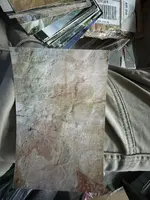
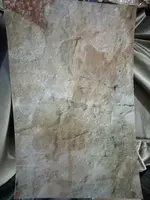
You can see the weed on the right bottom of the picture that is the ground surface so less than a foot deep.
This is the same picture but one is right side up an the other upside down. It’s a place I’ve been showing ya!
 

Attachments

  • IMG_1621.webp
    IMG_1621.webp
    2 MB · Views: 63
  • IMG_1620.webp
    IMG_1620.webp
    1.5 MB · Views: 62
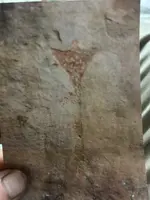
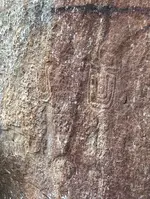
Have you ever seen this carving out in the field?? Thanks
 

Attachments

  • IMG_1622.webp
    IMG_1622.webp
    1.4 MB · Views: 58
The place we dug was at 41.25 feet (15 varas ) on 300/120 degree line with an inline marker (120 degree direction) and was the trap spot. We are looking at a spot straight thru the A frame from the shaft marker at 337.5 degrees perhaps about 33 more feet (unmeasured) into a hillside spot just across the main trail. There is one more A frame above the hillside, in close and uphill (maybe 25-30 feet) at true north south from the hillside place we are looking at. You see the main A frame aligned with the shaft sign as you come up the trail ( the shaft sign being across the wash and thru some trees. The Main A frame is very obvious and just on the wash side of trail and has a lightning bolt on it pointing sideways and up to the right.. The shaft sign marker is across a wash 66 feet from that main A frame.
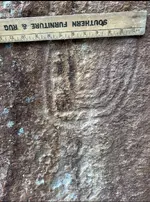
So if I had this carving on a wall . I could measure from this to my a-frame rock?
 

Attachments

  • IMG_1626.webp
    IMG_1626.webp
    1 MB · Views: 45
  • IMG_1625.webp
    IMG_1625.webp
    799.7 KB · Views: 44

Users who are viewing this thread

Latest Discussions

Back
Top Bottom