Believe you would take out a floor the opposite the way you installed it.
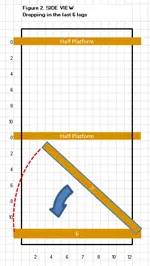
Let's say a ten ft floor with 2 ft sticking into the walls at each end, so you dig the niche on on end 4 FT deep, put your pole in all the way. When level, pull back out 2 ft into the opposite wall.
TA-DA ! ! ! Shouldn't cause any cave ins.
Think you're onto something regarding the materials handling/manpower requirements.
I understand what you are saying.
Let me explain the entire process...
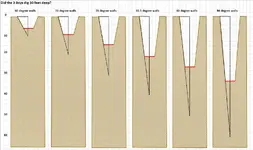
1. So lets suppose the depositors had the knowledge to dig 90 degree vertical walls because it was virgin, unworked soil.
2. Then, let's suppose they could did the niches and in stall 14ft log platforms because it was virgin, unworked soil. We would also have assumed there was no fresh water seepage to compromise the walls.
These platforms might be 14' long but they could only be 4' to 6' wide because they need the other 6' to 8' to raise and lower buckets and eventually the treasure.
This actually is better for the story because the logs could be angled and then slid in and straightened into place
3. Finally, they reach the desired depth for the vault. Im going the assume this depth is 10' below the last log platform.
4. Now, they begin digging horizontally to make the vault big enough for the treasure. I hope we can all agree cribbing/ceiling support would be necessary.
5. The concern would be the vertical wall above the horizontal cribbing of the vault to the last platform in the vertical shaft. It seems they would have had to have cribbed at least the bottom 10' .
6. They now deposit the treasure in the vault. If i remember right, Armchair proved the windlasses used pre-1700 would not support a lowering a heavy treasure treasure box so they would have built the box in the vault and filled it in the vault.
Since the reports indicate two stacked boxes, this would make more sense because you wouldn't need a vault. Maybe they really don't mean treasure vault but treasure trove.
7. Nonetheless, the treasure is is finally where they want it and they start filling the vertical shaft.
The easiest method would be to remove the log platforms working from bottom to top and then just filling in the hole. My concern would be the removal would compromise the 100' of vertical wall somewhere along the way and cause a collapse. However, as Armchair mentioned they could just angle them as they did putting them in.
However, the removal of the platforms goes against the onslow company's report of platforms every 10'.
So to support the onslow company's claim, they had to throw or bucket the dirt down with the platforms in place filling 10' at a time and adding logs to cover the entire opening. This too would require niches but unlike the half platforms, the logs could not be angled so the niches would have to be deeper and require more fanagaling to complete the full platform.
If they were simply risk takers to dig a vertical shaft with 90 degree walls, they were really BIG risks takers to try to put logs 100% across tthe pit.
I could not find a source the confirm whether half platforms or full platforms were found...just log platforms.
So i asked four people i know who watch COOI and asked them about the log platforms and all four said they were all the way across covering 100% of the shaft. My vote made five.
8. The shaft is now full and they leave.
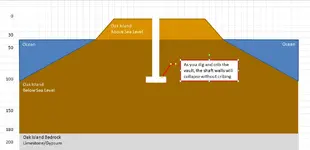
This scenario relies entirely on whether a 100' shaft can be dug with 90 walls without cribbing. I looked and looked but could not find one.
If someone one does find please post it so i can update my research.
But for now, my position is...you can't do it without cribbing.